Addressing the event, PM Le Minh Hung commended the accomplishments recorded over the past 31 years by the university's leaders, officials, scientists, lecturers, staff, and students.
    |
 |
|
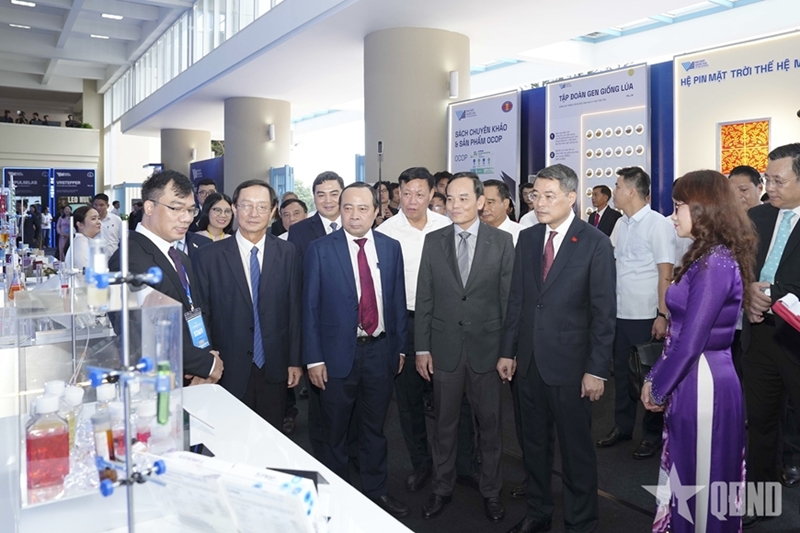
PM Le Minh Hung and delegates tour an exhibition held on the sidelines of the ceremony. |
He called on VNU-HCM to establish itself as the nation’s premier center for discovering, nurturing, and retaining exceptional talent. This effort, he noted, requires a seamless development pipeline spanning high-achieving undergraduate and postgraduate students, early-career researchers, and seasoned specialists, with particular emphasis on fundamental sciences and critical strategic technologies.
The leader emphasized that the institution must leverage its past accomplishments, define more ambitious objectives, modernize its institutional mindset and administrative framework, and cultivate a scholarly environment that values original thinking while assessing success based on tangible outcomes.
In addition, VNU-HCM is expected to emerge as a flagship domestic center for education, training, scientific discovery, technological progress, innovation, and digital transformation. It must aim to secure a position among Asia’s top 100 universities by 2030 and evolve into one of the region’s foremost research university systems by 2045, featuring a minimum of four academic fields ranked within the world’s top 50.
The PM also urged the university to accelerate the implementation of contemporary institutional governance models. He underscored that VNU-HCM needs to serve as a dependable environment where skilled professionals can operate at peak capability and pursue lasting professional careers.
Furthermore, he expects VNU-HCM to function as a major think tank and a cornerstone of independent policy advisory, delivering robust scientific data to guide decision-making at the central, regional, and municipal levels. The university must proactively examine pressing real-world challenges and put forward actionable remedies, translating theoretical knowledge from lecture rooms and research laboratories into public policies, socioeconomic development strategies, administrative systems, and community living standards.
|
|
 |
|
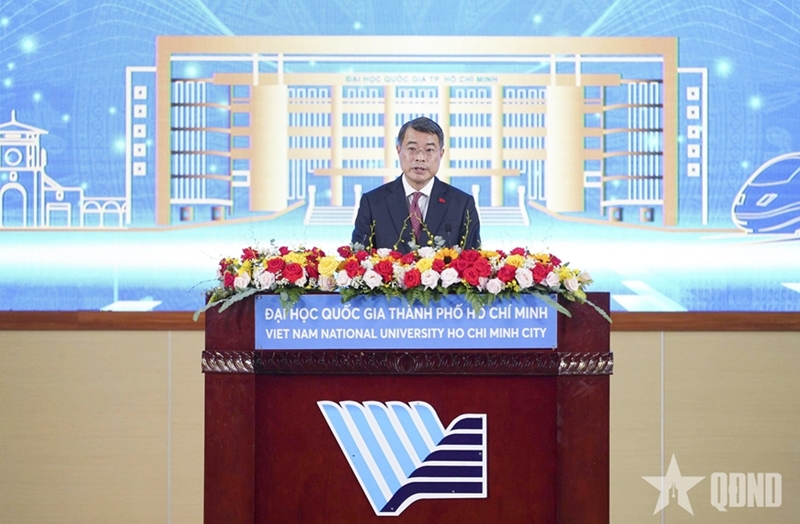
PM Le Minh Hung speaks at the event. |
Higher education, scientific research, and technological innovation must be seamlessly connected within a unified ecosystem. In frontline sectors including semiconductors, quantum computing, and aerospace, the university needs to actively engage both domestic and international specialists and enterprises while enforcing rigorous quality standards for all deliverables.
According to his remarks, VNU-HCM must assume leadership in mastering strategic technological domains and avoid fragmenting its resources. Rather than measuring success solely through academic publications, the institution should clearly define target technologies, specific products to be manufactured, end users, and practical implementation timelines. Furthermore, it must progressively enhance internal technological capabilities, develop proprietary core solutions, and deliver competitive market-ready products under Vietnamese brand names.
The institution is also expected to serve as a vital conduit linking the State, academia, and industry. In this role, it should mobilize diverse resources, expand impactful international cooperation, and refine operational frameworks to expedite technology transfers and the commercial rollout of scientific findings. The overarching objective is to advance Viet Nam’s science, technology, and innovation to cutting-edge standards in key areas, helping elevate the nation into the upper tier of upper-middle-income economies by 2030.
On this occasion, the PM instructed the Ministry of Education and Training to promptly formulate a comprehensive proposal establishing robust investment mechanisms and transformative policies. These measures aim to build elite higher education institutions benchmarked against leading global research universities and cultivate top-tier national talent. He underscored the need to expand administrative decentralization and delegate broader authority to national universities regarding governance models, institutional structures, emerging academic disciplines, pedagogical methods, and the recruitment and utilization of skilled personnel and assets—balanced by strict accountability, operational transparency, and independent oversight.
In addition, he urged that VNU-HCM, Viet Nam National University-Hanoi, and Hanoi University of Science and Technology be transformed into core pillars of the national research, development, and innovation network.
The Ministry of Science and Technology, in coordination with the Ministry of Finance, was requested to examine a mechanism providing lump-sum financial allocations for scientific, technological, and innovative endeavors at public research bodies affiliated with flagship universities. Both ministries were also tasked with improving regulatory frameworks to bridge the divide between laboratory discoveries and commercial market adoption.
The Government leader instructed the Ho Chi Minh City People’s Committee alongside local authorities across the southeastern region and the Mekong Delta to explore direct project commissioning for VNU-HCM and co-finance shared infrastructure initiatives. This coordinated backing is intended to support the preparation of high-caliber human resources while generating specialized research programs and practical technological solutions tailored to regional development priorities.
During the event, he presented commemorative gifts to contributors involved in the 500-day national drive dedicated to accelerating the search, recovery, and scientific identification of fallen soldiers' remains.
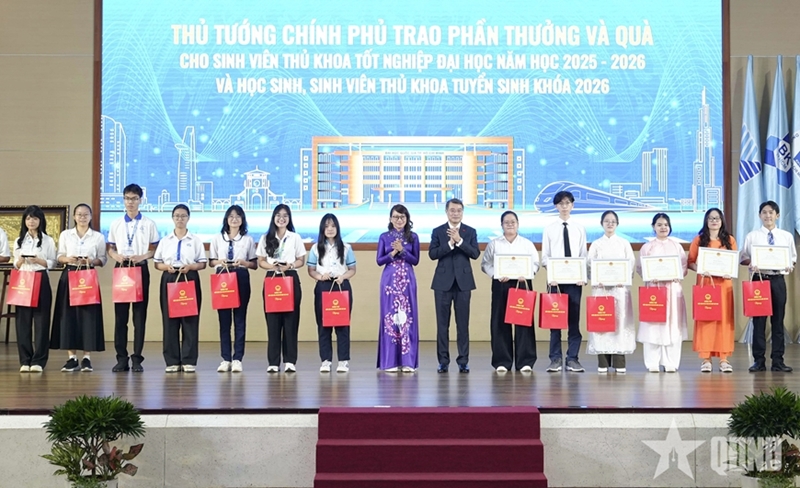
Meanwhile, VNU-HCM recognized outstanding individuals and collectives that have garnered prestigious domestic and international awards and distinctions since the beginning of 2026, alongside contributors with exemplary track records in patenting, scientific publication, and applied research endeavors.
|
|
 |
|
PM Le Minh Hung presents gifts to outstanding students. |
Over 160 billion VND (equivalent to 6.15 million USD) has been committed to the university by corporate entities and strategic partners.
In the immediate future, VNU-HCM will focus its research efforts on areas capable of fast-track implementation for enterprises, healthcare facilities, and local authorities. These core areas encompass artificial intelligence, edge computing chips, bioproducts, and molecular diagnostics.
Looking ahead to 2030, the institution intends to establish dedicated research clusters alongside public-private laboratories. These centers will focus on developing Vietnamese-language large language models, vaccines, cellular technologies, energy storage batteries, green hydrogen, and quantum innovations. Beyond the 2030 milestone, the university sets its sights on achieving technological autonomy in cutting-edge domains, specifically sovereign artificial intelligence, 6G semiconductors, aerospace engineering, precision healthcare, and nuclear energy.
By 2030, the university also aims to secure 100 international patents, deliver 10 strategic technology solutions, master 15 core technologies, and cultivate 20 elite research groups, thereby strengthening its standing among Asia’s top-tier higher education institutions.
Prior to the announcement, the PM visited the “Made by VNU-HCM” exhibition, an event spotlighting research, technological development, and innovation from the university’s own faculty and scientists. Featured exhibits included a quadrupedal firefighting robot, a brain-computer interface system, an AI tool designed for assisted reproductive treatments, semiconductor chips, indigenous herbal remedies, stem cell therapies, microneedle patches, and next-generation solar energy cells.
Translated by Chung Anh