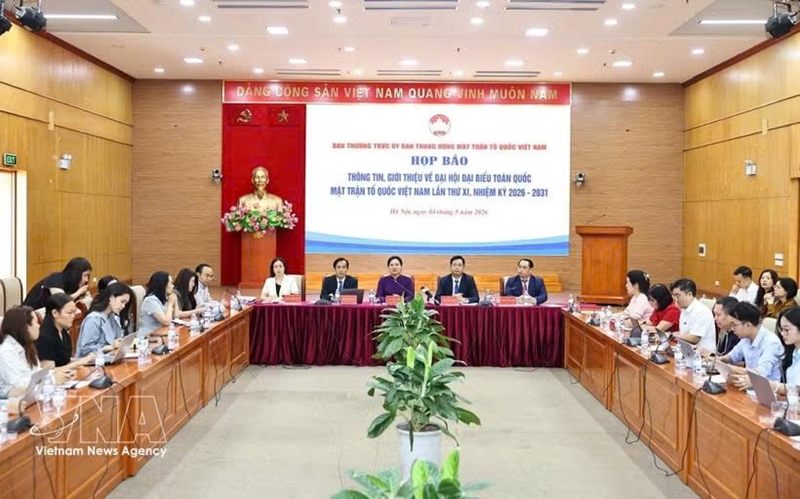
At a press briefing on May 4, Ha Thi Nga, Vice President and Secretary General of the VFF Central Committee, described the upcoming congress as “particularly significant,” noting the shortened interval since the previous congress in October 2024. The move, approved by the Party Central Committee’s Politburo and Secretariat, aims to ensure alignment across the political system following the 14th National Party Congress.
    |
 |
|
At the press briefing on the 11th National Congress of the Vietnam Fatherland Front (VFF) for the 2026–2031 term in Hanoi on May 4, 2026 |
Preparations are largely complete, with subcommittees finalizing key tasks including document compilation, personnel planning, communications and logistics, she said, adding that final reviews are underway to ensure a successful event.
Nga said the congress would mark a new phase of development for the Front, with draft documents translating the Party’s major policies into concrete goals, tasks and solutions, along with a system of action programs and clearly defined breakthroughs.
She also called on media organizations to provide comprehensive and sustained coverage before, during and after the event to help build public consensus and promote national unity.
According to Nguyen Tuan Anh, deputy head of the VFF Central Committee’s communications department, the congress will be held under the theme “Solidarity – Democracy – Innovation – Creativity – Development.”
On May 11 morning, delegates will pay tribute to President Ho Chi Minh and heroic martyrs before attending a preparatory session in the afternoon. The opening session on May 12 will be attended by Party, State and VFF leaders, followed by discussions on personnel proposals and the election of the 11th-term VFF Central Committee for the 2026-2031 term. The congress will close on the morning of May 13.
More than 1,300 delegates are expected to attend the event, including 1,138 official representatives. Women account for 33.5% of delegates, non-Party members 46.7%, ethnic minorities 24.3%, religious representatives 19.2%, and Vietnamese abroad 1.6%. A total of 79% hold university degrees or higher.
The congress is expected to approve a revised charter and adopt a resolution outlining seven key action programs, including strengthening public engagement, safeguarding citizens’ rights, promoting socio-economic development, advancing digital transformation, and enhancing international cooperation.
The 11th-term VFF Central Committee is expected to comprise 405 members, while the Presidium will include around 70 members. Its Standing Board is projected to have 12 members.
Source: VNA