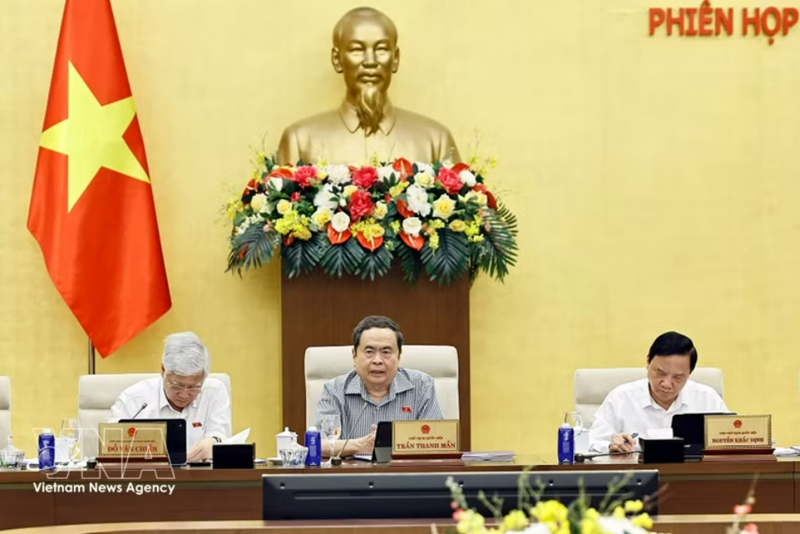
Addressing the N.A. Standing Committee's sixth session in Hanoi on September 24, N.A. President Tran Thanh Man praised the sweeping overhaul of the Law on Food Safety after more than 15 years in force, noting that the Politburo, the Party Central Committee's Secretariat, and Party General Secretary and President To Lam have closely guided efforts to protect public health and food safety.
    |
 |
|
N.A. President Tran Thanh Man speaks at the N.A. Standing Committee's sixth session in Hanoi on September 24. |
He said the draft must reflect three fundamental shifts. The first moves from fragmented oversight to a single body with overall responsibility, with the Ministry of Health as lead agency. The draft must spell out how ministries and agencies divide responsibilities and coordinate, including who answers for food poisoning incidents or safety violations.
The second moves from procedural checks to risk- and outcome-based management, with risk management as the law's backbone. That will let regulators sort products into three buckets: those needing state pre-market inspection, those businesses self-certify, and those subject to post-market checks.
The top legislator warned that food safety shouldn't be used to bring back a "request-and-grant" mechanism, and administrative reform shouldn't be an excuse to lower safety standards. Any policy that directly affects products or public health must rest on scientific evidence.
The third is a shift from manual inspection to digital, data-driven governance and supply-chain traceability, turning data into core infrastructure under a "declare once, use many times" principle, ensuring transparency while protecting businesses' trade secrets and formulas.
He also called for controls to start at the source, with tighter limits on chemical residues and better tracing of fresh produce, rather than relying only on inspections after goods reach the market.
The revised law, he said, must answer three questions: Is the food reaching consumers safe? Will compliant businesses see lighter administrative burdens? And can incidents be traced to their source, responsibility pinned down, and problems fixed fast enough?
Presenting the draft, Deputy Minister of Health Do Xuan Tuyen said it spans nine chapters and 76 articles. It will narrow the scope of pre-market inspection, speed up decentralization and delegation of authority, and set up a single state management body, namely the Vietnam Food Administration under the Ministry of Health at the central level, and provincial-level food safety sub-departments locally.
Nguyen Thanh Hai, who chairs the N.A. Committee for Science, Technology and Environment, backed the need for the law in the preliminary appraisal report. She called for careful study of mandatory nutritional-fortification rules, higher administrative fines, and possibly stripping professional licenses for intentional violations with serious consequences.
Deputy Prime Minister Pham Thi Thanh Tra said the Government will take the guidance on board and clearly divide responsibilities between lead and coordinating agencies, stressing that protecting people's health and lives comes first, with risks caught early, from a distance and at the source.
Risk-based management must be consistent with Vietnamese law and international standards the country has signed onto, she said.
Closing the session, N.A. Vice President Nguyen Hong Dien said the N.A. Standing Committee backs a full revision of the 2010 Law on Food Safety, urging agencies to quickly finalize a draft that locks in a single-focal-point model with clear accountability while accelerating digital transformation and data-driven management.
Source: VNA