In the morning session, lawmakers discussed two draft laws: the amended Law on Real Estate Business and the amended Law on the Implementation of Grassroots Democracy.
In the afternoon, the legislature is scheduled to debate the implementation of the 2026 socio-economic development plan and the proposed plan for 2027, as well as the implementation of the 2026 state budget, the 2027 state budget estimates and the proposed allocation of the central budget for next year.
    |
 |
|
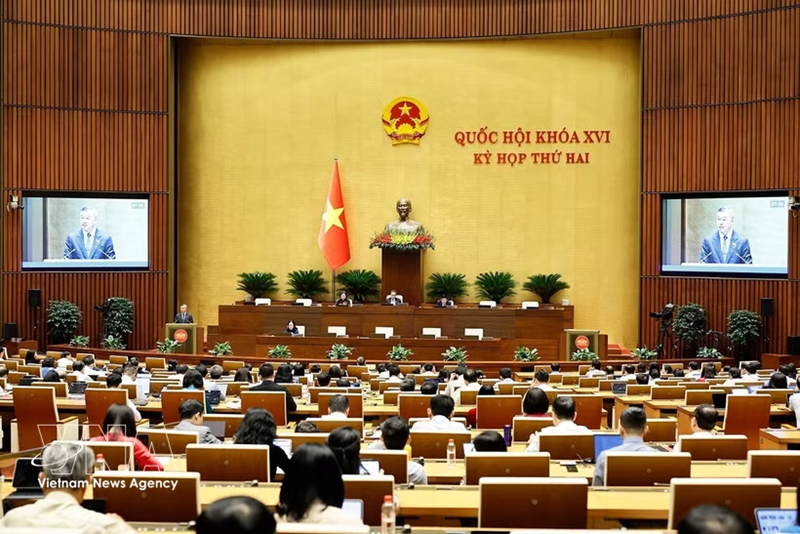
A plenary discussion of the 16th National Assembly’s second session on October 29 |
Other items on the agenda include the implementation of the 2026 public investment plan and the proposed public investment plan for 2027, the 2025 state budget final accounts, a review of the implementation of National Assembly Resolution No.66/2013/QH13, dated November 29, 2013, and the completion of investment and construction of the two-lane Ho Chi Minh Road project.
The session is being broadcast live on television and radio to enable voters and the public to follow the proceedings.
According to a Government report, Viet Nam’s socio-economic performance in 2026 has achieved important and relatively comprehensive results despite complex developments in the international and regional environment, supported by concerted and decisive efforts across the political system. The country is expected to meet or exceed 14 of its 15 key socio-economic targets.
However, the Government acknowledged that macroeconomic management and inflation control remain under considerable pressure, while deposit and lending interest rates are still high. Small and medium-sized enterprises (SMEs) also continue to face difficulties in accessing land and credit.
For the remaining months of 2026, the Government will focus on achieving the highest possible results against the targets set, particularly the goal of double-digit economic growth while maintaining macroeconomic stability and keeping inflation under control.
The Government has identified 2027 as a year of acceleration and breakthrough, aimed at building the momentum, position and capacity needed to successfully implement the Resolution of the 14th National Party Congress.
Its overarching objective is to achieve economic growth of at least 10% while maintaining macroeconomic stability, controlling inflation and safeguarding major economic balances. The Government also aims to lay the foundations for a new national development model, with science and technology, innovation and digital transformation serving as the primary drivers of growth.
To achieve these goals, the Government will prioritize boosting economic growth in tandem with maintaining macroeconomic stability. It aims to increase state budget revenue by approximately 9.1%, strictly economize on recurrent expenditure and ensure the disbursement of 100% of allocated public investment capital.
Further priorities include completing the institutional and legal framework, comprehensively streamlining administrative procedures, ensuring the effective operation of the two-tier local administration system and improving the quality of the civil service. Officials who shirk responsibility, avoid difficult tasks or display a reluctance to take responsibility will be promptly replaced.
The Government will also accelerate economic restructuring and reform the growth model, promote the development of the private sector and attract foreign investment selectively, with an emphasis on technology transfer.
The development of strategic infrastructure will be another key priority, with efforts focused on building a coordinated and modern infrastructure network, completing the expressway system and advancing major national railway projects.
The Government will also pursue breakthroughs in science and technology, innovation and digital transformation, while ensuring the effective operation of the National Data Center, expanding 5G coverage nationwide and piloting 6G technology.
In education and human resource development, the focus will be on making substantive improvements in education and training quality and developing a highly skilled workforce.
The Government will ensure that sufficient textbooks are available before the 2027-2028 academic year and complete the second phase of multi-level boarding schools for general education by August 30, 2027.
Alongside economic development, the Government will prioritize culture, social affairs and healthcare, while strengthening social welfare and security.
It will also consolidate national defense and security, step up foreign affairs and international integration, and make thorough preparations for the successful organization of APEC Year 2027.
The Government will further strengthen implementation capacity and enhance the accountability of heads of agencies and organizations, ensuring that every policy translates into tangible and measurable improvements in practice.
Source: VNA