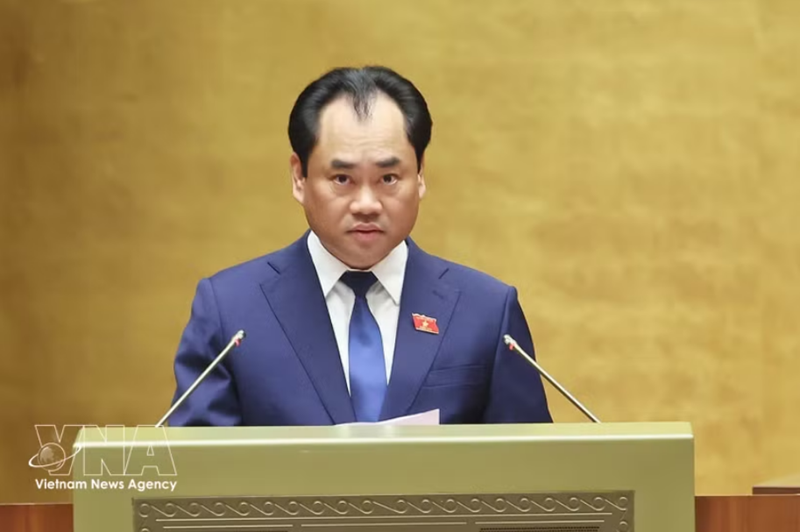
Presenting the draft law on amending and supplementing several articles of 10 laws concerning administrative procedures and business conditions in the agriculture and environment sector, Minister of Agriculture and Environment Trinh Viet Hung said it is designed to institutionalize the Party's policy of reducing and simplifying administrative procedures and business conditions, while promoting decentralization, innovation, and more effective state governance.
    |
 |
|
Minister of Agriculture and Environment Trinh Viet Hung speaks at the session. |
The draft amends provisions in 10 laws, including those on crop production, plant protection and quarantine, livestock, veterinary services, fisheries, geology and minerals, water resources, irrigation, hydrometeorology and dykes.
It proposes eliminating 40 administrative procedures, simplifying 12 others, and abolishing 40 business conditions. It also delegates 24 administrative procedures currently handled by the Ministry of Agriculture and Environment to provincial-level People's Committee chairpersons.
Chairwoman of the N.A. Committee on Science, Technology and Environment Nguyen Thanh Hai said the committee agreed with the need for the amendments, noting that they are generally consistent with the Party’s guidelines, international commitments and the existing legal framework.
The committee recommended further review of the draft law and implementing regulations, particularly post-audit mechanisms for simplified procedures, risk-based management of goods and services, stronger digital infrastructure and data connectivity, as well as ensuring that decentralization matches local implementation capacity, she said.
N.A. deputies also examined the draft law amending and supplementing several articles of the Law on Radio Frequencies, the Law on Telecommunications, the Law on E-Transactions, and the Law on Technology Transfer.
Minister of Science and Technology Vu Hai Quan said the bill does not alter the scope of the four laws but focuses on streamlining and simplifying administrative procedures, reducing business conditions and conditional business lines, strengthening decentralization and delegation of authority, and refining regulations governing radio frequency resources, telecommunications infrastructure, Internet resources, and trust services.
Key proposed amendments include adjustments to special radio-frequency licensing procedures, new provisions allowing telecommunications infrastructure sharing by agreement between operators, and a legal framework for shared telecommunications infrastructure serving national defense and security purposes.
Hai said the N.A. Committee on Science, Technology and Environment supported the proposed approach but stressed that the Government should only codify policies already approved by competent authorities, without incorporating new policy proposals. The use of expedited legislative procedures should shorten only the timeframe, not lower the standards for the quality.
The committee also urged the Government to ensure adequate resources, technical infrastructure and personnel for effective post-audit enforcement, while safeguarding state secrets, cybersecurity, information security, radio frequency safety and national sovereignty over the radio spectrum. It also called for stronger interconnection of national databases and the simultaneous issuance of implementing regulations when the amended law takes effect.
At the same sitting, legislators also heard a proposal and verification report on the draft Law on Urban Development.
Source: VNA