The second plenum took place in Hanoi from March 23-25 at a particularly significant moment. The country had just completed the election of deputies to the 16th National Assembly and People’s Councils at all levels for the 2021–2026 term, setting a broadly optimistic and expectation-driven political backdrop.
    |
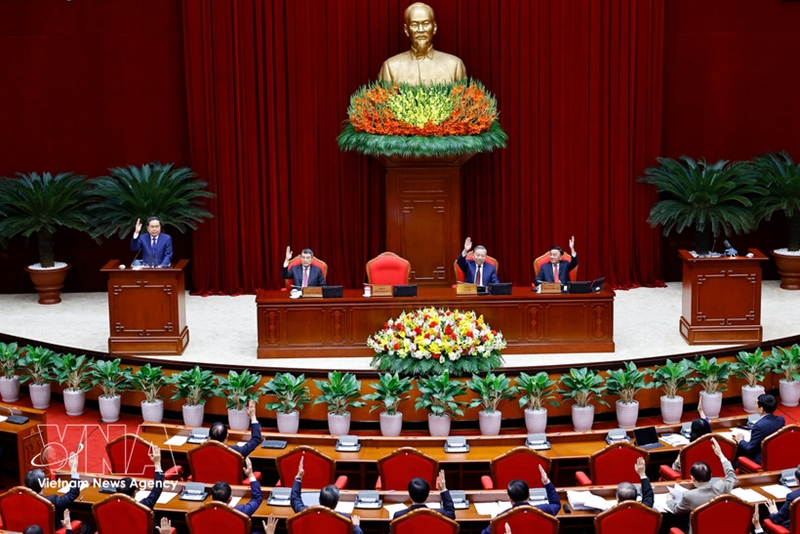 |
|
At the 14th Party Central Committee's second plenum |
In such context, the Party Central Committee focused not only on what needs to be done, but on how it will be executed and what measurable outcomes should follow. The central message of the plenum was the need to build a genuinely effective operating mechanism. From the opening session, the plenum was positioned at the appropriate level of responsibility, tasked with translating the spirit, aspirations, determination, and major directions of the 14th National Party Congress into operational mechanisms, organizational frameworks, principles of action, and the Party’s real governing capacity throughout the entire term.
A notable feature of the plenum was the scale and complexity of the agenda, covering urgent and necessary tasks that cannot be postponed. Despite the breadth of work, the focus was placed on “legal corridors,” “operational rules,” “disciplinary principles,” and “standards of action.” The emphasis was clear: all policies, guidelines, and decisions move beyond documentation and deliver concrete actions, measurable results, and visible changes.
Accordingly, the Party Central Committee outlined four core requirements, all centered on a single question: how to make the system operate more accurately, efficiently, and with greater real-world impact.
The first requirement is to lay a solid operational foundation for the full term. This includes the overall working agenda, internal regulations, Party Charter compliance rules, and regulations on inspection, supervision, and discipline. Together, these form the organizational structure and power channels that ensure governance discipline while maintaining internal democracy and order. If well designed, the system will operate smoothly; if not, achieving goals will be difficult.
In today’s volatile global environment, this requirement is even more urgent. Domestically, opportunities for breakthroughs are clear, but so are the pressures. Vietnam must renew its growth model, improve the quality of its workforce, reorganize development space, and effectively operate the two-tier local administration model in a creative and citizen- and business-oriented manner.
The second requirement is to renew leadership methods. This does not mean changing goals but making Party leadership more accurate, scientific, and effective. Renewal is reflected in better strategic vision, more coherent institutional framework, tighter inspection and supervision, stronger role modeling, and more precise cadre selection.
Importantly, the Party also spotlighted faster policy responses. In a rapidly changing world, speed has become a decisive factor. Slow policy responses can lead to lost opportunities and higher risks. Therefore, mechanisms must be adjusted to enable quicker reactions, clearer decentralization, closer oversight, and more timely practical reviews.
This is a concrete expression of substantive operational mechanisms!
The plenum also carefully reviewed requirements related to inspection, supervision, and the fight against corruption, wastefulness, and misconduct. This was framed not merely as internal housekeeping, but as a matter of the Party’s survival and a prerequisite for maintaining public trust. Without effective control, deviations can easily arise, making even correct policies difficult to enforce properly. Regular inspection and supervision, by contrast, help control power and continuously train and screen civil servants.
More importantly, such efforts reinforce public trust - the groundwork of development.
The fourth requirement is to closely link Party building with national development and improving living standards. All regulations and decisions must ultimately serve the goal of faster and more sustainable national development and better living conditions for citizens.
This is the highest measure of substantive governance!
The Party Central Committee has set a clear target of achieving GDP growth of over 10% during the 2026–2031 term. However, this growth must be of high quality and sustainable, requiring smooth operational mechanisms, unlocked resources, and an efficient administrative system.
At the plenum's closing, the concept of “substantive mindset” was further clarified, particularly in economic development and national governance. Foremost is the goal of achieving double-digit growth. The Party Central Committee stressed that low growth is unacceptable, as high and sustainable economic growth is an objective requirement of the national development in the new phase and a reflection of the national aspirations to rise. The emphasis was on maintaining high, sustainable, and real growth momentum.
Four core principles were outlined to support double-digit growth: substantive growth, maintaining macroeconomic stability and controlling inflation, ensuring major economic balances; effectively tapping all available resources, with priority to key projects and public–private partnerships, to improve investment efficiency and national competitiveness; and ensuring that high economic growth serves public interests and social equity.
The most notable among these principles is “substantive growth,” meaning that each percentage point of GDP expansion must contain higher knowledge content and added value, without compromising long-term sustainability or future resources. The shift signals a move away from headline growth figures toward value-driven development. Party General Secretary To Lam warned that prioritizing speed over quality would come at a very high cost.
Another key highlight is the two-tier local administration model, described as a new approach to local governance. Organizational restructuring alone is not enough; effectiveness must be judged by public satisfaction. If citizens still face administrative inconvenience, reform cannot be considered successful.
In inspection, supervision, and anti-corruption efforts, the requirement is clear: institutional framework must be designed tightly enough to make corruption impossible, and supervision mechanisms strong enough to ensure officials do not dare and do not want to engage in corruption. At the same time, mechanisms should protect dynamic, creative, and responsible officials who dare to think and act for the common good.
After three days of urgent, serious, democratic, and in-depth discussions, the second plenum completed all agenda items with a high level of consensus, demonstrating not only determination but also unity in implementation.
As Party General Secretary To Lam said in his closing remarks, with institutional foundations in place, strong political resolve, and unity of the entire Party, people, and military, Vietnam can firmly believe that the national development goals and aspirations set out by the 14th National Party Congress will soon become reality, ushering the country into a new phase of faster, more sustainable and comprehensive development.
Source: VNA