After thorough preparations from the central to grassroots levels, the essential conditions for the nationwide event – widely regarded as a major festival of the people – have been basically completed. Beyond its significance as an important political event, the election is also an occasion for citizens to exercise their right to mastery through the ballot, demonstrating their responsibility to the nation.
    |
 |
|
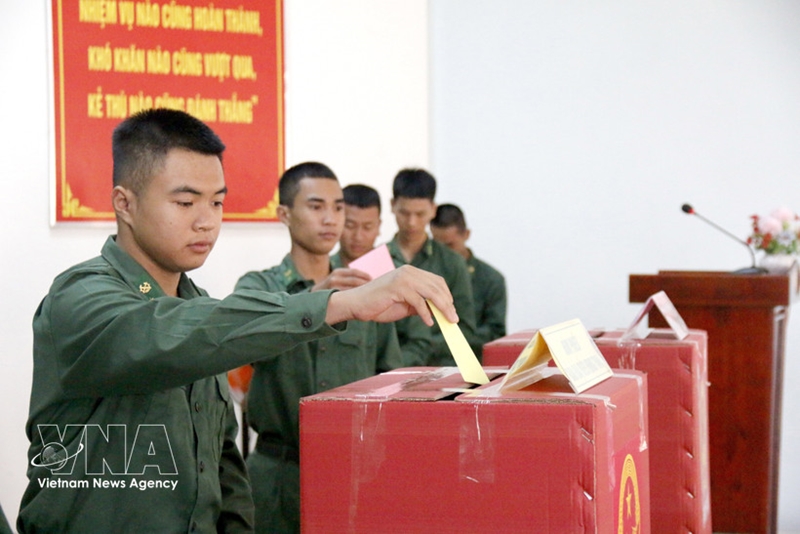
Newly-enlisted soldiers at the 2nd Training and Mobile Battalion in Lam Dong province eagerly participate in the early voting session. |
Looking back at the preparation process for the upcoming election day, the coordinated engagement of the entire political system is evident. At the central level, the National Election Council issued 27 documents as prescribed by law, along with a number of resolutions and guiding documents to support local authorities. Directions from the Politburo, the Secretariat, the National Assembly and the Government have been thoroughly implemented, ensuring unity in implementation nationwide. All steps in the electoral process, from consultations, nomination of candidates, compilation of voter lists and voter-candidate meetings to the preparation of facilities for polling day, have been conducted in accordance with legal regulations, ensuring transparency, openness and strict compliance.
Local authorities have also proactively issued thousands of documents directing and guiding election-related tasks, reflecting the active participation of the entire political system. The establishment of election bodies has been carried out in line with regulations.
Nationwide, 34 provincial-level election committees and 3,320 commune-level election committees have been set up, along with 182 election boards for National Assembly deputies, 724 election boards for provincial People’s Council deputies, 22,401 election boards for commune-level People’s Council deputies and 72,191 polling stations.
Personnel work, a decisive factor in ensuring the quality of elected bodies, has been carried out seriously through multiple rounds of consultation and feedback from voters at both residential areas and workplaces. The official list of 864 candidates for the 16th National Assembly was announced in accordance with regulations, ensuring appropriate structure, composition and the required number of candidates. The appraisal of candidate dossiers and evaluation of eligibility standards were conducted carefully, reflecting a high sense of responsibility towards voters and the nation.
Statistics show that 78,928,647 voters (updated as of March 10) have been included in voter lists at 72,195 polling stations across the country. At each polling location, facilities such as ballot boxes and voting booths, along with plans for security, fire prevention, healthcare services and communications, have been fully prepared. Public information campaigns have also been widely implemented through diverse channels, from grassroots broadcasting systems to digital platforms, helping voters better understand their rights and responsibilities on election day.
The vibrant atmosphere of preparations can be seen across the country. In the capital city of Hanoi, streets and residential areas have been decorated with flags and banners, while polling stations have undergone careful inspections. In Ho Chi Minh City, nearly 9.7 million voters have been reviewed and updated in the voter list. Thousands of voter-candidate meetings and briefings on candidates’ biographies have been organized, allowing voters to gain a clearer understanding of those seeking their support.
This election takes place as the country continues to improve its socialist rule-of-law State and implement reforms in the organization of the administrative apparatus. It is also the first election held under the two-tier local government model following the reorganization of administrative units. With wider jurisdictions and larger populations, the demands on representatives’ capacity and governance ability are higher than ever, making the selection of capable and responsible deputies particularly important.
Another noteworthy development is the expanded application of information technology and digital transformation in election work. The connection and verification of voter lists with the national population database have helped improve data accuracy. The VNeID application also allows voters to check their polling stations, access information on candidates and even register for changes in their voting location when necessary. These utilities not only facilitate citizens’ participation but also demonstrate progress in building a digital administration serving the people.
However, the core value of a democratic election lies not in technology or organizational form, but in the people’s genuine right to exercise their mastery. Each ballot represents the trust voters place in their representatives within the state apparatus. Through the ballot, state power is conferred constitutionally and legally, forming the basis for oversight and accountability throughout the term.
When citizens are fully informed, have the opportunity to interact and dialogue with candidates, and are free to choose their representatives, that is a vivid manifestation of socialist democracy.
The profound significance of the election is particularly visible in remote and special areas. In Tho Chau special zone, located more than 200 km from the mainland, over 2,000 eligible voters have already taken part in early voting with enthusiasm and responsibility. Ballot boxes have also been delivered to fisheries surveillance vessels operating offshore and to DK1 platform stations on Vietnam’s southern continental shelf, enabling officers, soldiers and fishermen to exercise their civic rights.
These ballots cast at sea or on distant islands are not only expressions of citizens’ democratic rights but also vivid symbols of national sovereignty affirmed through the presence of people and forces performing duties in challenging maritime areas.
Ensuring the voting rights of all citizens remains a priority. Visually impaired voters have been provided with election materials in Braille and audio formats and supported in reaching polling stations. Such seemingly small actions carry significant meaning, demonstrating the commitment to leaving no citizen behind in exercising their constitutional rights.
All these efforts converge to create the significance of the national election day. Though small, each ballot carries the weight of civic responsibility. By selecting the right representatives and placing trust wisely, voters contribute to building a National Assembly and People’s Councils capable of making important decisions for the country and localities in the new tenure.
As March 15 approaches, the atmosphere of readiness can be felt from mountainous areas and plains to urban centers and distant islands. While the political system has made comprehensive preparations, the success of the election ultimately depends on the active participation of every voter. When tens of millions of ballots are cast, the will and confidence of the people will once again be affirmed, ensuring that State power truly originates from the people and serves the people.
Source: VNA