Turning the 1-trillion-USD trade goal into reality
Presenting a report on economic diplomacy, Deputy Minister of Industry and Trade Nguyen Sinh Nhat Tan highlighted Vietnam's impressive trade achievements.
To date, Vietnam has concluded and implemented 17 free trade agreements (FTAs) and has recently completed negotiations on an agreement with the European Free Trade Association (EFTA). Between 2016 and 2025, the country's total trade turnover increased 2.7-fold, from 176 billion USD to 475 billion USD. In 2025, total trade reached 930 billion USD, placing Vietnam among the world's 15 largest trading economies.
    |
 |
|
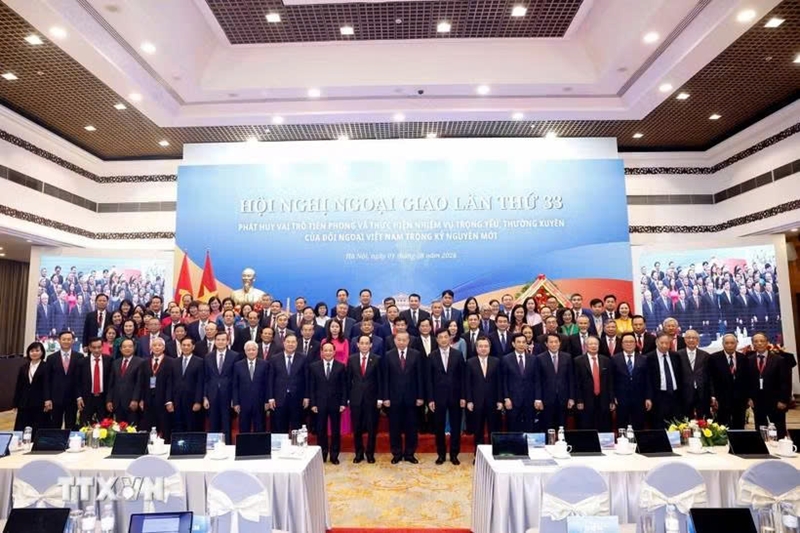
Party General Secretary and State President To Lam and delegates at the 33rd Diplomatic Conference in Hanoi on August 1, 2026 |
During the first seven months of 2026 alone, total import-export turnover reached 659 billion USD, up 28% year-on-year, putting the country on course to surpass the historic 1-trillion-USD milestone for the first time by the end of the year.
The utilization of FTAs has also delivered encouraging results. More than 1.2 million certificates of origin (C/O) have been issued, covering exports worth nearly 100 billion USD, equivalent to 28% of total export value. Preferential tariff utilization under FTAs with EVFTA, ASEAN–India and ASEAN–Australia–New Zealand has reached between 30 and 50%
Looking ahead, the ministry outlined six key priorities, including renewing economic diplomacy to directly improve productivity and technological capability; placing businesses at the center of development through the Go Global program for 2026–2030 to diversify markets and supply chains; and reforming trade promotion activities to deliver more tangible outcomes. It is also necessary to develop an integrated ecosystem for economic, scientific and defense diplomacy to attract talent, technology and strategic investment; strengthen coordination between foreign affairs, the economy, science and technology, defense and security; and enhance national risk management capacity in trade, energy and technology to balance deeper international integration with strategic autonomy.
Expanding development opportunities, making diplomacy a key growth driver
Addressing the conference, Chairman of the Hanoi People's Committee Vu Dai Thang said the capital's external relations have shifted decisively from traditional friendship exchanges to diplomacy serving economic development.
Hanoi now maintains cooperative ties with 58 capitals and major cities worldwide. In 2025, the city attracted 4.3 billion USD in foreign direct investment (FDI), while during the first half of 2026 it secured a further 3.5 billion USD, equivalent to 75% of its annual target. During the same period, Hanoi welcomed 3.5 million international visitors, an increase of 36%.
The capital has also strengthened its international profile by retaining its designation as the city for peace and actively participating in UNESCO's Creative Cities Network and Global Network of Learning Cities.
Hanoi and the Ministry of Foreign Affairs have signed a coordination agreement for the 2026–2030 period, covering political protocol, economic diplomacy, science and technology diplomacy, cultural diplomacy, overseas Vietnamese affairs and the training of diplomatic personnel.
Strengthening domestic capacity, enhancing economic resilience
Speaking on international integration in the financial sector and foreign investment to support growth model transformation and sustainable development, Minister of Finance Ngo Van Tuan said Vietnam's international standing has continued to improve, reflected in FTSE Russell's upgrade of the country's stock market status to from "frontier" to "secondary emerging" and the progress made by international credit rating agencies towards granting Vietnam investment-grade status.
According to Tuan, financial integration in the new era should go beyond attracting capital and instead directly enhance the economy's resilience while safeguarding national independence and strategic autonomy.
The ministry has identified four major priorities of improving capital mobilization (prioritizing ODA and long-term financing for infrastructure, digital transformation and the green transition); developing a modern and transparent capital market in line with international standards; reforming the approach to FDI attraction by prioritizing high-tech projects and technology transfer to help domestic enterprises move up global value chains; and accelerating digital transformation in the financial sector while strengthening cooperation in financial technology and digital financial standards.
Rethinking development to build a double-digit growth model
Nguyen Duc Trung, Deputy Head of the Party Central Committee's Commission for Policies and Strategies, said foreign affairs must become a pillar supporting a development model driven by science and technology, artificial intelligence and innovation.
He outlined three strategic priorities.
First, diplomacy should expand new development space in technology, finance, innovation and markets.
Second, Vietnam should shift from attracting resources to creating them, focusing on acquiring core technologies, venture capital and supporting domestic enterprises in moving deeper into global value chains.
Third, diplomacy should evolve from safeguarding development space to building national development capacity by making full use of comprehensive strategic partnerships to improve human resources and strengthen national competitiveness.
Deepening parliamentary diplomacy, shaping multilateral forums
Chairman of the National Assembly (N.A.)’s Committee for National Defense, Security and Foreign Affairs Le Tan Toi said parliamentary diplomacy in the new period must move beyond its traditional political role to become a driver of national development.
He proposed five priorities, including disseminating the orientations of the 14th National Party Congress on foreign affairs; strengthening coordination in strategic information sharing, forecasting and early warning from an early stage and from afar between the Ministry of Foreign Affairs, the N.A. Committee and the National Assembly Office; and aligning parliamentary diplomacy with national priorities such as digital transformation and energy security.
Other priorities are enhancing the quality of multilateral parliamentary diplomacy by proactively shaping international agendas and contributing initiatives to the development of global rules; and accelerating digital transformation while building a contingent of parliamentary foreign affairs officials with strong political mettle, strategic thinking, and professional and modern working capabilities.
Proactively guiding public opinion in digital age
Warning of the challenges posed by the rapid development of artificial intelligence (AI), misinformation and increasingly intense competition in the online information environment, Vice Chairman of the Party Central Committee's Commission for Information and Education Phan Xuan Thuy, said external information should deliver a unified message throughout the political system, from central to local levels.
He stressed that external information must remain aligned with the three pillars of Vietnam's foreign policy, with priority given to supporting economic diplomacy and science-technology diplomacy.
The work should also harness the country's soft power by promoting Vietnamese cultural values and projecting an authentic image of a dynamic, responsible Vietnam, while strengthening engagement with overseas Vietnamese communities to reinforce the great national unity bloc.
In particular, it must shift decisively from a reactive approach to one centered on forecasting, agenda-setting and proactively shaping a positive mainstream information flow. It should harness big data and digital transformation to enhance policy advice, and utilize the voices of reputable experts and international organizations to protect and promote Vietnam’s policies internationally.
Strengthening, elevating Vietnam's soft power
Minister of Culture, Sports and Tourism Lam Thi Phuong Thanh said the ministry had signed 136 international treaties and agreements, organized nearly 40 cultural and art programs in support of overseas visits by Party and State leaders, and hosted 90 Vietnam culture weeks and cultural days in countries around the world.
Vietnam is now home to nine UNESCO world natural and cultural heritage sites, 16 elements of intangible cultural heritage, four UNESCO Memory of the World inscriptions, seven Memory of the World Committee for Asia and the Pacific inscriptions, and four UNESCO Creative Cities.
Between 2018 and 2025, Vietnam was named the world's leading heritage destination six times, Asia's leading destination seven times, and Asia's leading cultural and culinary destination four occasions.
Notably, the country has for the first time simultaneously assumed responsibilities in six key UNESCO mechanisms and has been elected to a number of the organization's important bodies.
To further amplify Vietnam's soft power in the new development era, Thanh proposed renewing approaches to cultural diplomacy and integrating it more closely with external information; developing distinctive "Vietnam cultural spaces" at Vietnamese diplomatic missions abroad; continuing to harness the role of overseas Vietnamese communities and cultural institutions in promoting Vietnamese culture; strengthening Vietnam's pioneering role within multilateral mechanisms, particularly UNESCO; and proactively putting forward international initiatives that match the country's organizational capacity.
Source: VNA