Many veteran journalists, writers, and former leaders of the newspaper, including Phan Quang, Nguyen Dinh Thi, Thai Duy, Hoang Xuan Tuy, Pham Phu Bang, Nguyen Khac Tiep, Tran Cu, Le Phuc Nguyen, and Pham Van Huan, have written about these wartime editions from different perspectives. Their works preserve profound memories and historical testimony. However, these 33 issues also deserve deeper scholarly research and scientific evaluation as a journalistic treasure and a cultural heritage of Vietnamese revolutionary journalism.
Lessons in newsroom organization in wartime
As the resistance war entered its most decisive stage, the establishment of a frontline newsroom in the forests of Muong Phang was an unprecedented and highly creative model in both Vietnam and the world at that time.
Unlike previous campaigns, where only reporters accompanied troops, journalists at this frontline newsroom lived and worked like soldiers. They carried both rifles and pens, remaining constantly alert, courageous, and adaptable. To produce even short reports or dispatches, reporters had to follow military units directly in combat zones, often under extremely dangerous conditions.
    |
 |
|
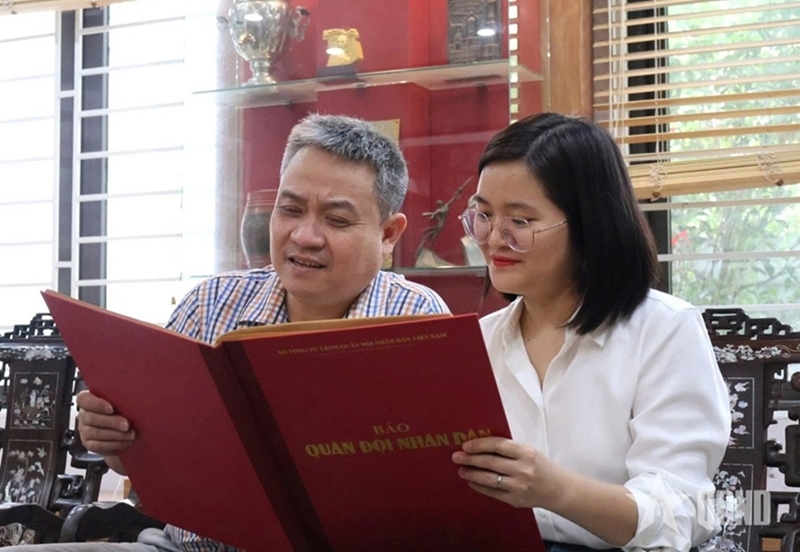
A lecturer from Hanoi University of Culture learning about the 33 issues of PAN |
The printing site was located close to the trenches so newspapers could be distributed immediately to frontline soldiers. Journalists also immersed themselves in the lives of soldiers, conscripted laborers, youth volunteers, and local people to capture the atmosphere of war and gather material for articles that could encourage and inspire troops.
Placing the newsroom directly at the battlefield allowed journalists to stay at the source of wartime developments and report events quickly and accurately. Newspapers were written, printed, and distributed right at the frontline. Such work required iron discipline, sacrifice, determination, and deep devotion to both journalism and soldiers.
Lieutenant General Pham Hong Cu, former Deputy Director of the General Department of Political Affairs, once remarked, “People’s Army Newspaper marched into battle alongside the main divisions and fought together with us throughout this campaign.”
Lessons in content organization
Journalist Tran Cu once wrote, “The rhythm of the newspaper was dictated by the rhythm of the battlefield.” That spirit was clearly reflected in both publication schedules and editorial content.
At first, the newspaper was published every four to five days, then every three days, and later every two days as the campaign intensified. Particularly notable was the March 10, 1954 issue, published immediately after the previous day’s issue. It carried the full text of General Vo Nguyen Giap’s appeal declaring: “The Dien Bien Phu battle is about to begin,” and calling on troops to “resolutely annihilate all enemy forces at Dien Bien Phu.”
These consecutive issues aimed to strengthen morale and prepare soldiers ideologically before the opening battle at Him Lam on March 13, 1954. Immediately after victory at Him Lam, the March 14 issue carried the front-page headline: “Our troops have completely annihilated enemy forces at Him Lam.”
This demonstrates the newspaper’s agility and precision in organizing the content of each issue.
The newspaper consistently followed developments at the front. Early issues contained broader reports and commentaries, but once the campaign began, coverage focused closely on battlefield realities and combat operations through the final issue published on May 16, 1954 and reached soldiers directly at the front.
The 33 issues demonstrate that wartime journalism not only performed the function of informing, but also shaped awareness, reinforce confidence, and encourage collective action. Through vivid reporting and carefully selected narratives, the newspaper promoted values such as heroism, sacrifice, and victory, helping strengthen determination among soldiers, youth volunteers, civilian laborers, and the public.
Lessons in writing and professional skills
The 33 issues reveal a highly professional and responsive style of journalism. Their content was practical, diverse, topical, and closely tied to battlefield missions, especially in reporting major offensives and key battles.
Lieutenant General Pham Hong Cu described the newspaper as an effective political instrument during the Dien Bien Phu Campaign. It provided timely battlefield updates, news from coordinated fronts nationwide, and information from the rear. It also served as educational material and helped promote exemplary individuals through stories of heroism and sacrifice. A fourth contribution was its role in enriching soldiers’ cultural life amid continuous and fierce combat.
The newspaper’s style matched its primary readership of soldiers, civilian laborers, and youth volunteers. Alongside policy and battlefield reports, it included international news, rear-area stories, poetry, satire, memoirs, sketches, and cartoons.
Works such as “The Gang Flowers Still Bloom Red” by Chien Ky, “The Soldier Defusing Delayed-Action Bombs” by Tran Cu, and “Tonight Uncle Ho Does Not Sleep” by Phu Bang – Tran Cu became memorable examples of frontline journalism. Cartoons by Nguyen Bich and Mai Van Hien brought humor and relief amid the harsh realities of war.
Articles were generally concise and vividly written. Headlines often emphasized contrasts between “our forces” and “the enemy,” highlighting victory and defeat. Numerical headlines were frequently used for impact, such as: “We have annihilated 5,000 enemy troops, shot down 50 aircraft, and destroyed seven ammunition and fuel depots and five tanks.”
Feature articles and memoirs used emotionally resonant and conversational titles, while political and ideological articles remained accessible and easy to understand.
Notably, many issues also employed graphic information formats. The first frontline issue, published on December 28, 1953, featured a large battlefield diagram illustrating troop movements and enemy retreats. Overall, 14 of the 33 issues used graphics to support reporting.
Today, modern technology, AI, and automation are transforming journalism and reducing manual workloads. Yet creativity, originality, and professional instinct remain qualities that technology cannot easily replace.
For that reason, preserving and promoting the professional lessons and spiritual values embodied in the 33 issues of PAN published on the Dien Bien Phu Battlefield remains both necessary and meaningful for the continued development of Vietnamese revolutionary journalism.
Journalist, Dr. Tran Ba Dung, Former Head of Professional Affairs Division, Vietnam Journalists Association
Translated by Tran Hoai