At about 8 p.m. on May 4, a family in Hung Chan commune discovered the animal wandering into their garden. Recognizing it as a strictly protected wild species, they voluntarily handed it over to local authorities the following day for proper handling in line with regulations.
After receiving the pangolin, local authorities directed police and forest rangers to provide care and monitoring. Initial health checks showed the animal was in stable condition with no signs of injury or weakness, allowing it to be safely returned to its natural habitat within the reserve, an area known for its rich forest ecosystem and high biodiversity under strict protection.
    |
 |
|
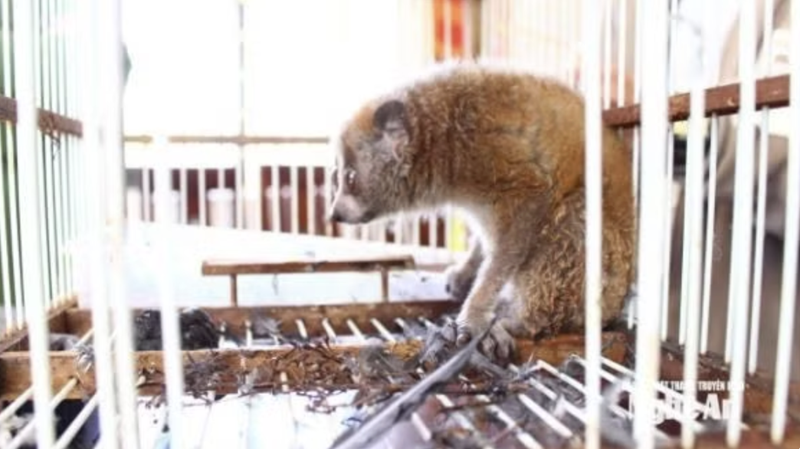
The pygmy slow loris (Nycticebus pygmaeus) was handed over to authorities by a resident of Con Say hamlet, Quynh Anh commune, on November 28. (Source: truyenhinhnghean.vn) |
Pangolins, scaly mammals capable of curling into a ball for defense, are classified as critically endangered and are strictly protected under both Vietnamese and international law.
The Pu Huong Nature Reserve, covering nearly 46,500 ha, is part of the core zone of the recognized the Western Nghe An Biosphere Reserve. It forms a vital ecological corridor linking with the Pu Mat National Park and Pu Hoat Nature Reserve, ensuring habitat connectivity.
Pu Huong is a biodiversity hotspot, home to nearly 570 animal species, many listed in Vietnam’s Red Data Book, the International Union for Conservation of Nature (IUCN) Red List and the Convention on International Trade in Endangered Species of Wild Fauna and Flora (CITES), along with over 1,800 plant species, including numerous rare and endemic varieties. Camera trap surveys in recent years have also recorded the presence of pangolins in the area.
Authorities said the voluntary handover of the animal reflects growing public awareness and sense of responsibility towards wildlife protection, contributing to broader efforts to conserve forests and biodiversity in buffer-zone communities.
Source: VNA