The event drew the participation of retired Senior Lieutenant General Pham Thanh Ngan, former Politburo Member, former Director of the General Department of Politics; retired Lieutenant General Tran Hanh, former Deputy Defense Minister, other retired generals and senior officers, Heroes of the People’s Armed Forces, military experts, representatives of defense and civilian agencies, and leaders of Hanoi city.
    |
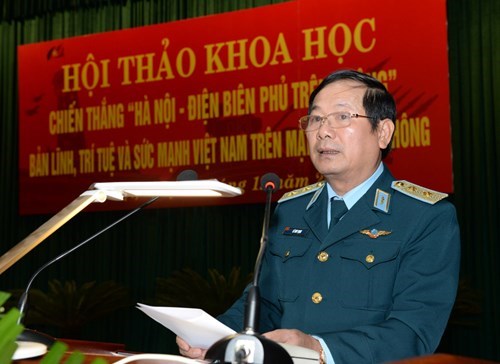 |
| Lieutenant General Le Huy Vinh, Commander of the Air Defense-Air Force Service speaking at the seminar |
Senior Lieutenant General Phan Van Giang, Standing Member of the Central Military Commission, Chief of the General Staff and Deputy Defense Minister, and Senior Lieutenant General Nguyen Trong Nghia, Deputy Director of the General Department of Politics, sent their reports to the seminar.
Reports read at the seminar clarified many issues related to the “Hanoi - Dien Bien Phu in the Air” (called Christmas Bombing or Operation Linebacker II by the US) campaign, the great victory and the undaunted will, bravery, mind and military talent of the Vietnamese people and armed forces in December 1972.
Party and Uncle Ho’s strategic vision
Making a keynote speech at the seminar, Lieutenant General Le Huy Vinh, Commander of the Air Defense-Air Force Service, emphasized that the event aimed to reconfirm and clarify the Party and Uncle Ho’s strategic vision in leading the building of the air defense and air force and developing combat tactics of air defense and air force troops in general and the combat tactics of air defense force to protect key ground targets in particular.
It also aimed to promote the national pride, educate the traditions of officers and soldiers of the Vietnam People’s Army, and raise troops’ resolve to overcome any difficulties, to be ready to undertake and excellently complete all assigned tasks in the current situation.
To continue the discussion, General Hanh affirmed that the “Hanoi-Dien Bien Phu in the Air” victory has vividly demonstrated the Party's and Uncle Ho’s brilliant mind and good abilities to predict and appraise the situation. In late 1967, President Ho Chi Minh predicted that the US Air Force would sooner or later assign B-52s to strike Hanoi, and they would withdraw from the Vietnam battlefield after losing in the Hanoi airspace.
Thanks to Uncle Ho’s accurate, almost prescient prediction, the Vietnamese people and armed forces were not strategically surprised when the US Air Force opened Operation Linebacker II, using B-52s to bomb Hanoi, Hai Phong and other Northern localities. In fact, the Vietnamese people and armed forces had well prepared both in terms of combat spirit and forces, and a plan was implemented with the use of both military and diplomatic means to defeat US Operation Linebacker II right in the Hanoi airspace, which would culminate in winning the war.
In his report sent to the seminar, General Giang also pointed out that the Party’s and Uncle Ho’s strategic vision and sound leadership in building the air defense and air force prior to US Operation Linebacker II was the decisive factor for the “Hanoi-Dien Bien Phu in the Air” victory. He underscored that the Party and Uncle Ho led the whole nation and army to build the air defense and air force and whole people’s air defense posture based on thorough analyses and objective, scientific evaluation of the international and domestic contexts, rules of warfare, the ongoing situation of the battlefield, and US strategies and military equipment and tactics. During the 1960s, the air defense force developed quickly and had several regiments with modern missiles and air defense platforms, which functioned as the core force in the 1972 air defense campaign against US Operation Linebacker II. As soon as the US Air Force started to use B-52s in the South Vietnam battlefield, the Party and Uncle Ho instructed the Air Defense-Air Force Service to study the aircraft and methods to shoot down the bomber. Under this guidance, the service actively conducted surveys, studied technical and tactical features of the B-52, assigned some units with experts to the South to gain experience and find effective methods to shoot down the B-52, and built a comprehensive combat plan to readily respond to a possible US air campaign with the use of B-52s. At that time, the service also developed a set of “top secret” documents on the B-52’s combat features, its radar interference capabilities and combat tactics, B-52-based aircraft formation and so on, which were then used in training air defense and air force troops in an effort to defeat a possible US airstrike scheme on Northern cities and key targets.
What is important in the force building is that the Party and Uncle Ho instructed the armed forces to build three air defense forces: regular air defense units, local air defense units and air defense militia and self-defense force. The three air defense forces were closely coordinated and formed a comprehensive, multilayer air defense battlefield, ready to shoot down enemy aircraft flying at different altitudes.
Furthermore, the Party and Uncle Ho paid special attention to promoting political will and resolve of all people and armed forces, particularly the Air Defense-Air Force Service. Uncle Ho said, “Despite the fact that the US Army has much money, many modern weapons, B-52s or whatever modern aircraft, our people and army still fight them… We do fight them, we will definitely defeat them.”
Keeping in mind Uncle Ho’s words, air defense and air force troops overcame many difficulties and hardships and spared no pains and sacrifices to fight and defeat the US air operations on Hanoi in December 1972.
Effective use of forces, close combat coordination
Delivering a speech at the seminar, Lieutenant General (retired), Hero of the People’s Armed Forces Nguyen Van Phiet, former Deputy Commander of the Air Defense-Air Force Service, discussed the use of the missile force during the “Hanoi-Dien Bien Phu in the Air” Campaign. According to him, prior to the campaign, the missile force had studied the B-52, mastered all available weapons and equipment to use them most effectively, and developed combat plans in response to possible US air operations in the North. As a result, some missile units were positioned nearby key targets to fight the enemy face-to-face while other units were ready to maneuver around the battlefield fighting the enemy to support the units in the main battlefield and the remaining units were arranged at possible B-52 entrance directions to wait in ambush for the enemy. In doing so, the missile force could always hold initiative in combat, fight the enemy at all time and in all places and inflict on the enemy the most while still maintaining its force.
Meanwhile, Lieutenant General (retired), Hero of the People’s Armed Forces Nguyen Duc Soat, former Deputy Chief of the General Staff of the Vietnam People’s Army, focused discussion on the experience in coordinating the air defense force and air force during the campaign against US air operations on Hanoi in December 1972. He said the coordination between air defense and air force units during the campaign was conducted very smoothly and efficiently regardless of whether it was day or night. At night, the zone-based coordination was applied, which allowed both air defense and air force units to fight enemy aircraft both in the air and from ground while still effectively covering each other. In daytime, our air force units found and attacked enemy anti-air defense aircraft formations to protect missile units, which were mainly tasked to shoot down US bombers, particularly B-52s.
In his report presented at the seminar, Major General Vu Hai San, Commander of Military Zone 3 clarified the coordination between the Air Defense-Air Force Service and local air defense forces. He said that, under the Party’s guidance, the armed forces of Military Zone (MZ) 3 had meetings to exchange knowledge and experience in fighting US air operations, and conducted a number of air defense exercises. On knowing the enemy’s scheme to bomb Hai Phong city, particularly Hai Phong seaport, MZ 3 laid an air defense artillery battlefield that could best protect the city while coordinating with missile and air force units most efficiently. Units of MZ 3 positioned groups of troops with their weapons on the top of buildings to be ready to fight enemy aircraft flying at low altitudes.
Highlighting the role of the local militia and self-defense forces and people in the “Hanoi-Dien Bien Phu in the Air” Campaign, Standing Deputy Secretary of the Hanoi Municipal Party Committee Ngo Thi Thanh Hang said that all people and armed forces in Hanoi had an undaunted spirit and high resolve to fight the enemy during those historic 12 days and nights of December 1972. The Hanoi leadership instructed agencies, units and people to evacuate humans and assets from the city while actively preparing forces and developing a combat plan to fight enemy B-52s. As a result, most people and important assets had been transported to safe places from the city, and formed air defense units based on the local militia and air-defense forces. As a result, Hanoi had four 100mm-artillery companies, 92 14.5mm machine gun batteries and more than 100 riffle-gunmen to fight enemy aircraft and search for parachuting US pilots.
All reports at the seminar asserted that the Vietnamese people and armed forces with the Air Defense-Air Force Service as the core force, under the sound leadership of the Party, actively prepared for the historical fierce encounter with the US Army with advanced military weapons and equipment. This has been considered as the main factor for the “Hanoi-Dien Bien Phu in the Air” Victory during the 12 days and nights of December 1972.
At the historical battles, the Northern people and armed forces shot down 81 US aircraft, including 34 B-52s. The huge loss forced the US to stop its Operation Linebacker II after 12 days.
To conclude the seminar, Lieutenant General Le Huy Vinh summarized the origins and significance of the great victory, highlighted valuable lessons and experience for the Air Defense-Air Force Service in actively grasping and analyzing the situation, building its force, developing a comprehensive combat plan with the participation of various forces to be ready to fight and defeat any enemy to firmly protect the territorial integrity of the Fatherland and peaceful life of the people.
Translated by Thu Nguyen