Firm grasp of enemy situation and accurate prediction of landing areas
During the operation planning, the command correctly assessed that after the liberation of Buon Ma Thuot town, the enemy would be forced to rely on airlift to launch counter-attacks, with landing forces likely equivalent to one or two regiments along Routes 14 and 21.
Accordingly, Division 10 was assigned to maneuver to the Northeast of Buon Ma Thuot to prepare for counter-attacking enemy reinforcements. Artillery and air defense units were repositioned to provide timely fire support. As predicted, after losing Buon Ma Thuot, the enemy deployed helicopters to land troops along Route 21, precisely in the areas already anticipated.
This lesson underscores the importance of accurate intelligence assessment, prediction, and battlefield judgment. In officer training, emphasis should be placed on analytical thinking, situational assessment, and the ability to draw precise operational conclusions.
Selecting right tactics and establishing solid combat posture
Through sound analysis, the campaign command adopted appropriate tactics and built a firm operational posture. Forces seized key positions, denied the enemy footholds, and disrupted their deployment.
    |
 |
|
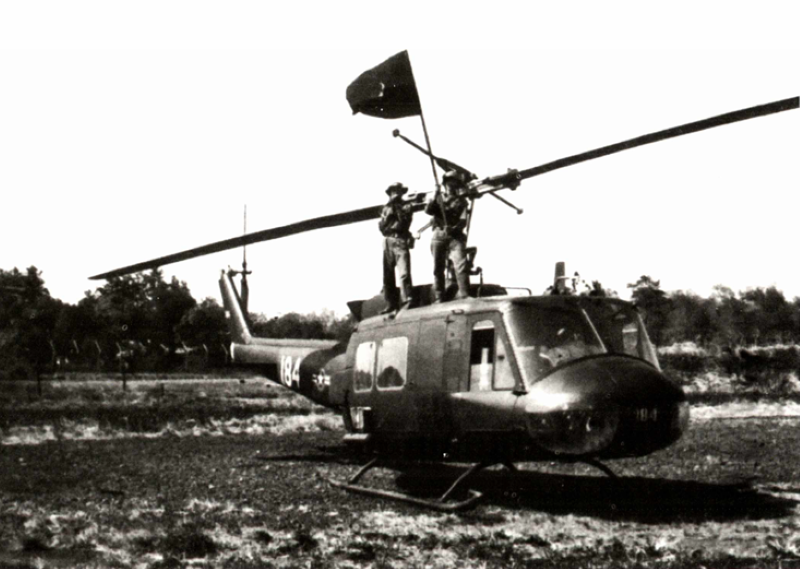
Liberation troops enter Hoa Binh Airport in Buon Ma Thuot town, March 1975. (Archival photo) |
Newly-landed enemy units were quickly encircled, isolated, and subjected to intense firepower. Infantry and armored forces then maneuvered to launch decisive assaults, eliminating each enemy cluster in sequence. Within five days, Division 10 destroyed and disintegrated the enemy’s 23rd Infantry Division, firmly securing Buon Ma Thuot.
In training, commanders must learn to establish encirclement, interdiction, and maneuver postures, combining firepower and mobility to strike effectively at airborne forces before they consolidate.
Flexible and creative application of tactics
During the Central Highlands Campaign, the Vietnamese forces demonstrated flexibility by combining multiple forms of combat: attack in maneuvering, engagement in movement, ambushing, pursuit, and encirclement. Small-unit tactics like rapid movement, tight encirclement, and continuous pressure proved decisive.
Forward elements cut off and isolated enemy reinforcements, enabling follow-on forces to deploy and attack effectively. This turned the enemy from an offensive posture into a reactive and ultimately defeated force.
For future warfare scenarios, where adversaries may combine land, sea, and airborne operations, training must ensure mastery of diverse tactical forms, with a strong focus on countering highly mobile forces such as airborne units.
Effective command, control, and coordination
The campaign’s success also stemmed from proactive command and tight coordination among forces. Despite limited transport capabilities, Division 10 maneuvered over 170km in a short time to reach its assembly area and prepare for combat.
Combat operations were conducted decisively and in sequence: seizing key positions, striking enemy units immediately upon landing, and preventing them from regrouping. Close coordination among infantry, armor, artillery, air defense, and other forces created overwhelming combat power.
In officer training, especially for army-staff commanding officers training, priority should be given to joint operations, command flexibility, and coordination across arms and services. Training must progress systematically, from individual skills to unit-level combined operations, ensuring both tactical proficiency and the ability to adapt in real combat conditions.
These lessons remain highly relevant in modern military education, particularly in preparing officers capable of commanding in complex, high-intensity, and multi-domain operations.
Translated by Trung Thanh