It is a challenging task, hindered by the relentless passage of time and the harsh effects of nature. However, it kindles hope of restoring the identities of the fallen soldiers and bringing them home to their families.
The Mekong Delta is now entering the rainy season. While the first seasonal rains have brought relief from weeks of sweltering heat, they have also made the collection of biological samples from martyrs' remains considerably more difficult. The region's distinctive climate with six months of dry season followed by six months of flooding creates extremely harsh conditions for the preservation of human remains. During the flood season, rising groundwater levels can inundate burial vaults and coffins. In the dry season, the soil hardens and cracks. Many areas are also affected by acidic sulfate soils and salinity, accelerating the degradation of biological materials.
According to Vu Anh Tuan from the DNA Identification Center under the Institute of Biotechnology, Vietnam Academy of Science and Technology (VAST), if the environment is consistently dry or permanently submerged, sample preservation will actually be more favorable. However, the continual alternation between these two conditions over many years has significantly degraded DNA quality. These challenges have long been anticipated by scientists, and technical solutions have been developed to address them.
    |
 |
|
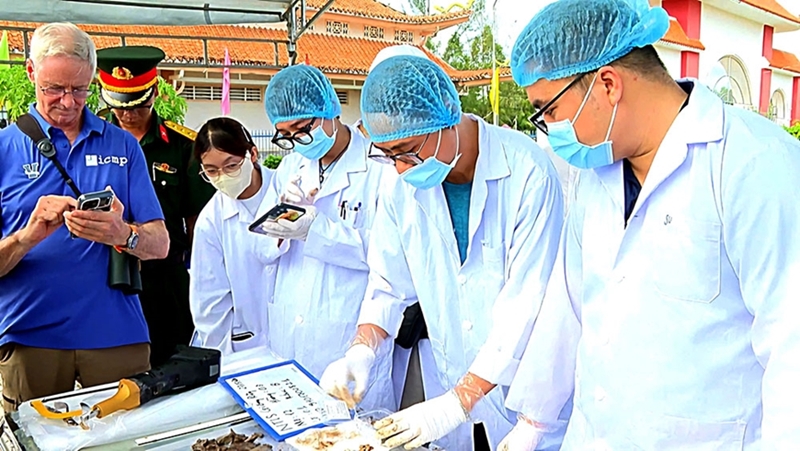
Staff from the DNA Identification Center collect biological samples from martyrs’ remains for DNA identification at Giong Rieng war cemetery. |
In some cases, it takes several hours to locate a single sample suitable for DNA analysis. Despite the difficulties, what stands out most at the war cemetery these days is the unwavering perseverance and enduring hope. Among thousands of graves, every set of remains is handled with meticulous care and a profound sense of responsibility. The scientists' hands are not only precise in every procedure but also guided by deep reverence for those who sacrificed their lives for the nation.
“Experts always prioritize samples that are most likely to preserve DNA, such as teeth or large bones. After being carefully cleaned and processed on site, the samples are strictly stored before being transported to the laboratory to minimize any further environmental impact,” said Tran Viet Vinh, a staff member at the DNA Identification Center.
Behind each seemingly small and meticulous procedure lies the hope of countless families who have waited for their loved ones for decades. Sometimes, a single high-quality DNA sample is all that is needed to bring a search spanning generations to its long-awaited conclusion.
A notable feature of this sampling campaign is the participation of international scientists and forensic anthropologists under a cooperative project between the VAST and the International Commission on Missing Persons (ICMP), funded through a non-refundable aid from the United States Government. Beyond providing technical expertise, this partnership gives Vietnam access to some of the world's most advanced DNA identification technologies.
According to Dr. Thomas Parsons, Senior Science Advisor at the ICMP, previous identification efforts relied primarily on mitochondrial DNA. However, because mitochondrial DNA is not entirely unique to each individual, there remains a possibility of coincidental matches within the population.
He emphasized that the next-generation DNA sequencing technology that the ICMP is helping transfer to Vietnam enables much deeper genetic analysis. It can identify individuals with virtually complete certainty, even from remains that have undergone severe degradation after many decades.
Once sample collection is completed, the martyrs' remains are reburied with full honors in their final resting place. They lie there among orderly rows of graves, surrounded by the greenery and tranquility of today's peaceful homeland. Now, alongside them burns a new hope illuminated by scientific advancements.
One day, the nameless headstones will bear the full names of those who rest beneath them. Families who have waited for decades will finally be able to offer incense at the correct graves of their loved ones. Those who sacrificed their lives for the nation's independence and freedom will, at last, return home with their identities restored.
Translated by Mai Huong