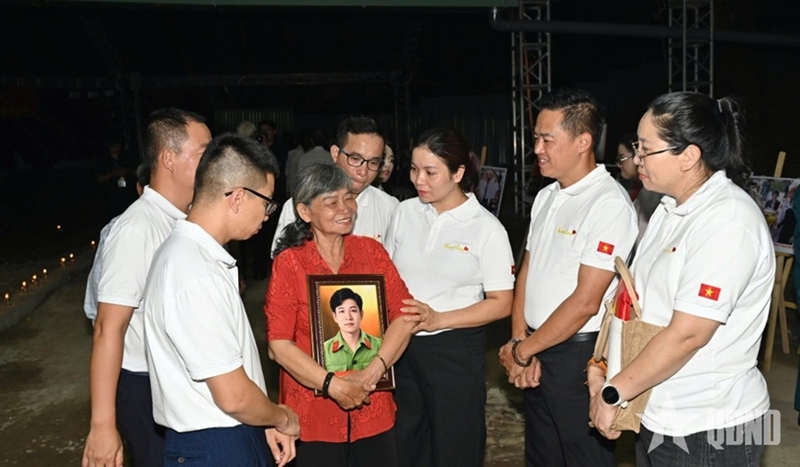
In recent days, alongside efforts to recover, repatriate, and identify the remains of fallen soldiers in Ho Chi Minh City, Team Lee has restored and personally presented 115 commemorative portraits to their families. The group's mission continues with the hope that no family will have to honor their loved ones with nothing but fading memories.
According to Team Lee member Pham Van Tuan, Ho Chi Minh City has become one of the group's primary areas of focus because it was once one of the fiercest battlefields of the war. Many families have yet to recover the remains of their relatives or no longer possess any photographs of them. By combining experience, digital restoration technology, and close collaboration with families, Team Lee has helped many people see the faces of their fallen loved ones once again.
    |
 |
|
Team Lee members hand over restored commemorative portraits to families of fallen soldiers at Le Thi Rieng Park. |
The greatest challenge is not the restoration technology itself. Some original photographs survive only as yellowed, blurred fragments, while others have lost more than half of the face of the fallen after decades of damage. In many cases, no photographs remain at all. Instead, families can only recall a pair of eyes, a smile, or a hairstyle remembered by a mother, wife, or sibling more than half a century after the soldier's sacrifice.
To recreate each portrait, Team Lee members spend hours listening to relatives describe every detail they can remember. They compare those recollections with photographs of other family members and combine them with the limited historical materials available to create the portrait. Every facial feature is carefully refined and reviewed multiple times to produce an image that most closely matches the family's memory.
Much of this work begins after their regular jobs have ended. Seated before computer screens, Team Lee members painstakingly restore every facial feature, strand of hair, expression, and contour. While some portraits can be completed within hours, others require days or even weeks because of the lack of reference materials or the severe deterioration of the original photographs.
“What concerns us most are the cases where families no longer have a single photograph of the fallen soldier,” Pham Van Tuan said. “We have to patiently listen as relatives describe every facial feature, from the eyes and smile to the smallest details preserved in their memories. Only then can we piece together those fragments and recreate a portrait that reflects how the family remembers their loved one,” Tuan added.
Those conversations often involve mothers in their eighties, widows who have preserved memories of their husbands throughout their lives, or younger siblings who know their brother only through family stories. From these recollections, Team Lee carefully compares available references and family photographs to gradually reconstruct the soldier's face.
One of the most emotional cases involved the family of Heroic Vietnamese Mother Nguyen Thi Na in Cu Chi commune, Ho Chi Minh City. She had nine children, including five sons who sacrificed their lives during the war, yet none of their remains have ever been recovered. For many years, the family had no portraits to place on the ancestral altar.
“When we presented the restored portrait, the soldier's younger sister embraced it and broke down in tears. The portrait was placed beside their mother's memorial photograph. It felt as though, after so many years apart, mother and son had finally been reunited. Moments like that inspire us to continue restoring more portraits so that more families can once again see the faces of those they have lost,” said Tuan.
For fellow Team Lee member Ngo Duc Tu, one of the most memorable experiences was restoring and presenting the portrait of fallen soldier Huynh Van Quen to Nguyen Thi Le, who was officially recognized as his widow after waiting 58 years.
“When she received the portrait, mother Le held it tightly and burst into tears. We later created a composite photograph showing the two of them standing side by side as a gift. Despite her poor health, she waited for us from early morning. The moment she saw the picture, her eyes filled with happiness. It made me realize that war has not only taken away those who went to the battlefield but also left behind losses and lifelong grief and decades of waiting for those left behind . We simply hope these restored portraits can help ease some of that loss,” said Tu.
Although the war ended long ago, the void it left behind remains in countless families of fallen soldiers. A restored commemorative portrait cannot erase that loss, but it can bring a familiar face back from memory, allowing those left behind to see their loved one again after decades apart. The significance of Team Lee's work lies not only in the use of modern technology but also in its patience, compassion, and commitment to preserving memories while honoring those who sacrificed their lives for Vietnam's independence and freedom.
Translated by Tran Hoai