    |
 |
|
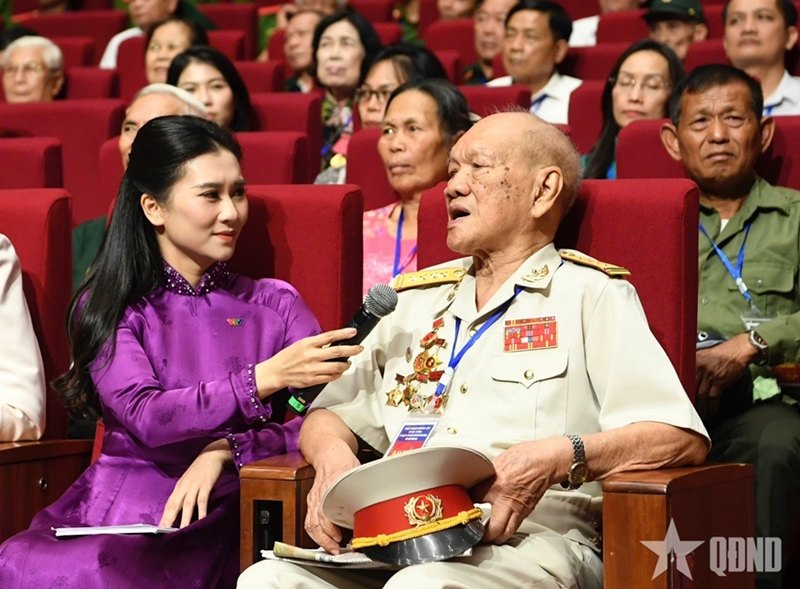
Sr. Col. Nguyen Huu Tai shares his memories of the nation's struggle for independence and the bonds of comradeship. |
At the age of 97, Senior Colonel Nguyen Huu Tai, a pre-August Revolution veteran and former Deputy Director of the Department of Military Training (now the Department of Military Training and School Management under the General Staff), still remembers the years when the country was mired in oppression and poverty.
Together with his generation, Col. Tai witnessed the immense suffering endured by the Vietnamese people under the rule of the French colonialists and Japanese fascists. Inspired and guided by the Communist Party of Vietnam and President Ho Chi Minh, young patriots like him voluntarily joined the revolutionary movement.
“We were never afraid of sacrifice or difficulty. We never hesitated to shed our blood and give our lives, and we were always ready to fight for the Fatherland and people,” Col. Tai recalled. Having gone through two wars of resistance, Col. Tai said his greatest source of satisfaction is knowing that his generation helped secure and safeguard the nation's independence.
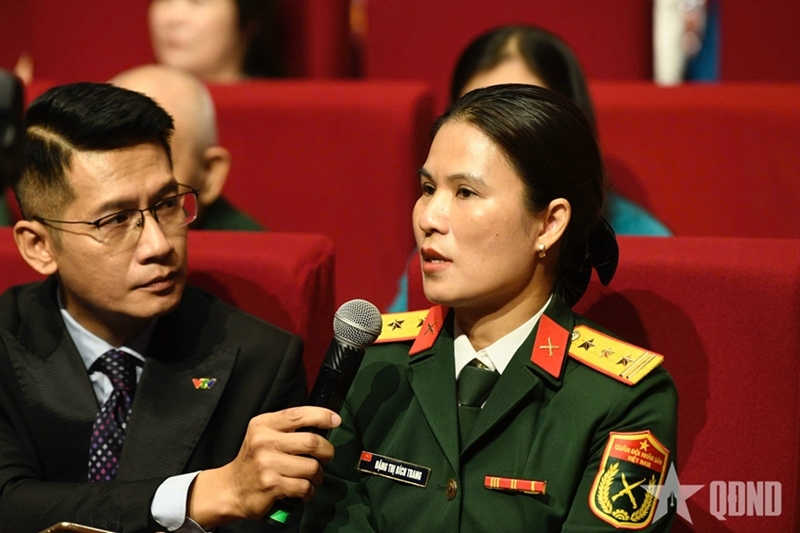
While Col. Tai's story reflects the memories of a generation that fought for national independence, the account shared by Colonel Dang Thi Bich Trang, Deputy Head of the Editorial Department of the monthly magazine "Events and Witnesses" of the People's Army Newspaper, deeply moved the audience with the sacrifices made by military officers in peacetime.
|
|
 |
|
Col. Dang Thi Bich Trang reads from her late husband's diary and recounts the story of martyr and military pilot Tran Thanh Nghi. |
Seventeen years ago, Trang’s husband Senior Captain Tran Thanh Nghi, a pilot of Regiment 923 under Division 371 of the Air Defense - Air Force Service, lost his life while performing his duty. At the time, she was 27 years old, pregnant with their second child, while their eldest daughter was just over three years old. Her husband's sudden death plunged her into a prolonged period of depression and despair, leaving her struggling even to communicate.
During those difficult days, she began reading the diary her husband had left behind. Among its pages was an entry describing his first flight on March 5, 1999, at Cam Ranh, Khanh Hoa province. Although the flight lasted only 30 minutes, it marked a defining moment for the young cadet as he took control of an aircraft for the first time and soared into the sky.
Those diary entries helped her gain a deeper understanding of her husband's passion for flying, his love for the Fatherland, and the profound sense of responsibility carried by a military pilot. She came to realize that, despite fully understanding the dangers of their profession, her husband and his comrades continued to climb into the cockpit and carry out the missions entrusted to them by the Party, the State, and people.
"No one wishes for such sacrifice. Yet behind the pain and loss lies the pride and honor shared by the families and comrades of those who have devoted everything they had to the Fatherland," Col. Trang said.
Drawing strength from her husband's diary and the support of his comrades, she gradually overcame her grief. She resolved to live on with resilience so that her husband could rest in peace and those still serving the nation could carry out their duties with confidence.
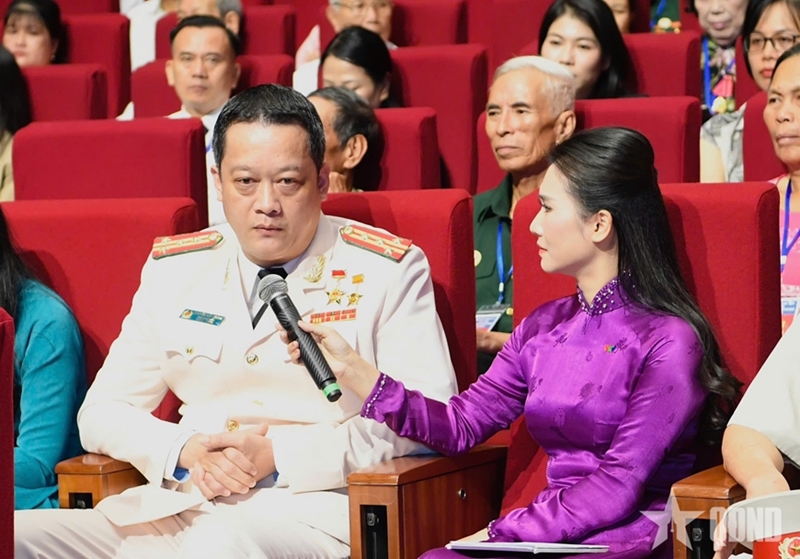
From a different perspective, Sr. Col. Nguyen Duc Cuong, a Hero of the People's Armed Forces and Deputy Director of the Nghe An provincial Police Department, shared his experiences from nearly two decades on the front line of the fight against drug-related crime. Wounded in the line of duty and classified as a war invalid with a 41-percent disability rating following a major anti-drug operation, he described the incident as the most difficult and challenging period of his career.
|
|
 |
|
Sr. Col. Nguyen Duc Cuong shares his experience from high-risk anti-drug operations carried out under dangerous conditions. |
Behind every operation, he explained, lies meticulous planning and preparation. Personnel selected for such missions must be highly experienced, resilient, physically fit, and mentally prepared for combat. Many officers voluntarily undertake these dangerous assignments despite knowing that suspects may be heavily armed and that every operation carries unpredictable risks. Even so, officers prepare to make the ultimate sacrifice in the line of duty. In such moments, comradeship, close coordination, and mutual trust become the source of strength that enables them to accomplish their missions.
Each story shared at the conference served as a testament to the spirit of dedication and sacrifice for the independence and freedom of the nation and for peace and well-being of its people. Caring for those who have rendered meritorious service to the revolution is therefore not only a tribute to the past, but also a political responsibility, a moral obligation, and a shared commitment of society. As these values continue to be upheld and passed on, the enduring traditions of patriotism, selfless service, and gratitude to those who came before will inspire both present and future generations to safeguard and build a strong and prosperous Vietnam.
Translated by Quynh Oanh