Veterans as “living maps”
Height 685 in Giang Nam village, Thanh Thuy commune (Tuyen Quang province), was once likened to a “lime kiln of century,” where many officers and soldiers sacrificed their lives in battles to defend the Northern border. Military Region 2 and Tuyen Quang province identified the area as a key site for the search and collection of martyrs’ remains.
In August 2026, based on documents and witness accounts, Military Region 2's Steering Committee for the search, collection, and identification of martyrs’ remains invited veterans of Divisions 356, 316, and 313 back to the site. The committee also coordinated with the Tuyen Quang provincial Steering Committee to organize a conference to collect historical information. Participants included Major General Nguyen Duc Huy, former Deputy Commander and Chief of Staff of Military Region 2 and former Chief of Staff of Vi Xuyen Front, along with many veterans. Among them was veteran Trinh Xuan Hung, residing in Hoa Quan commune, Nghe An province, former Officer Commanding of Battalion 5, Regiment 153, Division 356.
    |
 |
|
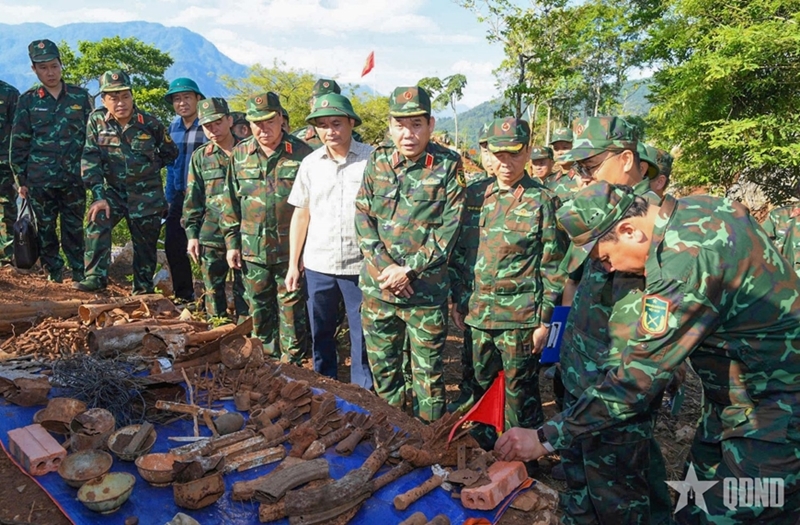
Senior Lieutenant General Nguyen Van Gau, Deputy Minister of National Defense, and leaders of Military Region 2 direct the search and collection of martyrs’ remains at Height 685. |
Returning to the old battlefield, veteran Trinh Xuan Hung pointed out the positions of the formations. Cross-checking his account with information from other former comrades, the Martyrs’ Remains Search and Collection Team under the Tuyen Quang provincial Military Command expanded the search to areas ranging from 150 to 600 square meters. After excavating about 7,500 cubic meters of soil, functional forces discovered many remains and artifacts. By September 22, at Height 685, the forces had recovered five mass graves containing 69 sets of martyrs’ remains.
In Lao Cai, veteran Tran Minh Bai, residing in Lao Cai ward, Lao Cai province, provided information about a martyrs’ burial site in the Lo Voi hill area, now Da Voi Hill. According to his account, more than 200 officers and soldiers from Regiment 121, Regiment 118, local armed police, and the self-defense and militia members of Cam Duong Apatite mine who died in the battles to defend the Northern border were buried there. Many graves were later relocated to cemeteries, but some martyrs’ remains have yet to be found. Based on this information, the provisional Martyrs’ Remains Search and Collection Team under the Lao Cai provincial Military Command conducted surveys and expanded the search area, removing layers of soil for inspection. By the end of September 2026, the team had recovered 45 sets of martyrs’ remains.
In Lai Chau, the combination of different information sources also brought about notable outcomes. Based on historical documents, witness accounts, and the results of a seminar with Regiment 148, Division 316, the Lai Chau provincial Steering Committee identified a mass grave at Tam Duong War Cemetery in Binh Lu commune as the burial site of 47 officers and soldiers of Battalion 920, Regiment 148 of the Northwest Military Region, now Regiment 148 under Military Region 2, and the former Phong Tho district Party Committee. They sacrificed their lives on February 14, 1951, in Muong Cau village, now Thanh Binh village, Binh Lu commune.
Expanding information sources, prioritizing field verification
Military Region 2 was the site of many fierce battles. As terrain has changed and the passage of time has blurred wartime traces, information about original burial sites has become increasingly difficult to find. This requires functional forces to collect information from multiple sources and carefully verify it.
Along with disseminating information through the press and social media, the Military Region 2 Steering Committee launched a campaign to collect information and issued an open letter. The military region directed 100 percent of communal-level military commands to establish information verification teams and distribute survey forms to every household. Specialized teams were also established to receive and process information.
Since July 2026, the military region has used SMS messages to call for information. To date, the steering committee’s standing agency has received nearly 1,500 pieces of information, screened 210 relevant information pieces relevant to the military region, transferred nearly 600 to other agencies and units, and continued to process the remaining pieces of information.
Major General Nguyen Ngoc Ngan, Deputy Political Chief and Standing Deputy Head of the Military Region 2 Steering Committee, said that the military region would continue reviewing historical records, meeting witnesses, and conducting field surveys to delineate search areas. Units coordinate in collecting battle histories, burial maps, and memorabilia and classify information sources according to their reliability.
Priority is given to verifying areas where many martyrs are believed to have been buried, suspected mass graves, or locations supported by at least two independent sources. Major General Nguyen Ngoc Ngan emphasized that accounts provided by elderly witnesses must be recorded in audio and video and linked with coordinates and field maps, enabling search forces to make effective use of the remaining information and contributing to the successful implementation of the “500-day campaign” in Military Region 2.
Translated by Chung Anh