The national park manages more than 121,764 hectares of natural forest, much of it in rugged limestone mountains with steep slopes and limited access, making patrolling, monitoring and preventing violations challenging.
According to the park's management board, it conducted 1,875 patrols covering more than 16,750 km in the first 10 months of 2026. Coordinated forest protection measures helped prevent major cases of deforestation, wildlife hunting, illegal transportation and trading of forest products, and forest fires. However, the vast forest area and complex terrain continue to place considerable pressure on personnel, equipment and time, highlighting the need for additional monitoring solutions.
    |
 |
|
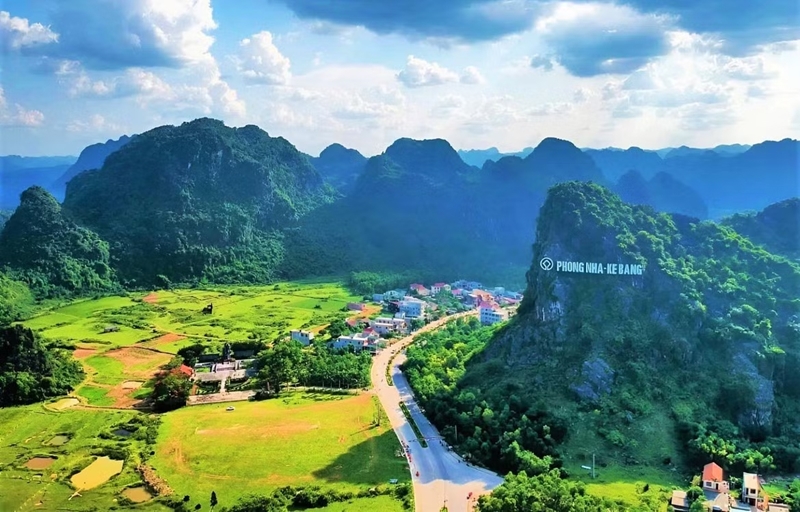
An overview of Phong Nha - Ke Bang National Park. Photo: cand.vn |
The park’s management board has gradually adopted technology in forest management, including SMART software, geographic information systems (GIS), remote sensing imagery and three UAVs. These tools support patrols, monitoring of changes in forest resources and forest fire prevention and firefighting. Aerial images captured by UAVs can help identify unusual signs and guide authorities in conducting inspections and verification.
Based on management needs, the management board has proposed further studying UAV applications for surveys and patrols in key areas and difficult terrain to detect early signs of forest encroachment and fires, as well as support search and rescue operations. It has also suggested installing artificial intelligence (AI)-integrated cameras at access points, along trails and in border areas to strengthen surveillance.
Standing Vice Chairman of the provincial People's Committee Hoang Nam stressed that applying science and technology was important to improving forest management and protection, forest fire prevention and firefighting, and search and rescue operations. He said that UAVs could provide valuable support for authorities working in areas with challenging terrain such as Phong Nha - Ke Bang National Park.
He called for selecting feasible applications for initial pilot deployment at the park and assessing their actual effectiveness before considering wider implementation across the province, avoiding scattered investment in technologies that might not deliver practical results.
However, UAV deployment in forest management still faces several challenges, including flight permits, equipment costs, operating personnel, telecommunications infrastructure, and data connectivity and processing, Nam said, noting that the rugged limestone terrain also requires careful consideration of equipment specifications, operating range, and signal transmission capabilities.
Chairman of the provincial People's Committee Bui Hoang Phuong described UAV applications as necessary to improve forest management, monitoring and protection, particularly in hard-to-reach areas. He agreed in principle to exploring and piloting their use at Phong Nha - Ke Bang National Park, tasking the park’s management board with developing a detailed plan in coordination with relevant departments, agencies and units.
He requested that the plan clearly define technical requirements, operating methods, funding, legal procedures, and practical effectiveness. Initial pilots should focus on feasible applications, while considering the hiring of services from capable technology companies and making effective use of existing equipment and resources to avoid fragmented investment.
To address these challenges, Quang Tri plans to strengthen coordination among the park's management board, police, military forces, border guards, telecommunications businesses and technology providers. Priorities focus on resolving issues related to flight permits, technical requirements, connectivity infrastructure, and equipment operation to ensure suitability for local conditions.
Through the pilot program at Phong Nha - Ke Bang National Park, Quang Tri aims to gradually expand technology applications in natural resource management, contributing to forest ecosystem protection and the long-term preservation of the World Natural Heritage site's values.
Source: VNA