Ngoc, who is also Secretary of the CPV Central Committee, Chairman of its Organization Commission and standing deputy head of the Central Steering Committee for Science-Technology Development, Innovation and Digital Transformation, appreciated IIT Madras’ experience in developing a research university model closely linked with industry and innovation.
He noted that such experience offers valuable reference points for Vietnam as the country accelerates efforts in science and technology development, innovation and digital transformation.
    |
 |
|
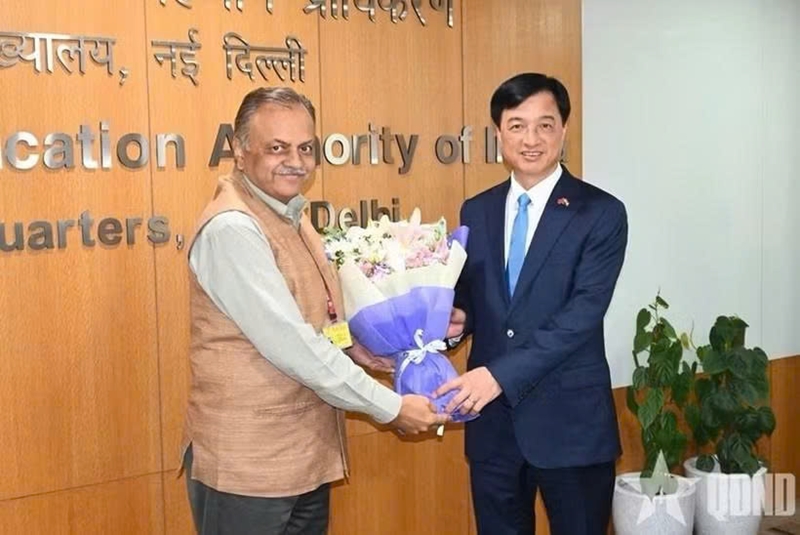
Politburo member Nguyen Duy Ngoc (right) and a representative of UIDAI leaders (Photo: qdnd.vn) |
Professor V. Kamakoti, Director of IIT Madras, said the institute has produced 68 scientific publications with Vietnamese co-authors over the past six years and is currently cooperating with around 18 Vietnamese higher education institutions, including the Vietnam National University, Ho Chi Minh City and the Posts and Telecommunications Institute of Technology.
He expressed interest in expanding cooperation with Vietnam in education and research through joint training programs, faculty and student exchanges, doctoral training and the possible development of articulation programs between IIT Madras and Vietnamese universities.
He also proposed stronger collaboration in deep-tech innovation and startup ecosystems, aiming to support Vietnamese and Indian students and research groups in jointly developing ideas, establishing startups and expanding operations in both countries.
In addition, IIT Madras is studying the possibility of establishing a presence or cooperative facility in Vietnam in the future.
Ngoc, in turn, reaffirmed that Vietnam is promoting science-technology development, innovation and digital transformation. He expressed the country’s desire to deepen cooperation with IIT Madras and Indian partners in deep technology, high-quality human resources training and innovation ecosystem development on the basis of shared research, shared development and mutual benefit.
During a separate working session with the Vietnamese official, UIDAI leaders introduced the development and operation of the Aadhaar national digital identity ecosystem. The Aadhaar system currently provides 12-digit identification numbers to more than 1.4 billion people and supports electronic authentication, biometric verification and connectivity for public services, finance, healthcare, education and social welfare.
UIDAI representative emphasized that the core of the Aadhaar model lies not simply in developing a citizen application, but in building a foundational national digital identity infrastructure enabling government agencies, businesses and organizations to deliver unified, secure and low-cost digital services.
Ngoc praised India’s experience in developing national digital infrastructure to support the digital economy and digital society, particularly its platform-centered approach to promoting innovation and large-scale digital service delivery.
He noted that Vietnam’s study of the Aadhaar model highlighted several important lessons, including large-scale digital identification and authentication, the integration of identity, payment systems and public services, deployment on common devices, scalability, cost efficiency and the combination of technology solutions with legal frameworks for data protection.
During the discussions, both sides exchanged views on digital identification management, electronic authentication, biometrics, personal data protection and experience in implementing large-scale national digital services. The two sides also agreed to strengthen exchanges of experts and cooperation in technical and policy experience-sharing in the coming period.
Source: VNA