Ranjan said the visit carries special significance as General Secretary and President Lam’s first trip to India since assuming his new leadership positions, calling it a reflection of the increasingly positive and deepening momentum in Vietnam–India ties.
He noted that the visit not only advances bilateral ties but also contributes more broadly to promoting a multipolar and multilateral world order, and a more balanced and inclusive Asia as well. He also welcomed the two countries’ reaffirmation of Vietnam’s role in the Indo-Pacific, particularly in driving the vision of a free, open, and inclusive region.
That, he said, signals Vietnam’s growing importance in India’s foreign policy and regional strategy.
    |
 |
|
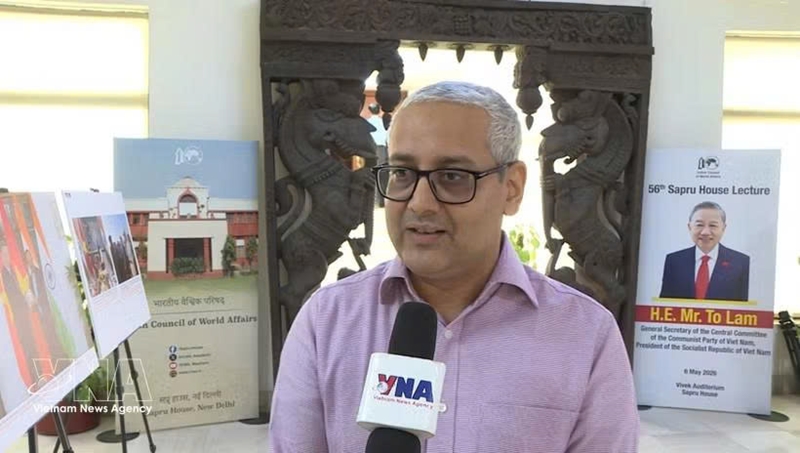
Dr. Rajiv Ranjan from the University of Delhi |
Pointing to the visit’s concrete outcomes, Ranjan highlighted the signing of 13 memoranda of understanding spanning healthcare, education, and other fields, demonstrating that India now views Vietnam as a trusted, strategic partner.
The foundation of bilateral relationship, he said, has been reinforced by long-standing historical and civilizational linkages. Vietnam and India share profound cultural and spiritual ties, with Buddhism acting as a critical bridge between their people. As such, both sides are now transforming this civilizational connectivity into a more substantive and effective strategic partnership.
He expressed confidence that the visit would create new momentum to elevate Vietnam–India relations, particularly in strategic areas like energy security, as global and regional uncertainties, including spillovers from the Middle East crisis, pile up.
To effectively convert the visit’s outcomes into gains, the two countries should continue fostering people-to-people exchanges, academic cooperation, and links among research and educational bodies, he said, adding that these areas will be essential to sustainably consolidate bilateral ties.
He closed on an optimistic note, believing that Vietnam-India relations will keep powering ahead and solidify into one of the key pillars of Asia and the wider Indo-Pacific.
Source: VNA