At the reception, Chau congratulated Japan on the UNESCO recognition of the “Asuka-Fujiwara Ancient Capitals” as a world heritage site.
He noted that cooperation between Viet Nam and Japan has made positive progress in several areas. Regarding semiconductor human resource training, the Vietnamese Ministry of Education and Training and Ministry of Science and Technology are studying an appropriate mechanism to train 250 doctoral-level semiconductor experts under Japan’s Strategic Science and Technology Innovation Initiative for ASEAN (NEXUS).
    |
 |
|
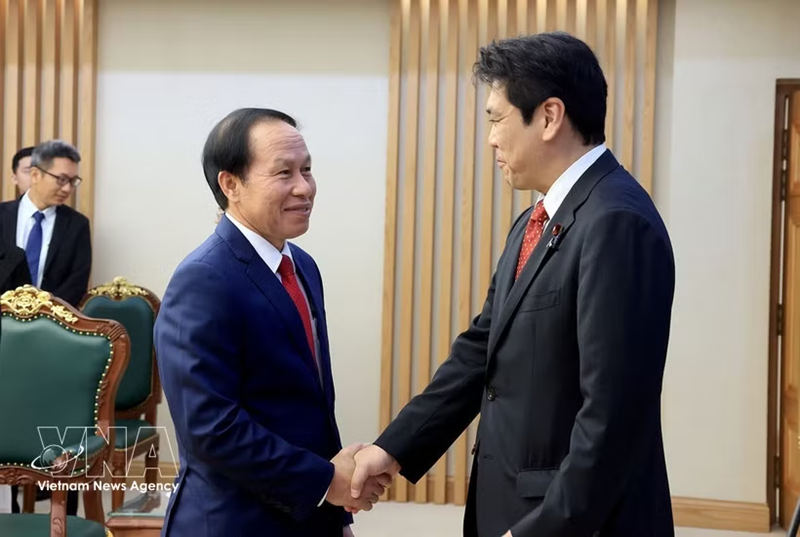
Deputy Prime Minister Le Tien Chau (L) receives Japanese Minister of Education, Culture, Sports, Science and Technology Matsumoto Yohei in Hanoi on September 7. |
The Deputy PM asked Japan to continue coordinating closely and facilitate access to support for Vietnamese candidates. Regarding the Japanese Human Resources Development Scholarship Program (JDS), the Vietnamese Government issued Resolution No.277/NQ-CP on August 6, 2026, on the signing of an exchange of notes.
Chau affirmed that Japan is one of Viet Nam’s top and long-term important partners as the country pursues its development goals in the new era.
He asked Matsumoto to continue supporting the effective implementation of agreements reached by the leaders of the two countries, including increasing the number and scale of jointly funded research projects under the NEXUS and Sakura Science Exchange Program, and working towards the early conclusion and signing of an agreement on the development of Viet Nam-Japan University.
Viet Nam also hopes Japan will continue helping train high-quality human resources in fields such as artificial intelligence, high technology, high-speed railways, space and quantum technology, he said.
He proposed that Japan support Vietnamese universities in participating in the fourth Viet Nam-Japan University Presidents’ Conference, scheduled to take place in Japan in October 2026.
The two sides should also promote science and technology, innovation and digital transformation cooperation through concrete projects, including joint research, research and development (R&D), and development of Viet Nam’s innovation ecosystem.
He called for coordination in organizing the fifth meeting of the Viet Nam-Japan Joint Committee on Science and Technology and a public-private cooperation forum between the governments and businesses of the two countries in the field.
The Deputy PM also proposed that Japan support Vietnamese language and Viet Nam studies programs in Japan, encourage more teaching, research and exchange activities related to Viet Nam at Japanese educational institutions, and strengthen practical cooperation between localities, as well as cultural, tourism and people-to-people exchanges.
He expressed his hope that Matsumoto would continue supporting efforts to create a favorable, equal and friendly living and working environment for foreigners, including the nearly 700,000 Vietnamese people in Japan.
He also called for the continued organization of Viet Nam-Japan festivals and noted the Viet Nam-Japan Local Cooperation Forum, which was held successfully in Hue on September 6.
For his part, Matsumoto said that alongside education and training, Japan is keen to strengthen cooperation with Viet Nam in science and technology, digital transformation and innovation.
He affirmed that his ministry will continue efforts to make practical contribution to Viet Nam-Japan relations.
Source: VNA