Speaking to Viet Nam News Agency (VNA) correspondents in Paris, Hugues Tertrais, Honorary Professor at Paris 1 Panthéon-Sorbonne University and former Director of the Center for Contemporary Asian History (CHAC), said the significance of the visit from September 9 to 12 should be viewed against the profound changes Viet Nam has undergone over nearly five decades and the current developments in the region.
A scholar specializing in Viet Nam, Southeast Asia and the Asia-Pacific, Tertrais said Viet Nam has entered an entirely new stage of development over the past nearly 50 years.
Having largely moved beyond war, Viet Nam, with its large and dynamic population, has created conditions for continuous renewal, he said. This process has taken place within Vietnamese society as the world has become increasingly complex and shifting balances of power have had a strong impact on relations among countries.
Looking back at Viet Nam's modern history, particularly from 1945 and the post-colonial period, the French historian used the phrase “Communistes et Dragons” (Communists and Dragons) to describe the country's development. It was also the title of a book he co-authored with Le Monde journalist Jean-Claude Pomonti and published in 1994.
    |
 |
|
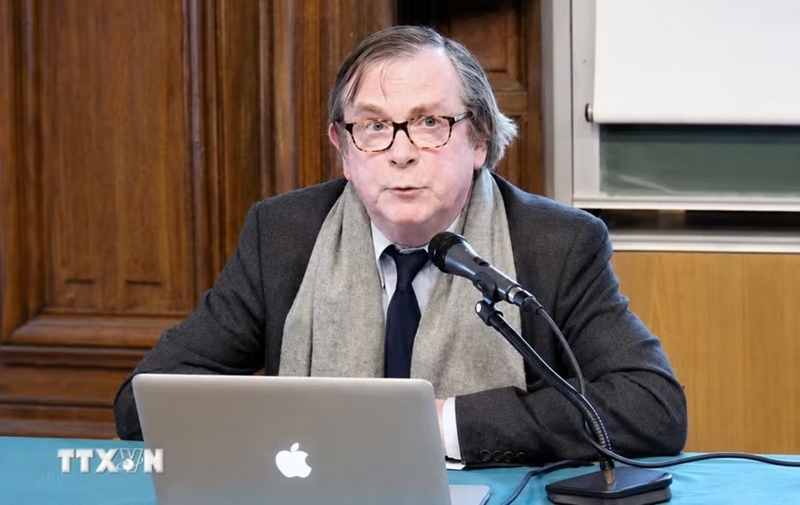
Hugues Tertrais, Honorary Professor at Paris 1 Panthéon-Sorbonne University and former Director of the Center for Contemporary Asian History (CHAC). |
Although the title reflects the period in which the book was written, it remains relevant today, Tertrais said. “Communists” recalls the long struggle led by President Ho Chi Minh and the Communist Party of Viet Nam while “dragons” represents Asia's dynamic development in recent decades.
The Communist Party of Viet Nam has adapted to changes and continued to lead the country while Viet Nam has gradually become part of the region's dynamic growth, he noted.
Tertrais said Viet Nam's economic achievements and developments in Asia are among the factors giving significance to General Secretary and President To Lam's visit, following his previous visit to France and attendance at the Francophonie Summit in October 2024.
He highlighted two parallel trends: Viet Nam is making notable economic progress, and Asia is facing risks that need to be managed. The Comprehensive Strategic Partnership between Viet Nam and France is being advanced against this backdrop.
Regarding the advantages, the two countries can draw on to deepen their Comprehensive Strategic Partnership, he said Viet Nam and France understand each other relatively well and share, in their own ways, certain similarities in their international and geopolitical positions.
Viet Nam's geographical location and historical ties with China have left a deep imprint on its history and culture. At the same time, Viet Nam has become increasingly connected with its Southeast Asian neighbors through ASEAN, he went on.
With a combined population approaching 700 million and a position at the intersection of major global flows of exchange and tensions, Southeast Asia is gaining increasing importance in the world and still has considerable, though difficult-to-predict, development potential.
Viet Nam's position in this rapidly changing region provides an important context for the Comprehensive Strategic Partnership with France. Meanwhile, the long history between the two countries offers a distinctive foundation for further cooperation.
Tertrais said the historical dialogue between Viet Nam and France had at times been very tense, but this process helped the two sides understand and respect each other better. Greater mutual understanding built over time has created conditions for cooperation at many levels today.
He stressed that the concept of a Comprehensive Strategic Partnership itself reflects the broad scope of bilateral ties, with information exchange and mutual trust as the foundation. Cooperation can cover a wide range of areas, from state governance and diplomacy to defense.
Education and training should be a priority for the future, particularly the training of teachers, he said. Viet Nam and France should also strengthen the technical skills of young Vietnamese and encourage greater use of French so they can make better use of opportunities offered by universities.
In economic cooperation, diplomatic agencies and businesses of both countries have tools to better understand each other's markets and changes, Tertrais said. The two sides should improve their ability to anticipate favorable regulatory conditions and expand access to each other's markets.
From this perspective, he raised a question about when cars, possibly electric vehicles, bearing the label “Made in Viet Nam” might appear on French roads.
According to the professor, after a past marked by difficult periods of dialogue, the two countries have learned to understand and respect each other better. This foundation of mutual understanding and trust allows them to expand cooperation in State affairs, diplomacy, defense, education, science - technology, and the economy.
Against the backdrop of Viet Nam's continued development and complex changes in Asia, the top Vietnamese leader's official visit to France is therefore significant not only for bilateral ties but also for broader issues facing the region, Tertrais said.
Source: VNA