    |
 |
|
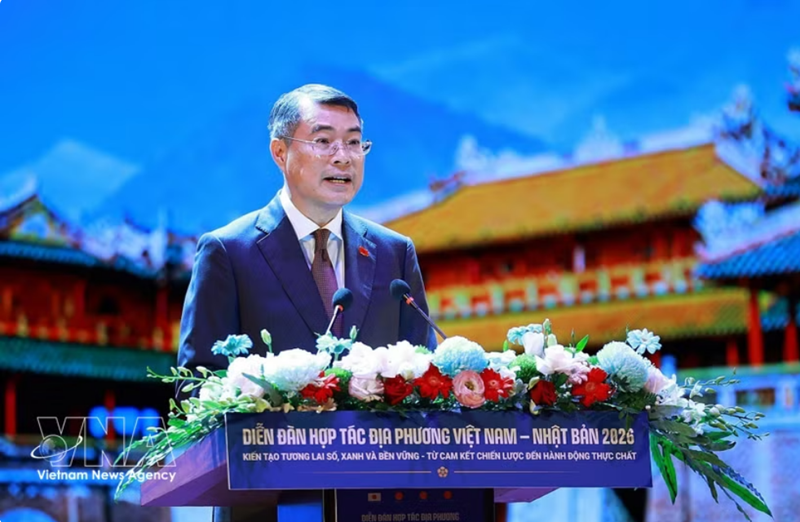
Prime Minister Le Minh Hung speaks at the 2026 Viet Nam-Japan Local Cooperation Forum in Hue city on September 6. |
The forum, focusing on building a digital, green and sustainable future, was jointly organized by the Vietnamese Ministry of Foreign Affairs, the Vietnamese Embassy in Japan, the Japanese Embassy in Viet Nam and the central city. It brought together representatives from 18 Japanese localities and more than 100 leading Japanese corporations and businesses.
In his remarks, PM Le Minh Hung said after four decades of Doi moi (renewal), Viet Nam has become the world’s 32nd largest economy and one of the 15 largest trading nations, participated in 17 free trade agreements and connected with 60 major economies. Per capita GDP has increased nearly 50-fold compared with the beginning of the reform process.
Against the backdrop of rapid and complex global changes, Viet Nam remains steadfast in maintaining stability to promote development and pursuing development to consolidate stability, he said. The country is determined to achieve double-digit economic growth during 2026-2030 while maintaining macroeconomic stability and promoting rapid, sustainable development based on science and technology, innovation and digital transformation.
|
|
 |
|
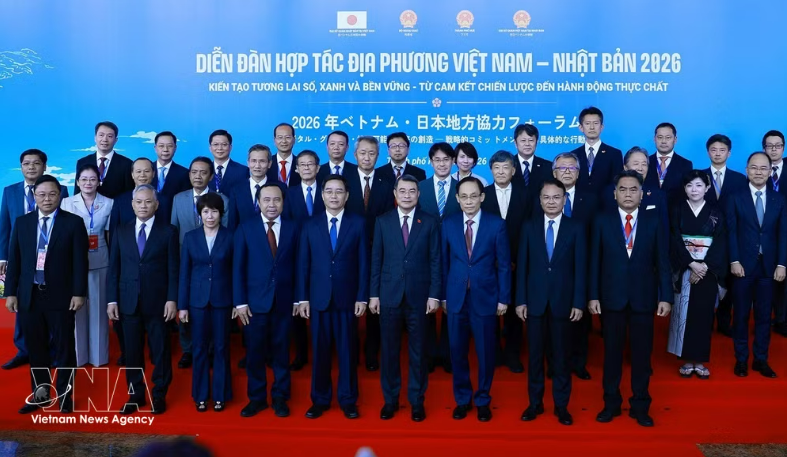
Prime Minister Le Minh Hung poses for a photo with delegates attending the 2026 Viet Nam-Japan Local Cooperation Forum in Hue city on September 6. |
PM Le Minh Hung stressed that Viet Nam seeks to attract foreign investment projects featuring advanced technologies, knowledge, modern governance, research and development, high-quality human resources and substantive links with domestic enterprises.
He proposed five orientations for future cooperation. First, Viet Nam and Japan should work to become partners in high-quality growth and strategic autonomy based on science and technology, innovation and digital transformation, and promote cooperation models in digital technologies, AI, semiconductors, smart cities, sustainable agriculture, start-up incubation and R&D centers.
Second, both sides should follow the principle of choosing the right priorities, conducting quick and thorough implementation and measuring success by results. Localities should identify complementary strengths and focus on feasible projects that can be implemented as soon as possible.
Third, localities, businesses and people should remain at the center of cooperation. Administrations at all levels should listen to businesses and communities and create favorable conditions for investment and connectivity, ensuring that people ultimately benefit through more jobs, higher incomes and improved skills.
Fourth, cultural exchanges and mutual understanding should serve as a foundation for long-term cooperation, he stated, stressing that the two sides should expand collaboration in culture, tourism and people-to-people exchanges; develop joint tourism products and direct air routes; promote youth and student exchanges; and share experience in preserving and promoting heritage and cultural industries.
Fifth, Viet Nam and Japan should deepen cooperation in green transformation, climate change response and disaster prevention through practical projects involving green infrastructure, urban flood control, waste and wastewater treatment, climate-smart agriculture, renewable energy and disaster preparedness.
PM Le Minh Hung also called on localities and businesses of both countries to play a pioneering role, renew their thinking and shift from cooperation to co-creation and from technology transfer to joint development.
He urged Japanese businesses to view Viet Nam not merely as a consumer market or production base, but as a center for manufacturing, innovation and sustainable supply-chain connectivity.
The Vietnamese Government, ministries and localities will continue accompanying Japanese investors, resolving difficulties and improving the investment and business environment, he affirmed.
Minister of Foreign Affairs Le Hoai Trung said that the forum provides an opportunity for localities of the two countries to introduce their potential, strengths and cooperation needs; share development experience and models; and engage directly with businesses, organizations and relevant partners, thereby proposing initiatives with potential for connectivity and practical implementation.
In a congratulatory message to the forum, Japanese Prime Minister Takaichi Sanae expressed her appreciation for the efforts of delegates, local authorities, friendship organizations and the business communities of both countries. Recalling her visit to Viet Nam in May, the PM said she had witnessed clear progress in bilateral cooperation across various fields, ranging from people-to-people exchanges, economy and economic security to culture, security and defense.
She stressed that the vitality of localities is the vitality of the nation, showing her hope that the dynamism and youthful spirit of Vietnamese localities, combined with the experience and expertise accumulated by Japanese localities in regional development, industrial promotion, tourism and human resources training, will contribute to strengthening the autonomy and resilience of both countries.
The Japanese PM called on the two sides to move forward together to build a future in which they are stronger and more prosperous together.
The forum also featured thematic discussions on innovation ecosystems, AI, big data, digital and green transformation, semiconductors, green hydrogen, heritage preservation, tourism and cultural industries. More than 40 meetings between Vietnamese and Japanese localities and businesses were held on the sidelines of the event, creating opportunities to turn cooperation potential into specific and practical projects.
Source: VNA