Speaking to a Viet Nam News Agency (VNA) correspondent in Paris ahead of the official visit to France by General Secretary of the Communist Party of Viet Nam Central Committee and President To Lam, Hai emphasized that Viet Nam-France relations have particular depth, having been nurtured over generations through historical, cultural, educational and scientific ties, as well as extensive people-to-people exchanges. Despite the ups and downs of history, the two countries have successfully built a relationship of friendship, equality and mutual respect, looking towards the future together.
He noted that the solid foundation of Viet Nam-France relations lies not only at the state level but is also deeply rooted in the societies of the two countries. French culture, language, health care, sports and science have left many positive imprints in Viet Nam, while Viet Nam, its people and culture have always held a special place in the hearts of the French public.
He highlighted education and training, science and technology, and health care stand out as prominent areas of cooperation.
With nearly 6,000 Vietnamese students currently studying in France, along with prominent educational models such as the University of Science and Technology of Hanoi and the France-Viet Nam Center for Management Education, Hai said these are valuable foundations that should continue to be promoted and expanded into high technology, specialized healthcare and the green economy.
    |
 |
|
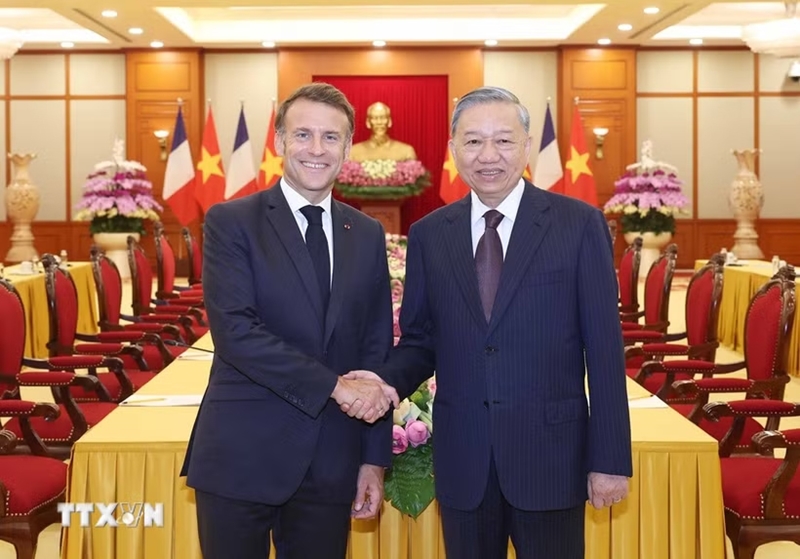
On May 26, 2025, Party General Secretary (now Party General Secretary and State President) To Lam receives French President Emmanuel Macron during his state visit to Vietnam. (Photo: VNA) |
Another distinctive feature of the two countries’ relations is cooperation in archives and documentary heritage, he said.
Sports exchanges have also become a vibrant bridge between the peoples of the two countries through athlete training programs, expert exchanges and joint events. Alongside this, the community of more than 300,000 Vietnamese and people of Vietnamese origin who are deeply integrated into French society, together with the network of cooperation between localities of the two countries maintained over many decades, has generated practical value in areas such as urban planning, heritage preservation, primary health care and community sports.
According to the ambassador, to create further impetus for bilateral relations, traditional areas of cooperation such as culture, education, healthcare, sports and science need to be more closely linked with new drivers of development, including digital technology, innovation and high-quality human resources training in key sectors.
At the same time, the two countries should make greater use of the potential of Vietnamese intellectuals and experts in France, creating conditions for this pool of resources to contribute directly to the country’s strategic breakthroughs.
The ambassador held that the official visit to France and participation in the International Space Summit by General Secretary and President Lam is of particular importance. In political and diplomatic terms, the visit will reaffirm Viet Nam’s consistent foreign policy of independence, self-reliance, multilateralization and diversification of external relations, as well as proactive and active international integration in a comprehensive and extensive manner. It also demonstrates Viet Nam’s high regard for France - an important partner in Europe and on the international stage.
It will provide an important opportunity for the leaders of the two countries to further consolidate political trust, strengthen coordination of positions at multilateral forums, and generate high-level political impetus to address obstacles and promote key, long-term cooperation projects.
In terms of economy, trade and investment, the visit is expected to provide additional momentum for economic cooperation to develop in line with the scale of the political relationship. Priorities include attracting high-quality, high-technology investment projects from leading French corporations; encouraging France to complete as soon as possible its ratification of the E.U.-Viet Nam Investment Protection Agreement; and supporting the early removal of the “yellow card” warning imposed on Vietnamese seafood under the E.U.’s regulations on illegal, unreported and unregulated (IUU) fishing. The visit will also provide an opportunity for Vietnamese businesses to gain deeper access to the French and E.U. markets.
In particular, the diplomat said he expects the visit to open up an important transition in new strategic areas of cooperation, from academic research towards joint research and the transfer of core technologies in such fields as artificial intelligence (AI), semiconductors, quantum technology, outer space, transport infrastructure and renewable energy.
At the same time, the two sides will expand specialized cooperation in essential social sectors, including preventive healthcare, the transfer of biomedical and pharmaceutical technologies, the digitization, preservation and publication of shared historical archival documents, high-performance sports and sports medicine.
Looking further ahead, Hai said France possesses many strengths that enable it to accompany Viet Nam in pursuing its long-term development goals. Viet Nam is entering a new era of development, with the goal of becoming a developed, high-income country by 2045, focusing on transforming its growth model based on science and technology, innovation, green transformation and digital transformation.
As an industrial power with one of the world’s leading research and innovation ecosystems, France is a natural strategic partner with the potential and experience to accompany Viet Nam extensively in pursuing these long-term development objectives.
According to the ambassador, science and technology, innovation and digital transformation could become breakthrough pillars of cooperation between the two countries. With world-class research centers, France has the capacity to cooperate extensively with Viet Nam in strategic technology sectors such as AI, semiconductor integrated circuits, quantum technology and information security.
Bilateral cooperation in these areas should shift strongly towards joint research, the transfer of source technologies and the establishment of research and development (R&D) centers in Viet Nam, while strengthening links between research institutes and universities and pioneering technology enterprises of the two countries.
Alongside key technology sectors, specialized healthcare and biotechnology are areas in which France has strengths and can make practical contribution to improving the quality of life of the Vietnamese people. Hai said cooperation in transferring techniques for cancer treatment, cardiovascular care, organ transplantation and nuclear medicine, as well as the development of smart hospitals and the pharmaceutical industry, could contribute to modernizing Viet Nam’s healthcare system.
France’s experience in archiving and digitizing documentary heritage could also help Viet Nam build a modern digital archival platform and preserve valuable historical sources. In sports, the two sides still have considerable potential for cooperation in elite athlete training, sports medicine and the sharing of experience in developing a professional sports economy.
Regarding energy, infrastructure and strategic industries, the ambassador said major French corporations could participate in important transport infrastructure projects in Viet Nam, such as the North-South high-speed railway and urban railway systems, as well as in industrial supply chains in the aviation sector, remote-sensing satellites and the deep processing of strategic minerals.
Across all these areas of cooperation, Hai stressed that developing high-quality human resources is a key factor of decisive importance. Accordingly, cooperation projects in infrastructure, technology and health care should be linked with the training of Vietnamese experts, engineers and doctors, thereby not only meeting immediate needs but also helping strengthen the country’s long-term capacity for strategic self-reliance.
Source: VNA