The events took place as part of the working trip to China by General Secretary of the CPV Central Committee and President To Lam to attend the 33rd Asia-Pacific Economic Cooperation (APEC) Economic Leaders’ Week and conduct bilateral activities.
The seminar was attended by Hoang Minh Son, member of the CPV Central Committee and Minister of Education and Training; Vietnamese Consul General in Guangzhou Nguyen Viet Dung; Chinese Ambassador to Viet Nam He Wei; and professors and experts from Shenzhen University, Tsinghua University, Peking University, the Chinese University of Hong Kong – Shenzhen, and Shenzhen Polytechnic University.
    |
 |
|
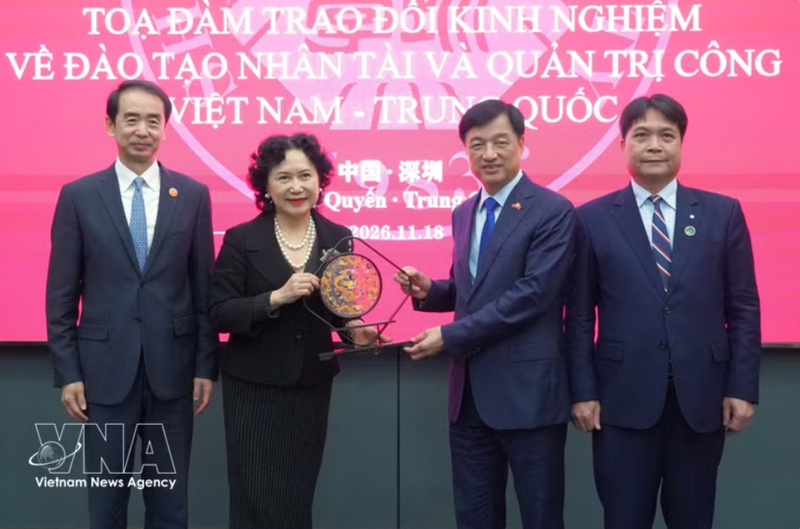
Politburo member, Secretary of the Communist Party of Viet Nam (CPV) Central Committee and Chairman of its Organization Commission Nguyen Duy Ngoc (second from right), Professor Tao Yitao, President of the Belt and Road International Cooperation Development (Shenzhen) Research Institute (second from left), and Chinese Ambassador to Viet Nam He Wei (left). |
In her opening remarks, Professor Tao Yitao, President of the Belt and Road International Cooperation Development (Shenzhen) Research Institute under the Shenzhen University, highlighted Viet Nam’s achievements after 40 years of Doi Moi (Renewal), as well as its efforts to streamline the organizational apparatus and pursue major development goals towards the country's centenary milestones.
She noted similarities between China's reform and opening-up and Viet Nam's Doi Moi, stressing that talent is a key driving force for modernization. Shenzhen University, which has maintained academic exchanges and cooperation with Viet Nam for years, wants to further serve as a bridge between the two countries' academic communities.
Ngoc outlined four areas Viet Nam wishes to learn from China, namely cooperation between municipal authorities and leading universities in establishing postgraduate training institutions; partnerships among the government, universities and businesses in training, research and innovation; policies to attract international talent and develop regional human resources; and ways to mobilize experts and talented personnel in public administration and state governance.
Chinese scholars shared Shenzhen's experience in developing higher education, attracting leading domestic and international universities, nurturing high-quality talent, and strengthening university-business cooperation, particularly in high-tech industries and new energy vehicles. They also discussed talent development in the AI era and training public-sector personnel in management and professional expertise.
For his part, Son emphasized universities' role in training, attracting and effectively utilizing talent, proposing stronger cooperation through a government-university-business model, including faculty and student exchanges, joint training programs and research cooperation.
Meanwhile, Ambassador He Wei affirmed his readiness to act as a bridge promoting collaboration in education and training between the two countries.
Concluding the seminar, Ngoc appreciated the practical contributions from Chinese scholars and suggested Shenzhen University and participating institutions establish cooperation networks with Vietnamese agencies and training institutions, with support from the Chinese Embassy in Viet Nam and the Vietnamese Consulate General in Guangzhou.
He called for joint development of training programs, curricula and teaching teams, with courses organized in either country, both in person and online.
The official stressed that educational cooperation enjoys strong attention from the high-level leaders of both Parties and countries, adding that Viet Nam's newly issued resolutions on education, training and talent development provide favorable conditions for expanding bilateral cooperation.
Emphasizing the spirit of comradeship and brotherhood, he expressed Viet Nam's willingness to share its development experience and called for practical exchanges and cooperation between the two sides.
Source: VNA