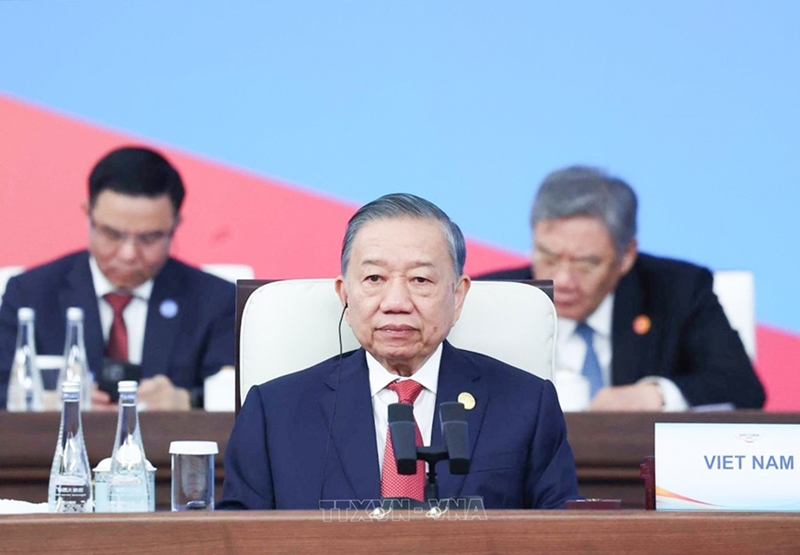
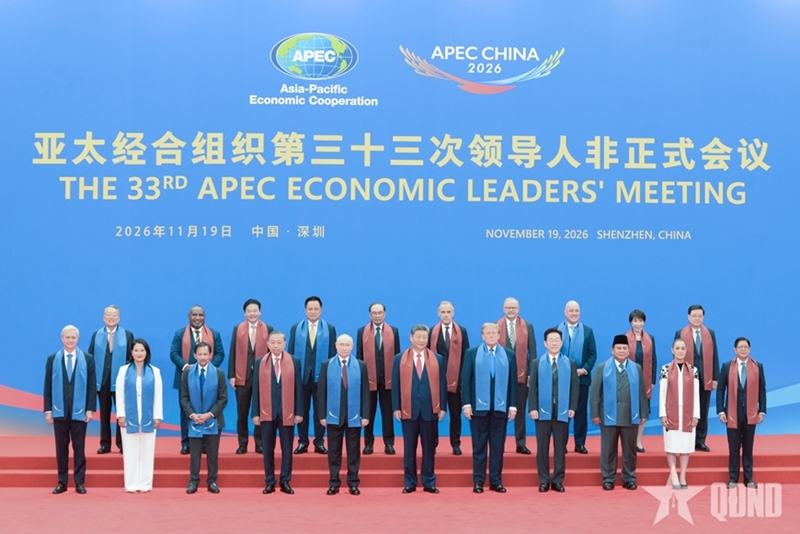
The proposals were presented at the 33rd APEC Economic Leaders' Meeting in Shenzhen, China, on November 19, where General Secretary and President To Lam headed a high-level Vietnamese delegation. The meeting was chaired by General Secretary of the Communist Party of China Central Committee and President Xi Jinping.
    |
 |
|
General Secretary of the Communist Party of Viet Nam Central Committee and President To Lam attends the 33rd APEC Economic Leaders’ Meeting in Shenzhen, China, on November 19. (Photo: VNA) |
In his address, the Vietnamese leader outlined Viet Nam's vision for APEC cooperation in a changing international environment. He observed that the Asia-Pacific region is entering a period of far-reaching transformation, bringing both significant development opportunities and increasingly complex challenges. Against this backdrop, closer cooperation and stronger connectivity among member economies are essential to making the most of emerging opportunities and addressing common concerns.
He also highlighted APEC's role as a platform for bridging differences and fostering dialogue. Established after a prolonged period of global division and conflict, the forum has helped bring economies together through open regionalism, forward-looking initiatives and a shared commitment to development. With 21 member economies, APEC has made substantial contributions to the region's economic progress by promoting connectivity, cooperation and shared prosperity.
Against this background, General Secretary and President To Lam outlined three priorities to guide the forum's future work.
The first is to strengthen APEC's leadership in advancing open trade and investment. He called for a more favorable environment for economic integration, with trade flows kept smooth, stable and sustainable. Maintaining the uninterrupted operation of strategic supply chains is equally important, alongside efforts to improve the resilience, adaptability and self-reliance of individual economies and the region as a whole.
The second priority is to identify new sources of growth and expand development opportunities. The Vietnamese leader proposed positioning APEC as a platform for generating ideas and testing next-generation institutional arrangements and growth models based on technology and innovation. He also encouraged member economies to explore emerging economic sectors, including the digital economy, silver economy, care economy, low-altitude economy and 24/7 economy, in order to unlock the region's untapped growth potential.
The third priority is to use dialogue and cooperation as foundations for trust and stability. He emphasized APEC's potential to serve as an open and constructive channel for strategic discussions, helping economies bridge differences, ease tensions and work toward practical solutions. Consensus-building, he said, should be based on fairness, equality, mutual benefit and respect for the legitimate interests of all parties.
|
|
 |
|
General Secretary of the Communist Party of Viet Nam Central Committee and President To Lam (fourth from left, first row), and leaders of APEC member economies pose for a group photo at the 33rd APEC Economic Leaders’ Meeting in Shenzhen, China, on November 19. |
The Vietnamese leader's proposals received positive feedback from APEC leaders, who particularly appreciated the three orientations for strengthening cooperation in the coming period.
Held under the theme "Building an Asia-Pacific Community to Prosper Together," the meeting examined developments in the global and regional economies, assessed the prospects and challenges facing trade, investment and economic growth, and discussed priorities for APEC's future agenda.
In their discussions, leaders reiterated their commitment to building an Asia-Pacific community that is open, dynamic, resilient and peaceful, with the aim of ensuring prosperity for people across the region and future generations.
They also pledged to advance work toward the Free Trade Area of the Asia-Pacific (FTAAP), improve regional connectivity, facilitate trade and make supply chains more resilient. Innovation and productivity were identified as important drivers of future growth, while digital transformation and artificial intelligence (AI) were recognized as areas offering significant opportunities for regional cooperation.
Other priorities included developing a skilled workforce, supporting small and medium-sized enterprises, and strengthening joint efforts to address shared challenges. Ensuring energy and food security and maintaining macroeconomic stability were also highlighted as essential to promoting sustainable growth and delivering practical benefits to businesses and communities.
The meeting concluded with the adoption of a Leaders' Declaration and three accompanying documents. APEC leaders also acknowledged the achievements of APEC Year 2026 and welcomed Viet Nam's preparations to host APEC Year 2027.
They expressed confidence that Viet Nam's hosting of the forum would provide fresh impetus for regional cooperation and contribute to peace, stability and shared prosperity throughout the Asia-Pacific.
Translated by Song Anh