The event was part of a visit to Viet Nam from November 16 to 21 by a Die Linke delegation led by its Federal Deputy Chair Dr Theo Glauch.
    |
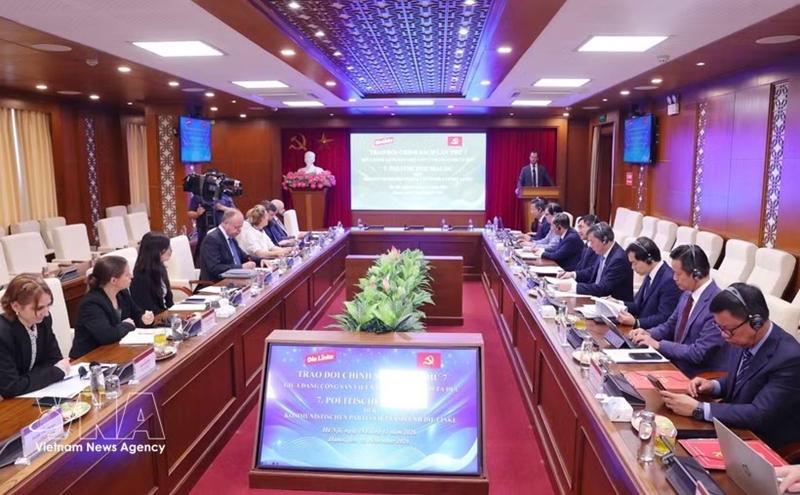 |
|
The seventh policy dialogue between the Communist Party of Viet Nam and the Left Party (Die Linke) of Germany in Ha Noi on November 18, 2026 |
The Vietnamese delegation was headed by Prof. and Dr. Le Van Loi, member of the CPV Central Committee, President of the Viet Nam Academy of Social Sciences and Vice Chairman of the Central Council for Theoretical Studies.
The event took place as Viet Nam and Germany celebrate the 15th anniversary of their Strategic Partnership (2011–2026). Over the past 15 years, bilateral relations have continued to grow across a wide range of areas, including politics, diplomacy, the economy, trade, investment, education, training, science – technology, and people-to-people exchanges.
Germany is one of Viet Nam’s important partners in Europe, while Viet Nam plays an active role in promoting Germany’s cooperation with Southeast Asia. Against this backdrop, the regular dialogue between the two parties has continued to serve as a channel for candid exchanges on theory and practice, helping strengthen mutual understanding and political trust while deepening the Strategic Partnership between the two countries.
In his opening remarks, Loi stressed that the dialogue was taking place at an important juncture as Viet Nam enters a new development phase following the 14th National Congress of the CPV.
Amid rapid, profound and complex global changes, intensifying strategic competition among major powers, and strong advances in science – technology, artificial intelligence and digital technologies, new challenges are emerging in employment, income distribution, inequality and social welfare.
He noted that although the two parties operate in different historical, political, economic and social contexts, they share common concerns over peace, social progress, the protection of workers’ legitimate rights and interests, inequality reduction and sustainable development promotion.
Loi reaffirmed Viet Nam’s consistent foreign policy of independence, self-reliance, peace, friendship, cooperation and development, diversification and multilateralization of external relations, proactive and active international integration, and being a friend, a reliable partner and an active, responsible member of the international community.
He stressed that Viet Nam consistently supports the peaceful settlement of disputes on the basis of the UN Charter and international law, with respect for the independence, sovereignty, territorial integrity and legitimate interests of all countries.
Amid growing global complexities, dialogue and cooperation based on equality, mutual respect and respect for differences are becoming increasingly important, the official went on, adding that boosting exchanges between political parties not only helps improve understanding of each other's views and policies but also contributes to promoting the shared values of peace, social progress and sustainable development.
Expressing his gratitude for Viet Nam’s warm welcome and conveying greetings from Die Linke leaders, Glauch highlighted the longstanding solidarity between the two peoples and recent high-level exchanges, notably a meeting on June 18, 2026 between General Secretary of the CPV Central Committee and President To Lam and German Bundestag Vice President Bodo Ramelow to strengthen political trust between the two countries.
Glauch spoke highly of Viet Nam’s achievements over 40 years of Doi Moi (Renewal) and the strategic vision set out at the 14th National Party Congress.
Sharing his impressions from a visit to Bac Ninh city during the trip, he said that although the two parties operate in different contexts, they share the mission of promoting economic development to bring prosperity to society as a whole, rather than just a small group.
In response to global challenges arising from the concentration of economic and technological power and the risk of an arms race in Europe, Die Linke attaches importance to peace, disarmament and ensuring social justice for younger generations, he said.
During two plenary sessions, participants held in-depth discussions on five key themes of the dialogue. They examined Viet Nam’s strategic development orientations following the 14th National Party Congress, alongside the development of left-wing forces and the recovery of Die Linke’s position in Germany.
On administrative reform and improvements to national governance institutions, they shared experience in streamlining the state apparatus, decentralization and delegation of authority, the organization of the two-tier local administration model and digital transformation in Viet Nam’s public sector, alongside Germany’s experience in federal multi-level governance.
Regarding global political developments, the two sides affirmed that peace is a prerequisite for all development programs and underscored the importance of respecting international law.
On social welfare and social housing, participants discussed inclusive social protection policies, expanding social insurance coverage, developing housing for workers and low-income earners, and lessons highlighting the risks of housing commercialization.
Regarding Party organization, internal institutional development and international cooperation, both sides emphasized the need to uphold organizational principles, promote internal democracy and maintain close and regular ties with workers.
In his concluding remarks, Loi identified three key theoretical issues for further joint research: the relationship between the State, the market and society in ensuring equality and social welfare; the impact of digital transformation and artificial intelligence on employment, income distribution and labor relations; and how political parties should operate in the digital media environment amid the rise of far-right and nationalist trends.
On this basis, he proposed four specific areas for future cooperation, including increasing regular exchanges on theoretical and policy research between the Central Council for Theoretical Studies, the Viet Nam Academy of Social Sciences and the research bodies of Die Linke and the Rosa Luxemburg Foundation, as well as organizing regular thematic seminars.
Source: VNA