In early 2026, Russell Headlee, Senior Bureau Official for the Bureau of Cyberspace and Digital Policy, led a delegation of U.S. businesses to Vietnam to explore cooperation opportunities in AI, digital infrastructure and cybersecurity.
Headlee said AI is now a top priority in U.S. digital policy, reflected in the “America’s AI Action Plan” announced on July 23, 2025. He praised Vietnam’s ambition, noting the country is positioning itself as a regional leader by being among the first to adopt the Law on Artificial Intelligence (AI)
    |
 |
|
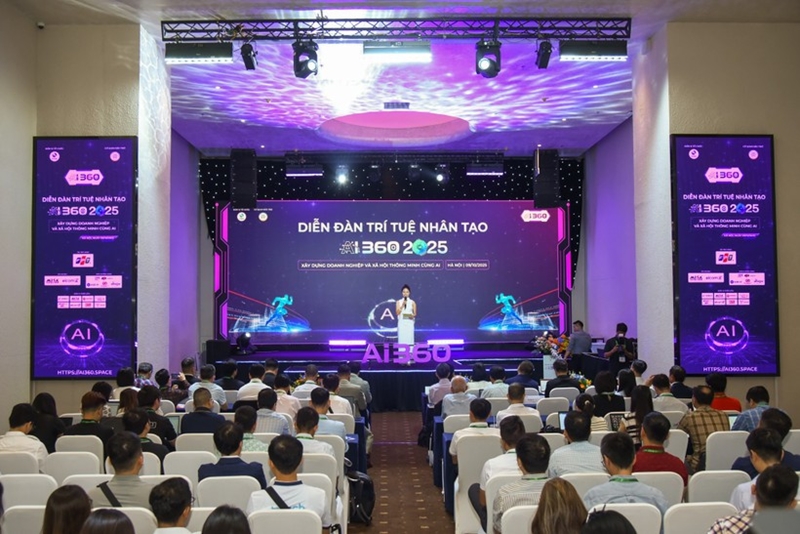
An overview of the opening session of the Vietnam Artificial Intelligence Forum 2025 on October 9, 2025 |
At the 6th ASEAN Digital Ministers’ Meeting in Hanoi in mid-January, a U.S. delegation including 18 major technology and telecommunications firms such as Google, Meta and Amazon Web Services expressed strong interest in Vietnam’s market, viewing it as a potential destination for building AI infrastructure, developing services and expanding operations.
Several major projects have recently been announced. Create Capital Vietnam, Haimaker.ai and the Vietnam DataGen joint venture plan to build a 100 MW AI data center in Da Nang’s High-Tech Park with total investment of 1 billion USD. Japan’s Meiko Electronics unveiled a 40 billion JPY (255 million USD) factory project in Hanoi to produce AI-integrated printed circuit boards, while Dassault Systèmes opened an R&D and a center of Excellence for AI and Digital Twin in the capital.
Competing with regional peers
In its “Artificial Intelligence in Southeast Asia” report, Source of Asia highlighted Vietnam’s growing role as a strategic hub for AI talent and research. While Singapore is described as the “brain” of policy and capital and Malaysia the “heart” of infrastructure, Vietnam is emerging as a large-scale provider of AI research and skilled human resources. The country was ranked among the “Developing AI Talent Powerhouses,” economies rapidly accelerating training and attracting talent.
Vietnam’s advantage lies in its people. With more than 500,000 engineers and IT professionals, it has one of Southeast Asia’s largest technology workforces. The number of AI startups jumped from about 60 in 2021 to 278 in 2024, signaling a rapidly evolving ecosystem.
Global perceptions are also shifting. Vietnam is no longer seen only as a software outsourcing base but increasingly as part of the AI value chain. Qualcomm’s AI R&D center in Hanoi, its third-largest AI hub globally, underscores this trend. CEO Cristiano Amon said Vietnam was chosen to serve not just the domestic market but the wider region.
Japan International Cooperation Agency (JICA) Chief Representative Kobayashi Yosuke noted that AI is moving from testing to commercial deployment across multiple sectors, and Vietnam’s skilled workforce, innovation spirit and expanding digital economy provide strong foundations for a competitive startup ecosystem.
Turning AI into a competitive advantage
Vietnam’s Law on AI will take effect on March 1, 2026, alongside a national AI strategy through 2030 with a vision to 2045. The country aims to become one of the top three AI R&D centers in Southeast Asia by 2030 and train at least 50,000 chip and AI engineers.
Deputy Minister of Science and Technology Vu Hai Quan said new science and technology laws effective from 2026 offer strong incentives for high-tech R&D investment. AI, semiconductors and ICT are among 11 strategic technologies being prioritized.
Experts stressed the need for coordinated action. FPT Chairman Truong Gia Binh urged Vietnam to safeguard key national data domestically and promote open systems. Professor Nguyen Ai Viet, Director of the Institute for Generative Intelligence Technology and Education (IGNITE), highlighted “technology diplomacy” and stronger R&D investment, while Professor Tran Xuan Tu, Director of the Institute of Information Technology, called for continued state leadership in legal frameworks, infrastructure and financial support.
Source: VNA