The forum provided a platform for Vietnamese and Dutch public and private sector stakeholders to gain a deeper understanding of saltwater intrusion in the Mekong Delta, strengthen cooperation, and facilitate exchanges on innovative solutions and technical expertise aimed at mitigating its impacts on crop cultivation in the region.
    |
 |
|
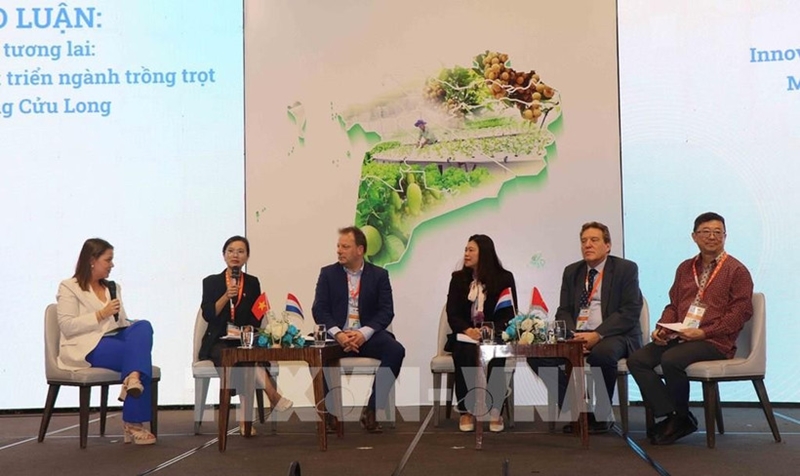
Delegates discuss innovative approaches to developing crop production in the Mekong Delta. |
Participants learned that about 70% of the Mekong Delta’s land, roughly 2.5 million hectares, is used for growing crops, with rice farming making up 60% of that. The area is home to around 10 million farming households and over 2,500 agricultural cooperatives, representing about 13% of the nation’s total.
The Delta serves both as a cornerstone of Vietnam’s food security and as a vital source of livelihoods for millions of farmers. It contributes 50% of national rice output and 95% of rice exports, 65% of aquaculture production and 60% of fish exports, and nearly 70% of the country’s total fruit output.
However, according to a study by the Netherlands’ Ministry of Agriculture, Fisheries, Food Security and Nature, the most significant challenge facing agricultural exports from the Vietnamese region is small-scale and fragmented production. Dispersed farming plots make it difficult to fulfil large export orders, complicating procurement for businesses and limiting farmers’ adoption of advanced technologies. This results in higher production costs, inconsistent quality and difficulties in market access.
In addition, climate change-related challenges, including saltwater intrusion, soil acidification, pests and diseases, flooding, drought and land subsidence, are serious threats to agricultural production in the region.
Vinod Ahuja, Representative of the Food and Agriculture Organization of the United Nations (FAO) in Vietnam, noted that for farmers in the Mekong Delta, saltwater intrusion directly leads to lower yields, uneven quality, higher production costs and unstable supply. Rising salinity is also increasing operational, market and credit risks.
Assoc. Prof., Dr. Van Pham Dang Tri, Director of the Mekong Institute at Can Tho University, stressed that strengthening linkages between science, policy and practice, promoting cross-border cooperation, and sharing knowledge are key to supporting long-term, evidence-based and socially inclusive adaptation pathways for the Delta.
At the forum, Dutch and international experts agreed that rather than attempting to completely prevent salinity, a smarter strategy is to manage it and learn to live with it. Areas that successfully develop profitable farming systems under saline conditions will gain a long-term competitive advantage.
According to Ahuja, local farmers are already adapting, production systems are shifting, and new technologies are being tested in the fields as part of a move towards more sustainable agriculture.
He recommended investment in early salinity warning systems using low-cost sensors and digital modelling. In addition, the adoption of precision drip irrigation combined with smart fertilization would help crops adapt while meeting international standards. From the State, he said, priority should be given to infrastructure investment, including community reservoirs, reinforced irrigation canals and data-driven sluice gate systems.
Raïssa Marteaux, Consul General of the Netherlands in Ho Chi Minh City, affirmed that crop production and the Delta have long been priorities in cooperation between the two countries. The Netherlands remains committed to sharing knowledge and technology and to working together for shared economic and environmental benefits.
Source: VNA