Commenting on the significance of the 14th National Party Congress, Prof. Tam said the aspiration for the nation to “rise” can only be translated into reality when supported by clear objectives, strong political will, sound scientific methodology and, most importantly, effective and substantive implementation capacity. Within this overarching vision, science and technology, with AI at its core, play a decisive and irreplaceable role.
    |
 |
|
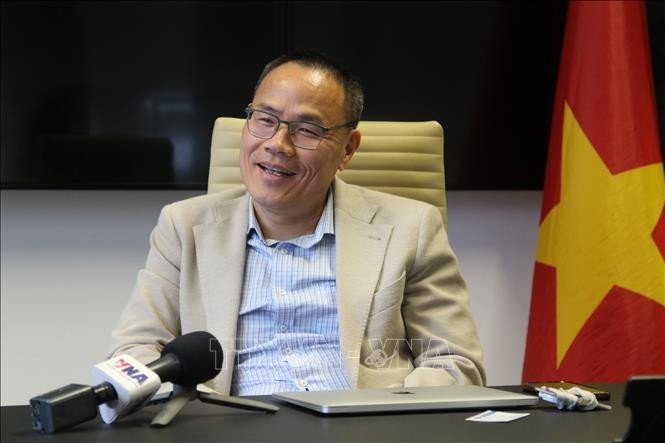
Prof., Dr. Nguyen Van Tam, Chair of the Department of Computer Science, Data and Artificial Intelligence at the Institut Polytechnique de Paris (IP Paris) |
In an interview with a Vietnam News Agency correspondent in France, the professor noted that Vietnam is standing at a historic moment to achieve a meaningful breakthrough based on science, technology and innovation. The central challenge, he stressed, lies not simply in recognizing the opportunity, but in making the right strategic choices, concentrating resources with sufficient strength, and implementing them persistently in a structured and scientific manner to turn development ambitions into concrete and sustainable results.
According to the scholar, the impact of AI is deep and far-reaching, going well beyond changes in production processes or communication to fundamentally reshaping how people think, learn and work. More broadly, AI is exerting a powerful influence on cultural and social values, everyday life, and is emerging as a key force transforming the global geopolitical landscape.
In this context, AI has become a focal point of strategic competition among nations. Prof. Tam described the 14th National Party Congress’s decision to identify science, technology and innovation as key drivers of development as both timely and strategically sound.
He argued that an effective development strategy must be implemented through three clearly defined steps of setting objectives that are both accurate and sufficiently ambitious; building a scientific, systematic and coherent methodological framework; and ensuring effective execution, in which human resources and institutional mechanisms play a decisive role. Without any one of these elements, he cautioned, even a well-designed strategy will struggle to deliver real breakthroughs.
A consistent point highlighted by Prof. Tam is that AI development should not be confined to applying existing technologies and models from abroad, but must aim towards mastering core technologies. He believes that within the next 10 to 20 years, if Vietnam sets clear goals, adopts a scientific approach and remains persistent, it is entirely feasible for the country to develop its own core AI technologies. The key, he emphasized, is to correctly identify priority areas and avoid spreading resources too thinly.
On human resource development, Prof. Tam stressed that mastering core technologies, particularly AI, cannot rely solely on undergraduate education. Instead, greater focus must be placed on postgraduate training, especially at the master’s and doctoral levels. Drawing from his own experience, he recommended close integration between domestic training and overseas education. Beyond training, he added that working environments, along with both material and non-material conditions, are critical factors in attracting and retaining scientific talent.
Regarding the mobilization of overseas Vietnamese intellectual resources, Prof. Tam said the potential remains significant, while cooperation models have become far more flexible thanks to technological advances. These include remote collaboration, co-supervision of doctoral candidates, participation in teaching and curriculum development, and the gradual expansion of cooperation as conditions become more favorable.
Source: VNA