Noting that the European Union (E.U.) is closely following developments of the congress, including decisions related to foreign policy orientations and issues linked to Vietnam - E.U. cooperation, E.U. Ambassador to Vietnam Julien Guerrier said that over the past five years, Vietnam has demonstrated strong capacity in modernizing governance and maintaining an impressive development trajectory.
    |
 |
|
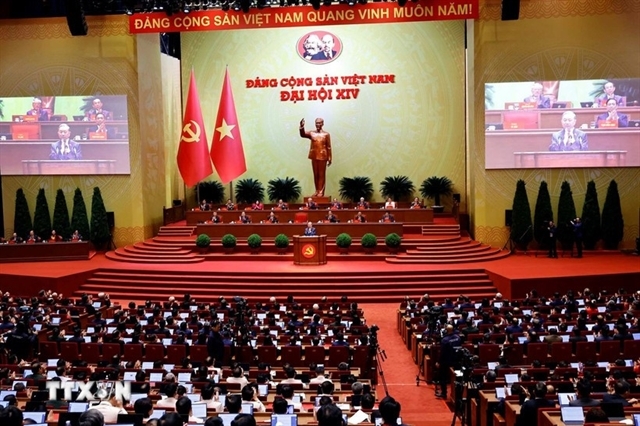
An overview of the opening session of the 14th National Party Congress |
From 2021 to 2025, Vietnam proved itself to be a country that not only grows rapidly but also reforms in ways that make that growth more resilient, innovative and attractive to long-term investment.
Vietnam is clearly on the right track, with strong growth momentum, reaching around 8% in 2025. This is a powerful signal of dynamism and confidence, and shows that Vietnam remains one of the most vibrant economic stories in the region, Guerrier emphasized.
Against this backdrop, he noted that relations between the E.U. and Vietnam have also developed significantly in recent years, becoming a meaningful partnership that has deepened at bilateral, regional and global levels – not only economically, but also increasingly in political cooperation.
Looking ahead, the ambassador said the E.U. sees great potential to further strengthen cooperation in the green transition and other key areas supporting sustainable development. The E.U. also wishes to enhance cooperation in research, science and technology, digitization, connectivity and semiconductor cooperation, all critical sectors for the future, he added.
Showing particular interest in the sustainable development policy content in the draft documents of the 14th National Party Congress, U.N. Resident Coordinator in Vietnam Pauline Tamesis affirmed that Vietnam has achieved remarkable progress, from poverty reduction to sustaining strong economic growth and human development, with its Human Development Index (HDI) ranking in the high human development group.
According to the U.N. Resident Coordinator, over the past three decades Vietnam has made extraordinary strides. From lifting millions out of poverty to maintaining robust economic growth, from promoting industrial development to expanding social security, Vietnam has demonstrated to the world what resilience and vision can achieve. With gross national income per capita exceeding 5,000 USD, Vietnam is on track to attain upper-middle-income status. The poverty rate has fallen to a record low, and the country continues to rank among nations with a high HDI (above 0.7). These are achievements worthy of recognition and pride, she commented.
She stressed that what truly inspires Vietnam’s story is not only the numbers, but also the determination to ensure that growth will bring a better life to all. This reflects a commitment to people-centered sustainable development, reducing inequality and strengthening institutions.
Commending Vietnam’s goals of becoming a high-income country by 2045 and achieving net-zero emissions by 2050, Tamesis affirmed that the United Nations is committed to accompanying Vietnam through the 2027–2031 Cooperation Framework, focusing on inclusive development, transparent governance and dual transition.
Beyond economy and politics, culture has also been recognized as an area of strategic breakthrough in the Party’s thinking at the 14th National Party Congress. UNESCO Representative in Vietnam Jonathan Wallace Baker praised the draft documents for placing foreign affairs and international integration on par with national defence and security, calling for diplomacy to be developed commensurate with the country’s historical, cultural stature and position, not only to elevate but also to promote the value of Vietnam’s culture and history in order to enhance international influence and contribute to peace and shared development of humanity.
From UNESCO’s perspective, he said, culture and heritage are increasingly seen as integral to Vietnam’s overall approach to foreign affairs and international integration. Cultural and heritage values can strengthen international cooperation and enhance a country’s global standing in four key ways.
First, shaped by a long history of cultural exchange, resilience and respect for diversity, Vietnam brings a deeply humanistic narrative to international dialogue. This depth allows culture to serve as a common language in multilateral spaces, fostering mutual understanding and long-term cooperation beyond political or economic differences.
Second, culture enhances national visibility and credibility. Vietnam’s growing role in UNESCO’s governance mechanisms, including its election as Vice President of the 43rd session of the UNESCO General Conference, reflects international trust. Beyond institutional roles, Vietnam has proactively contributed ideas and initiatives, such as the Decade of Culture for Sustainable Development, and has hosted and promoted international exchanges on cultural and creative development within the UNESCO Creative Cities Network, thereby helping shape global discussions on culture and development.
Third, culture links international cooperation with people-centered development through practical models. In Vietnam, heritage and creativity are increasingly integrated into education, sustainable tourism and community livelihoods, from heritage conservation associated with local economic development to creative cities that encourage participation by youth, artisans and cultural entrepreneurs.
Finally, emphasizing that culture nurtures creativity, Baker said that by investing in cultural and creative industries, creative spaces and youth-led initiatives, Vietnam is investing in its younger generation and future. Creativity keeps culture dynamic, contemporary and open, enabling Vietnam to connect with the world not only through its past, but also through contemporary ideas, design and artistic expression.
Source: VNA