Nguyen Thao Hien, Deputy Director of the Department of Foreign Market Development under the Ministry of Industry and Trade (MOIT), said agricultural exports play an increasingly important role in Viet Nam’s economy, generating tens of billions of U.S. dollars in annual export revenue while contributing to GDP growth and trade balance.
From 2022 to 2025, while the total export growth expanded by around 9% annually, agricultural exports grew by 15-16% a year. This result reflected not only higher output but also improvements in agricultural production organization and product quality, enabling Vietnamese products to better meet international demand.
    |
 |
|
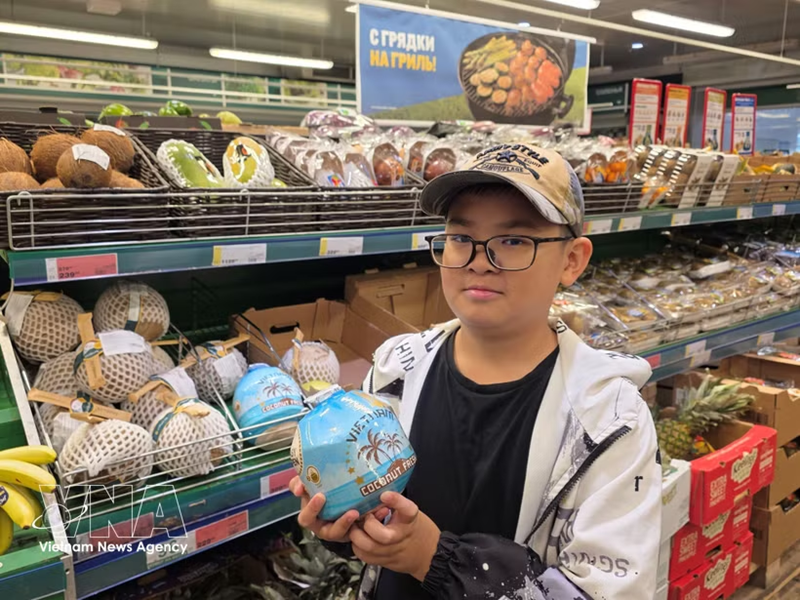
An Asian customer with a Vietnamese coconut product served with straws |
Viet Nam’s diverse agricultural production is another major advantage, said Le Anh Dung, General Director of Viet Nam National Vegetable, Fruit and Agricultural Product Corporation (Vegetexco Viet Nam). He noted that with a long agricultural tradition and favorable natural and soil conditions, the country has a solid foundation for developing competitive agricultural value chains and attracting domestic and foreign investment.
Viet Nam has about 1.2 million hectares of fruit-growing areas, producing around 13 million tons a year. Its fruits are exported to more than 60 countries, including major markets such as the U.S., the E.U., Japan, the Republic of Korea and China. The country is also among the world’s leading exporters of rice, cashew nuts, pepper and coffee, with its products reaching more than 150 countries, including markets with stringent standards.
Vegetable production has also emerged as a promising export segment. With diverse climates and terrain, Viet Nam can supply a wide range of vegetables from temperate to subtropical varieties. The country currently has about 1 million hectares under vegetable cultivation, with annual output of roughly 16 million tons.
According to Sven Dekker, co-founder of Viet Nam Food Europe BV, the E.U. imports about EUR 14 billion worth of food from ASEAN annually, with Vietnamese products accounting for around 25%. The rapid growth of business-to-business (B2B) e-commerce in Europe, at more than 22% a year, is creating additional distribution channels for suppliers able to meet requirements for quality, delivery speed and online transactions.
Vietnamese fruits and vegetables are highly regarded by European buyers and distributors for their variety and year-round supply, he said.
The Middle East is also emerging as a promising destination, with its large import market and growing demand for agricultural and food supplies. At the recent Viet Nam International Sourcing 2026 in Ho Chi Minh City, representatives of major regional retailers, including Lulu and Lootah, showed particular interest in Viet Nam’s supply capacity.
However, greater market access also brings tougher requirements on quality, traceability and sustainability. Major markets such as Europe and the U.S. are tightening sanitary and phytosanitary (SPS), traceability, environmental and sustainability standards. Regulations such as the E.U. Regulation on Deforestation-free Products (EUDR), Carbon Border Adjustment Mechanism (CBAM) and requirements related to illegal, unreported and unregulated (IUU) fishing are placing additional pressure on exporters. Sustainability is therefore no longer an option but a condition for maintaining market access.
Dung said free trade agreements, particularly new-generation FTAs, have expanded market access for Vietnamese farm produce, but tariff advantages are no longer enough. Competition is increasingly based on quality, stable supply, traceability, environmental standards, and social responsibility.
Vegetexco’s experience shows that building an integrated value chain is a strategic approach that has enabled the company to enter and expand its market presence in nearly 60 countries. To achieve this, the firm has invested in human resources and technology to develop the chain from breeding research and specialized farming areas to modern agricultural produce preservation and processing centers, while also expanding its international trade network.
Dung stressed that businesses need to diversify both products and markets to reduce risks and respond flexibly to changes in the business environment. If businesses can effectively manage their entire supply chains while ensuring consistent quality, they can overcome any barrier, he added.
Jose Mestre, Director of Central Retail Viet Nam's Fresh Food Academy, said the group maintains a 90% share of domestically sourced goods and applies strict food-safety controls based on the Hazard Analysis Critical Control Point (HACCP) system, while prioritizing organic and antibiotic-free products.
Fukui Tomoaki from AEON TOPVALU Viet Nam Co., Ltd., said the competitive advantage of Vietnamese agricultural and food products is shifting from export volume towards standards compliance, deeper processing and brand building in both domestic and international markets. Suppliers need to proactively standardize their processes in line with independent international certifications such as Global GAP, USDA Organic, E.U. Organic and ASC.
Experts said close coordination across production, harvesting, processing and trade is essential for meeting such standards. Beyond satisfying importers, compliance can raise product value, strengthen consumer confidence and help build the Vietnamese agricultural brand in international markets.
Source: VNA