    |
 |
|
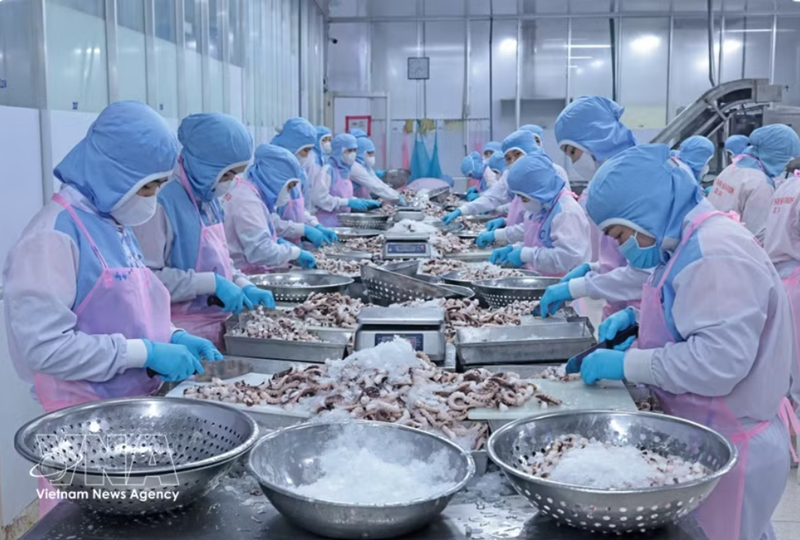
Octopus processing for export at Huy Nam Company in An Giang province |
However, turning tariff preferences into a competitive advantage will require businesses to meet stringent requirements on quality, traceability and sustainable development.
Expanding market opportunities
The Viet Nam-EFTA Free Trade Agreement brings together two groups of highly complementary economies. EFTA members Switzerland, Norway, Iceland and Liechtenstein have strengths in technology, innovation, finance, clean energy and sustainable development, while Viet Nam is one of Asia’s most dynamic economies and is emerging as a major regional manufacturing, trade and investment hub.
Deputy Minister of Industry and Trade Nguyen Sinh Nhat Tan said the agreement would provide a foundation for economic relations between Viet Nam and EFTA countries to enter a new stage of development. With comprehensive, high-standard commitments, it will create a stable, transparent and predictable business environment, giving fresh impetus to trade, investment, technology and knowledge flows between the two sides.
The EFTA bloc has a population of around 15 million, making it relatively small in market size. Its appeal, however, lies in its strong purchasing power and stable demand for high-quality products. With GDP per capita exceeding 100,000 USD in 2025, several times higher than the E.U. average, EFTA is a promising import market for Vietnamese products in areas of strength, including seafood, agricultural products, wooden furniture and electronics.
In 2025, bilateral trade between Viet Nam and EFTA reached 4.8 billion EUR, with Viet Nam posting a trade surplus of 2.5 billion EUR, excluding Switzerland’s gold trade.
Viet Nam’s seafood exports to the EFTA bloc remain modest, concentrated mainly in Switzerland and Norway. Despite the limited trade volume, EFTA markets offer considerable room for growth, particularly in the premium segment.
Economic experts said new-generation FTAs are shifting their focus from trade liberalization towards improving institutional quality and business competitiveness. Once Vietnamese seafood businesses meet EFTA’s stringent standards, the door to other developed markets will also open wider.
Norway and Iceland, meanwhile, have strong seafood industries, particularly in marine aquaculture, fishing, deep processing and logistics. Norway is the world’s second-largest seafood exporter, ranking just ahead of Viet Nam, which is third.
The deal therefore not only creates export opportunities but also prospects for cooperation in technology, supply chain management and new seafood product development. For Vietnamese businesses with strong processing capabilities, high-quality seafood raw materials from EFTA countries could support the development of products for modern retail markets or re-export.
Enhancing competitiveness
As with other new-generation FTAs, tariff preferences will only become a genuine competitive advantage when businesses meet stringent standards on quality, origin and sustainable development.
Nguyen Van Minh, Director of Nghi Son Food Joint Stock Group, said Switzerland, Norway and Iceland all have very high standards. As import tariffs fall, technical barriers and requirements on traceability, product quality and corporate social responsibility are likely to become more stringent.
The period from now until the agreement is signed, expected in the fourth quarter of this year, is a “golden period” for businesses to review their capabilities, complete compliance documentation and prepare market-entry strategies to maximize the FTA’s benefits.
Phung Thi Kim Thu, a market expert at the Viet Nam Association of Seafood Exporters and Producers (VASEP), said businesses seeking to effectively tap the EFTA market need to make comprehensive preparations covering farming areas, fishing vessels, raw material supplies, processing plants, traceability and sustainable development certifications.
Many Vietnamese seafood products use imported materials or undergo multiple stages of processing. Businesses should therefore carefully study the agreement’s commitments and rules of origin for each product code, as well as cumulation mechanisms and origin certification procedures, to avoid missing out on its benefits.
Nguyen Thi Hoang Thuy, Vietnamese Trade Counsellor in Sweden concurrently accredited to Denmark, Norway, Iceland and Latvia, said the EFTA market’s high standards were in line with Viet Nam’s new development orientation of increasing added value, improving the quality of growth and engaging more deeply in sustainable and responsible supply chains.
Businesses should start preparing now, she advised, adding that they should focus on investing in quality, innovation and green transformation, while establishing early links with import partners. In the new phase, businesses that move ahead on standards will move ahead in the market, Thuy said.
Source: VNA