Expanding UAV trials and applications
With its enlarged development space, Ho Chi Minh City now combines strengths in urban development, industry and services with high-tech agriculture, the marine economy, logistics and diverse ecological areas. These conditions provide an ideal testing ground for UAV applications in urban management, land administration, environmental monitoring, disaster prevention and response, agriculture, logistics and public services.
Under the city's Low-Altitude Economy Development Plan to 2030, the sector has been identified as a strategic new growth driver. The plan aims to turn Ho Chi Minh City into Vietnam's first hub for research, manufacturing and services related to the low-altitude economy.
    |
 |
|
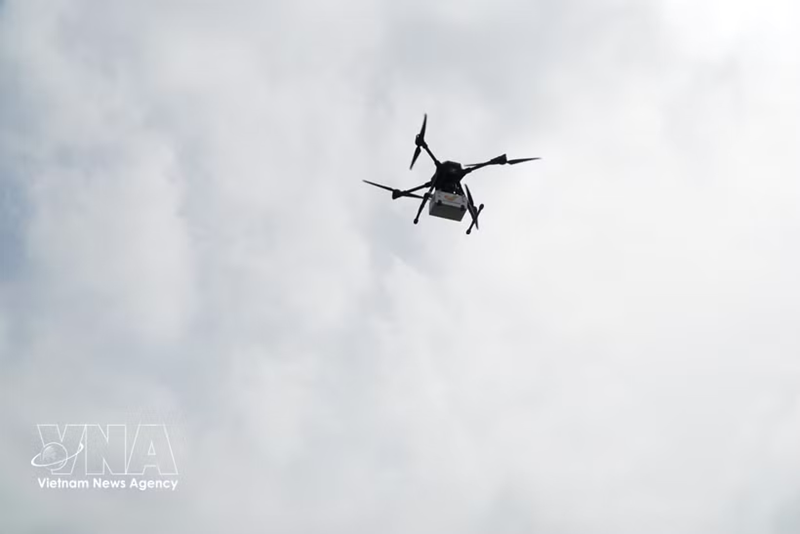
Ho Chi Minh City inaugurates a UAV postal route linking Can Gio commune and Vung Tau ward on February 12, 2026. |
During the 2026-2027 period, the city will focus on refining regulations, establishing a regulatory sandbox, planning low-altitude airspace and launching pilot projects. Between 2028 and 2030, it plans to expand commercialization, invest in infrastructure and develop services in healthcare, rescue operations, surveillance, transport, agriculture and logistics. Beyond 2030, the city aims to diversify low-altitude economic services and gradually master core and foundational technologies to build a comprehensive ecosystem.
On January 5, the city launched a UAV delivery pilot program involving Saolatek, Real-Time Robotics Vietnam and Di Dong Viet to gather real-world data for improving management policies and operating procedures. According to Saolatek founder Tran Anh Tuan, the sandbox mechanism gives companies greater room to refine products, master technologies and expand markets, although further support in resources and ecosystem development remains necessary.
On February 12, the city inaugurated a UAV postal route linking Can Gio commune and Vung Tau ward. The route, operated by CT UAV in cooperation with the Vietnam Post Corporation, is the country's first cross-sea unmanned postal service. It cuts delivery times from about one day to roughly two hours. If the pilot proves successful, the model could be expanded to areas with difficult transport conditions and used for emergency medical deliveries, search and rescue, disaster response and smart urban management.
A survey conducted by the municipal Department of Science and Technology across 60 communes and wards found that 56 have demand for UAV applications in public security, land and construction management, disaster prevention and control, rescue operations and environmental monitoring, indicating that UAVs have become a practical rather than futuristic requirement.
Strengthening the State-university-business partnership
UAVs are among the 11 national strategic technology groups in which Vietnam seeks to master core technologies. Experts say that improving competitiveness will require the development of a full UAV ecosystem built on close cooperation among the State, universities and enterprises.
Assoc. Prof., Dr. Ngo Khanh Hieu of the Ho Chi Minh City University of Technology under the Vietnam National University-Ho Chi Minh City said the State should continue improving the legal framework, universities should lead research and workforce training, and businesses should bring technologies into practical use. While Vietnam is benefiting from gradually improving regulations and pilot mechanisms, challenges remain in human resources, infrastructure and business conditions governing civilian UAV operations. He added that companies should focus on practical solutions and application efficiency while expanding sandbox programs on a larger scale.
From the business perspective, Luong Viet Quoc, Chief Executive Officer of Realtime Robotics, said Vietnamese UAVs can compete internationally if they possess superior technology. To build a strong UAV industry, he said, Vietnam must address financing, human resources and institutions at the same time, deepen cooperation among the State, universities and businesses, expand procurement mechanisms for proven products, provide preferential credit and support for R&D and testing facilities, and introduce policies that encourage the development of strategic technology talent.
Source: VNA