Following its administrative merger, Tuyen Quang is home to 46 ethnic groups, with ethnic minorities accounting for more than 70% of its population. The province has 794 historical and cultural relic sites and 871 intangible cultural heritage items, including 53 recognized as national intangible cultural heritage. It also maintains 135 festivals, 113 of which are traditional.
    |
 |
|
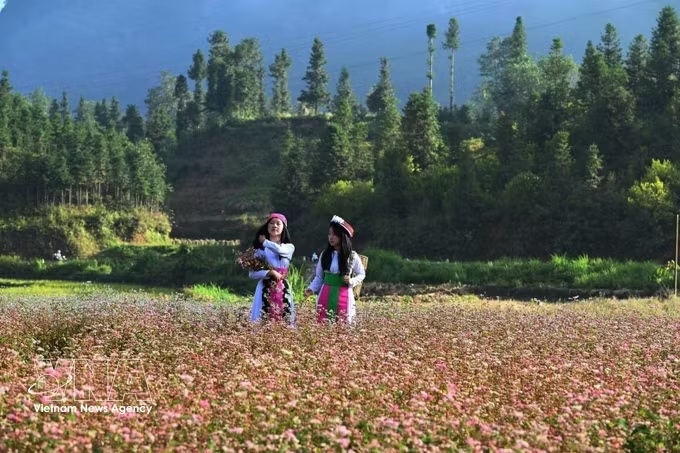
Young girls at a buckwheat flower valley in Tuyen Quang province (Photo: VNA) |
The UNESCO-recognized Dong Van Karst Plateau Global Geopark and the Then practice of the Tay, Nung and Thai ethnic groups, which is also on UNESCO’s Intangible Cultural Heritage list, give the province additional advantages in attracting visitors, investment and related services.
The economic value of heritage, however, depends not simply on its abundance but on the ability to turn it into products and income.
A traditional festival can have limited economic impact if it remains only a community activity. Similarly, handicrafts need good design, branding and market access to increase their value. Tuyen Quang therefore needs to build value chains in which local people remain the owners and practitioners of heritage, businesses connect products with markets, and authorities create a favorable environment.
The Pa Then fire dancing ritual provides one example. Once mainly a spiritual practice within the community, fire-dancing groups have in recent years performed at cultural events in Hanoi and other localities. The group from Thuong Minh village, Minh Quang commune, earns 6-20 million VND (230-765 USD) per performance.
The income remains modest, but shows how traditional heritage can be developed into a cultural product while providing additional earnings for its practitioners.
Similar opportunities can be found across the province, from H'mong flute music and embroidery and Cao Lan folk songs to Pa Then weaving, Tay Then singing and Tinh lute melodies, Lo Lo traditional costumes and rammed-earth houses, Shan Tuyet tea, medicinal herbs and local cuisine.
Linking culture with tourism and creative industries
Lung Cu, in the northern part of the province, demonstrates how culture can contribute to the local economy. Alongside the national flag tower and karst landscapes, traditional houses, costumes, embroidery, cuisine and community life create distinctive tourism products.
Lo Lo Chai village, once a remote border settlement, has become known to domestic and international visitors, generating demand for homestays, food, transport, handicrafts and local farm products.
Tuyen Quang now has 54 community-based cultural tourism villages, 28 of which are qualified to receive visitors. Destinations such as Nam Dam, Tha and Lo Lo Chai have established their own appeal. The province also has 357 OCOP products rated three stars or higher.
In Thuong Lam, in the Na Hang - Lam Binh eco-tourism area, the combination of natural scenery and Tay culture offers another advantage. Stilt houses, Tinh lute melodies and Then singing, traditional cuisine, handicrafts, and local products are increasingly integrated into tourism services.
The province currently has 1,478 accommodation establishments with more than 14,200 rooms and 52 travel companies. Tourism routes are gradually linking the special national historical site of Tan Trao and the Na Hang - Lam Binh Nature Reserve with the Dong Van Karst Plateau Global Geopark.
In the first seven months of 2026, Tuyen Quang welcomed more than 2 million visitors, including over 406,000 foreign tourists, earning more than 5.857 trillion VND in tourism revenue.
Nguyen Trung Ngoc, Director of the provincial Department of Culture, Sports and Tourism, said Tuyen Quang is pursuing an approach that combines preservation with promotion, with local communities playing the central role.
The province is also seeking to connect culture with technology, tourism and creative industries to increase the value of heritage in contemporary life.
Human resources will be crucial to building a genuine cultural industry market. In 2025, the province maintained 14 cultural clubs, which organized 1,272 activities, while training courses were held to pass on Then singing, Tinh lute, H'mong flute, and other traditional arts.
Achieving the GRDP target by 2030 will require stronger mechanisms, greater private-sector investment, skilled creative workers, better branding and intellectual property protection, digital technology and wider market access.
Source: VNA