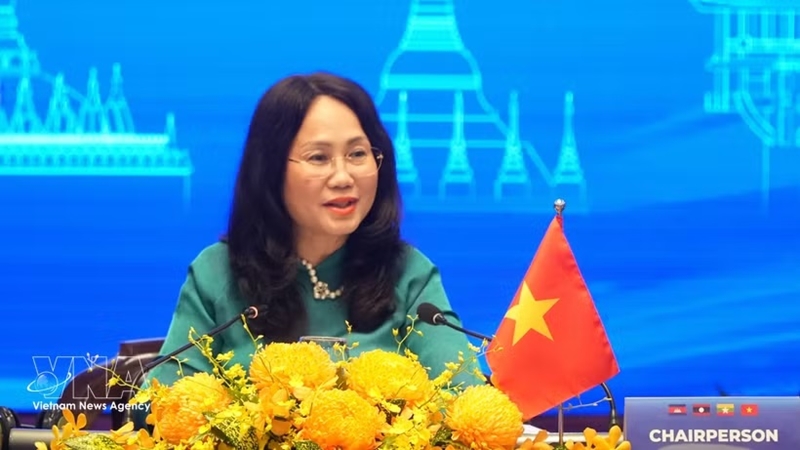
The meeting was chaired by Vietnamese Minister of Culture, Sports and Tourism Lam Thi Phuong Thanh and attended by Cambodian Minister of Tourism Thong Khon, Myanmar Union Minister for Hotels and Tourism Maung Myint, and Lao Deputy Minister of Culture and Tourism Darany Phommavongsa.
    |
 |
|
Vietnamese Minister of Culture, Sports and Tourism Lam Thi Phuong Thanh delivers the opening remarks at the 8th CLMV Tourism Ministers’ Meeting in Ho Chi Minh City on August 27. |
In her opening remarks, Thanh highlighted the steady consolidation and deepening of CLMV tourism cooperation since the four countries adopted their first joint declaration in 2010 on the occasion of the International Travel Expo Ho Chi Minh City (ITE-HCMC).
The mechanism has become one of the Mekong subregion’s longest-standing and most effective frameworks for tourism cooperation, she said.
The minister said this meeting confirmed the mechanism’s long-term value, showing the commitment to continue dialogue, boost connections, and turn promises into real action, thereby giving new energy to tourism growth in each country.
Delegates reviewed progress in cooperation since the 11th CLMV Summit, held under the theme “Friendship and Solidarity for a Resilient and Prosperous Community,” and the 7th CLMV Tourism Ministers’ Meeting held in Yangon, Myanmar, in November 2024.
The implementation of joint action programmes has delivered positive results. In 2025, the four CLMV countries welcomed 32.3 million international visitors, up 9.6% from 2024, generating approximately 45.8 billion USD in tourism revenue.
Intra-CLMV travellers reached 3.3 million, accounting for about 9.6% of total international arrivals. In the first six months of 2026, the four countries welcomed around 17.1 million international visitors, including 1.7 million intra-regional travellers.
The four countries have stepped up joint promotion and marketing activities and tourism workforce training through cooperation with ASEAN and the Greater Mekong Subregion.
However, progress towards building the “Four Countries, One Destination” brand has yet to match the region’s potential. Gaps remain in linking tourism products, developing tourism corridors, facilitating travel and conducting joint promotion.
The tourism industry is also facing a rapidly changing global environment shaped by geopolitical tensions, climate change, extreme weather and rising travel and accommodation costs.
At the same time, travellers are increasingly choosing multi-destination itineraries to optimise costs and experiences, while relying more heavily on digital platforms and artificial intelligence to search, compare and book tourism services.
These trends present both an opportunity for the “Four Countries, One Destination” model and a call to strengthen the adaptability and digital skills of tourism workers, particularly those in remote and disadvantaged areas.
Against this backdrop, the meeting reviewed the implementation of the CLMV Tourism Cooperation Program for 2025–2026 and adopted a Joint Action Plan on CLMV Tourism Cooperation for 2026–2028.
The plan focuses on five main priorities: making travel easier and boosting regional connections; enhancing joint promotion of the “Four Countries, One Destination” brand through digital tools and smart tourism; building skills and improving tourism management; encouraging sustainable, responsible, and community-based tourism along with cultural and heritage promotion; and increasing collaboration with development partners.
Thanh called on the four countries to develop specific targets and indicators for 2026–2028, covering international visitor growth, intra-regional travel, joint tourism products and new direct air routes.
Such targets would provide a clearer basis for assessing the effectiveness of the cooperation mechanism at the next meeting, she said.
The 9th CLMV Tourism Ministers’ Meeting is expected to be held in Cambodia in 2028.
Source: VNA