The forum was organized under the direction of the Hanoi People’s Committee and the Viet Nam Chamber of Commerce and Industry (VCCI), with the Hanoi Association of Small and Medium Enterprises (HANOISME) serving as the coordinating organizer alongside a network of 18 co-hosting units.
    |
 |
|
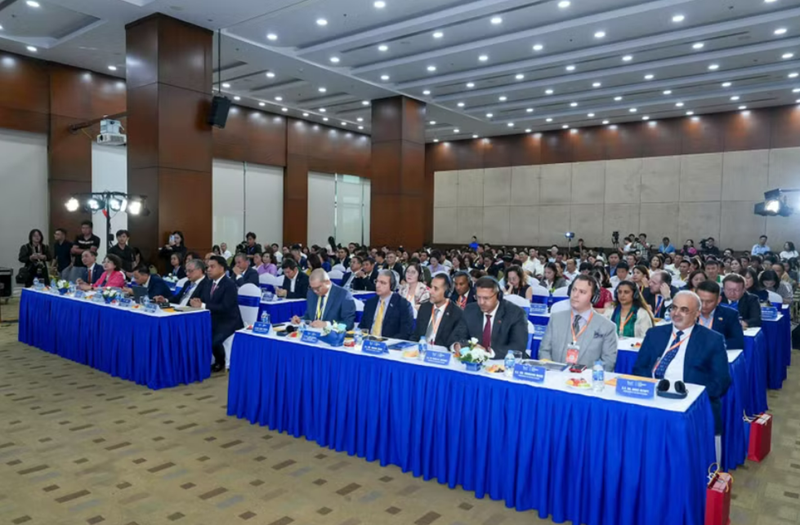
The third Capital Economic Forum (CEF III 2026) is held in Hanoi on October 8. (Photo: hanoimoi.vn) |
It was attended by ambassadors and diplomatic representatives from 15 countries, including Mozambique, Thailand, Iraq, Belarus, Azerbaijan, Sri Lanka, Kazakhstan, Egypt, Türkiye, Haiti, Pakistan, the Netherlands, Mongolia, Palestine and the United Arab Emirates.
Discussions focused on improving the quality of human resources to meet the changing demands of the economy, with people placed at the center of innovation, productivity growth and competitiveness enhancement.
Rather than viewing human resources simply in terms of recruitment and training, CEF III examined how a high-quality workforce can enable businesses to master technology, mobilize capital, develop markets and participate more deeply in global value chains.
The forum assessed the strengths and weaknesses of Hanoi’s business community. Key issues included developing human resources to increase productivity and added value; improving corporate governance, financial capacity and mergers and acquisitions (M&A) capabilities to help businesses absorb capital and restructure; and strengthening links between enterprises and training institutions to develop engineers, technicians and skilled workers for manufacturing, retail and global supply chains.
Speaking at the event, Azerbaijani Ambassador to Viet Nam Shovgi Kamal Oglu Mehdizade highlighted the important role of small- and medium-sized enterprises in the economy, particularly amid rapid technological development and digital transformation, noting that stronger competition and a modern legal framework are prerequisites for development.
New challenges require new knowledge and skills, as well as new and more flexible approaches to education, he said, adding that from this perspective, Hanoi authorities are doing a very good job.
A key difference between CEF III and the previous two editions was its focus on human resources capable of translating technology, capital and market opportunities into business results. While CEF I focused more on digital tools and CEF II on supply-chain and investor connections, this year's event placed human resources at the center of economic growth.
The forum also saw the launch of the CEF High-Level Expert Council, comprising nine experts in economics, science – technology, management, education, communications and business. The council will provide consultancy, independent assessment and professional guidance for the forum’s activities.
CEF III aimed to turn discussions into concrete action, with five to seven priority issues to be selected for pilot implementation and responsibilities assigned among State agencies, business associations, enterprises and training institutions.
Mac Quoc Anh, Vice Chairman and Secretary General of HANOISME and head of the forum’s organizing board, said high-quality human resources should not merely be an input for the economy but a direct force driving productivity, innovation, competitiveness and new growth.
The ultimate goal of the forum is to develop a “Post-CEF III Action Framework” to expand exchanges among authorities, businesses, training institutions and international partners, linking human resources development with higher productivity, technological innovation and stronger corporate competitiveness.
Source: VNA