The report was jointly compiled by the Viet Nam-Russia Knowledge Network, ANO Coordination Laboratory and the St. Petersburg Committee for External Relations, examining the current state and prospects of bilateral economic and trade cooperation.
The report adopts a practical approach, focusing on how businesses operate rather than relying solely on diplomatic assessments. Its aim is to identify ways to translate the two countries’ political goodwill and longstanding trust into tangible economic cooperation. Beyond traditional sectors, Viet Nam and Russia are seeking to expand collaboration in technology, clean energy and logistics to adapt to the changing global economic landscape.
    |
 |
|
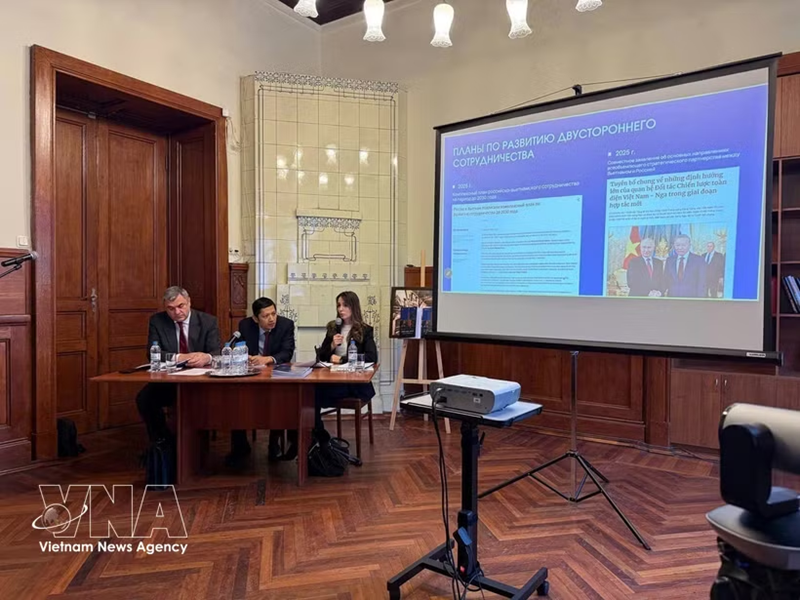
Speakers at the thematic session on economic cooperation at the St. Petersburg Chamber of Commerce and Industry on October 16. |
According to the report, the free trade agreement between Viet Nam and the Eurasian Economic Union (EAEU) has provided an important impetus for bilateral trade growth. Despite volatility in international markets, goods flows between the two countries have remained relatively stable, with encouraging results in agricultural products, food and processed industries.
To achieve more ambitious trade targets, the report recommends that relevant authorities continue reviewing and removing technical barriers and harmonizing technical standards to facilitate businesses’ access to each other’s markets.
It identifies major national-scale infrastructure projects as a key driver of future economic cooperation. The two countries are advancing key energy initiatives, including clean energy development, civilian atomic technology and liquefied natural gas (LNG) supply infrastructure. These projects are expected not only to strengthen energy security but also to support Viet Nam’s digital economy development.
Meanwhile, direct maritime routes linking major Vietnamese seaports with Russia’s Far East are delivering positive results. Increased investment in warehousing and integrated logistics services is helping shorten transport times, reduce costs and improve predictability in import-export operations.
Against the backdrop of rapid digital transformation in Southeast Asia, the report urges businesses to proactively renew their market access strategies. Product localization, centralized project management supported by locally based personnel, and deeper integration into domestic e-commerce ecosystems are identified as key factors in strengthening competitiveness and ensuring sustainable growth.
Speaking to Viet Nam News Agency correspondents in Moscow, Anna Sitnyk, managing director and co-founder of ANO Coordination Laboratory, said the report highlights the gap between bilateral trade ambitions and current performance.
The two countries aim to raise bilateral trade to USD 15 billion by 2030, while current turnover stands at around USD 5 billion. Achieving the target will require annual trade growth of approximately 25%, a considerable challenge, she noted.
The report therefore examines major obstacles in detail, including difficult issues that may require frank discussion, she added.
Source: VNA