The conference, examining economic security, connectivity and influence strategies in Southeast Asia, brought together Canadian researchers, policymakers and businesses.
As Canada–U.S. trade relations face numerous challenges, experts said expanding cooperation with stable, complementary economies such as Viet Nam has become a strategic priority for Canada.
    |
 |
|
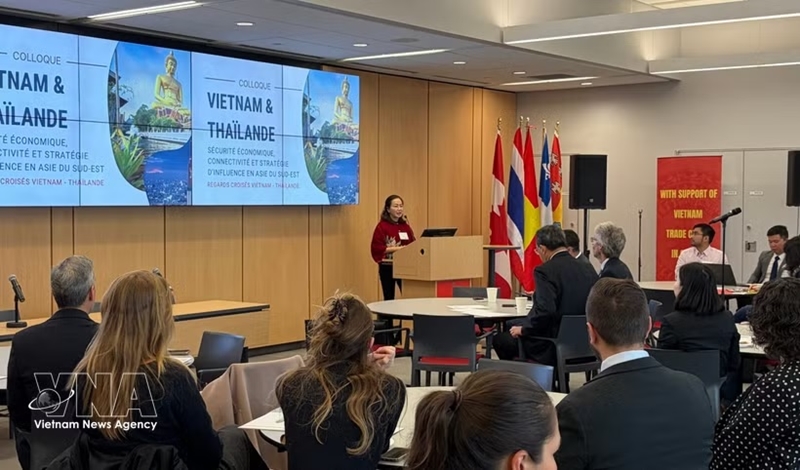
Tran Thu Quynh, Trade Counsellor at the Vietnamese Embassy in Canada, speaks at the conference at Laval University in Quebec, Canada |
Speaking to Viet Nam News Agency correspondents in Canada, Professor Richard Ouellet of Laval University said Canada is under considerable pressure from volatility in its trade relations with the U.S. Uncertainty surrounding tariff policies and the future of the U.S.–Mexico–Canada Agreement (USMCA) is prompting Ottawa to seek reliable partners to diversify its markets.
Viet Nam is becoming increasingly strategic for Canada, given the complementarity of the two economies and the potential for cooperation and trade across various sectors, he said. Vietnam also boasts economic stability, expanding trade ties with Canada and an important position within the Comprehensive and Progressive Agreement for Trans-Pacific Partnership (CPTPP), Ouellet noted.
Following the elevation of bilateral relations to a Strategic Partnership, experts stressed the need to translate high-level commitments into concrete cooperation, particularly in trade, investment, technology and human resources development.
Tran Thu Quynh, Trade Counsellor at the Vietnamese Embassy in Canada, said Viet Nam could serve as a gateway for Canadian businesses seeking access to ASEAN markets, while Canada can help Vietnamese enterprises expand into North America. Their extensive networks of free trade agreements offer both countries favorable conditions to participate more deeply in global value chains and supply chains.
She described the Strategic Partnership as an important political commitment and said the Viet Nam Trade Office in Canada is tasked with helping turn it into practical outcomes. The conference in Quebec was organized to facilitate dialogue among diplomats, policymakers, universities and businesses and identify practical mechanisms for cooperation.
From the business perspective, Martin Beaulieu, strategic adviser at Sherpa International, said cooperation agreements between governments and universities could deliver meaningful results only when they address business needs. Small- and medium-sized enterprises, in particular, require practical support with market information, partner identification and business opportunities when entering distant markets such as Viet Nam.
Universities could bridge research and commercial applications by helping businesses find partners and develop suitable projects, he said. For agreements such as the CPTPP to deliver their full potential, companies in both countries need to establish direct connections and work together rather than rely solely on memoranda of understanding.
One example is WaterShed Monitoring, a Quebec-based technology company specializing in water science and resource management solutions, which is exploring opportunities to expand cooperation in Viet Nam.
Karine Mailhot-Sarrasin, a representative of the company, said Viet Nam is receptive to Canadian technology and expertise. Cooperation should extend beyond technical solutions to include knowledge sharing, workforce training and local management capacity enhancement.
Drawing on Canada’s expertise in freshwater research and management, she added, WaterShed Monitoring hopes to help Viet Nam address climate change, transboundary water management and the protection of economic activities dependent on water resources. The company is particularly interested in the Mekong Delta, which faces mounting pressures from climate change and water security challenges.
Academic exchanges are also helping establish a long-term foundation for bilateral relations.
Ouellet said Laval University maintains research exchange activities with Vietnamese universities, adding that such initiatives could strengthen ties over time through knowledge sharing, education and engagement with younger generations.
As Canada steps up economic diversification and Viet Nam deepens its international integration, the conference highlighted opportunities to advance cooperation across policymaking, research and business. More effective use of the CPTPP, stronger market connections and knowledge transfer are expected to deepen the Strategic Partnership and deliver tangible benefits to businesses and people in both countries.
Source: VNA