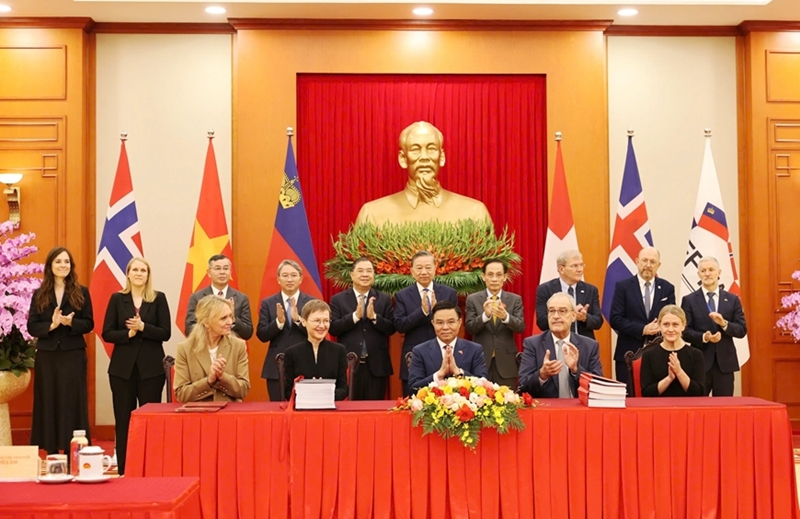
The agreement was signed by Minister of Industry and Trade Le Manh Hung and representatives of the four EFTA member states, namely Swiss President and head of Swiss Department of Economic Affairs, Education and Research Guy Parmelin; Liechtenstein Prime Minister and Minister of Government Affairs and Finance Brigitte Haas; Iceland's Minister for Foreign Affairs Þorgerður Katrín Gunnarsdóttir; and Norwegian State Secretary at the Ministry of Foreign Affairs Astrid Bergmål.
    |
 |
|
General Secretary and State President of Viet Nam To Lam witnessing the signing of the agreement |
The Ministry of Industry and Trade stated that the official signing represents a pivotal breakthrough in ties between Viet Nam and the EFTA, an alliance consisting of some of the most innovative nations across the globe. This major diplomatic and commercial achievement highlights the firm mutual commitment of both parties to bolster economic partnerships, advance free and open trade, and safeguard the rules-based multilateral trading architecture against a backdrop of prolonged global economic unpredictability.
This comprehensive pact encompasses an extensive spectrum of vital pillars, ranging from merchandise trade, tariff concessions, technical barriers to trade, and sanitary and phytosanitary regulations to customs procedures, trade defense measures, trade in services, investment, intellectual property protection, public procurement, competition frameworks, small and medium-sized enterprises, dispute resolution mechanisms, and the nexus between commercial trade and sustainable development.
Given its broad-ranging coverage and multifaceted fields of engagement, the agreement promises to open fresh avenues for Viet Nam to expand and diversify both its inbound and outbound trade flows, sharpen corporate competitiveness, and embed its domestic industries deeper into worldwide value chains. Concurrently, it serves as a powerful catalyst to draw high-caliber foreign direct investment, state-of-the-art technological transfers, and top-tier managerial acumen from Europe’s leading economic powerhouses.
Commercial, trade, and capital ties linking Viet Nam with EFTA member nations have maintained an upward trajectory, yielding an annual two-way merchandise exchange that averages close to USD 2 billion. The trade composition of both sides is mutually reinforcing, naturally aligning with the comparative advantages, distinct capacities, and market demands of each party.
Viet Nam’s chief export shipments destined for EFTA economies predominantly feature aquatic products, footwear, apparel and textiles, machinery, mechanical appliances, electrical equipment, and electronic components. In return, inbound supplies arriving from EFTA partners consist primarily of sophisticated machinery, industrial processing equipment, specialized chemicals, pharmaceutical goods, and raw input materials essential for domestic industrial production.
Bilateral investment ties have similarly recorded notable progress. Official figures through late 2025 reveal that Swiss investors had initiated 234 operational projects across Viet Nam, representing an aggregate registered capital commitment surpassing USD 2.4 billion. During the same period, Norwegian enterprises accounted for 62 distinct projects, mobilizing over USD 201 million in total registered capital.
A significant contingent of prominent corporate giants and institutional investors from EFTA have already solidified their operational footprint in Viet Nam, actively engaging in manufacturing, food processing, pharmaceuticals, green and conventional energy, and information technology. Looking ahead, EFTA conglomerates and financiers are actively preparing substantial new venture plans across Viet Nam, targeting strategic high-growth industries such as research and innovation, advanced high-tech solutions, integrated logistics networks, and precision engineering.
The Viet Nam-EFTA Free Trade Agreement stands positioned to inaugurate a dynamic era of collaborative progress, spurring economic expansion, accelerating modern innovation, reinforcing sustainable growth targets, and providing concrete, measurable gains to commercial enterprises and citizens across Viet Nam and all EFTA member states.
Translated by Chung Anh