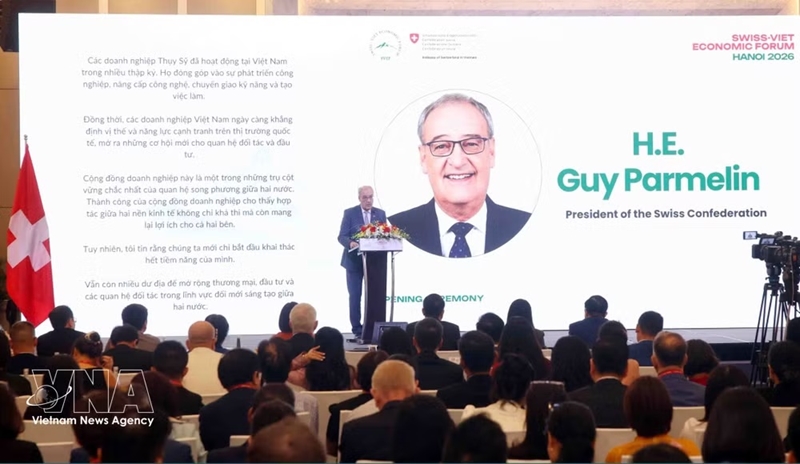
Addressing the opening of the Swiss-Viet Economic Forum 2026 in Hanoi on October 18, shortly after the signing of the agreement, the Swiss President expressed his satisfaction with the milestone, highlighting it as a strong signal of confidence in the future of economic relations between Viet Nam and the EFTA member states.
The agreement was signed earlier the same day between Viet Nam and the four EFTA member states, namely Switzerland, Norway, Iceland and Liechtenstein, marking an important milestone in their economic and trade cooperation.
    |
 |
|
Swiss President Guy Parmelin speaks at the Swiss-Viet Economic Forum 2026. |
Speaking against a backdrop of mounting geopolitical tensions, persistent supply chain disruptions and emerging trade barriers, the Swiss President emphasized the importance of openness and international economic integration.
He noted that both Switzerland and Viet Nam have benefited considerably from international trade, investment and economic cooperation, which have helped create opportunities, foster innovation and improve living standards.
However, he stressed that openness must be underpinned by clear and predictable rules, reaffirming Switzerland’s commitment to a rules-based international economic order in which commitments are respected and businesses can invest with confidence.
For countries such as Switzerland and Viet Nam, he said, cooperation delivers better results than isolation, while prosperity is best achieved through engagement rather than fragmentation.
Reflecting on the 55th anniversary of diplomatic relations between the two countries, the President highlighted the transformation of bilateral ties from a diplomatic relationship into a dynamic economic partnership connecting businesses, investors, researchers and entrepreneurs.
He noted that bilateral trade increased by almost 20% in 2025 compared with the previous year, reaching nearly 3.5 billion USD. Swiss companies have maintained a presence in Viet Nam for decades, contributing to industrial development, technological upgrading, skills transfer and job creation.
Meanwhile, Vietnamese enterprises have become increasingly competitive internationally, opening up further opportunities for partnerships and investment.
Despite these encouraging developments, the Swiss President said substantial untapped potential remains, particularly in advanced manufacturing, life sciences and healthcare, sustainable infrastructure, clean technologies, digitization and innovation.
He expressed confidence that Switzerland’s expertise and Viet Nam’s economic dynamism could complement each other to unlock new opportunities for businesses and strengthen bilateral economic ties.
Speaking at forum, Vietnamese Minister of Industry and Trade Le Manh Hung highlighted the opportunities arising from the Viet Nam-EFTA FTA, particularly in expanding trade, attracting investment and strengthening supply chain connectivity between Europe and Southeast Asia.
He said the agreement would provide a more transparent, stable and predictable framework for economic cooperation, encouraging businesses to pursue long-term investments amid global economic uncertainties.
The minister highlighted the complementary advantages of Viet Nam’s dynamic market and growing manufacturing capabilities and the EFTA member states’ strengths in advanced technologies, innovation, finance and quality standards.
He noted that the success of the Viet Nam-EFTA Agreement will not be measured merely by the number of tariff lines eliminated, but by the tangible projects realized, technologies transferred, supply chains established, and competitive capabilities elevated.
To translate these advantages into tangible results, Hung proposed that businesses from both sides focus on four priority areas of cooperation.
The first is developing processing and manufacturing industries and strengthening supply chains, with particular emphasis on precision engineering, automation, supporting industries and advanced manufacturing technologies. He also underscored the need to enhance the capacity of Vietnamese suppliers to integrate more deeply into global value chains.
The second priority is accelerating the energy transition and green growth through cooperation in smart grids, energy efficiency, green technologies, eco-industrial parks and the circular economy.
The third focuses on promoting innovation, the digital economy, healthcare and life sciences, particularly through technology transfer and stronger research and product development capabilities.
The fourth involves human resource development, including vocational education and training, skills development and workforce quality improvement. In this regard, Viet Nam hopes to draw on Switzerland’s dual vocational training model to better align training with the practical needs of enterprises.
The official also encouraged Vietnamese businesses to take advantage of the agreement to advance technological innovation, improve governance standards, meet international benchmarks, strengthen their brands and increase the value of their products.
He reaffirmed the Vietnamese Government’s commitment to continued institutional reforms, improving the investment and business environment, effectively implementing international commitments and supporting enterprises in capitalizing on opportunities brought about by the agreement.
The Swiss-Viet Economic Forum 2026 is taking place in Hanoi on October 18-20 with the aim of turning of the Viet Nam-EFTA Free Trade Agreement into concrete market-entry opportunities by facilitating commitments between businesses and connecting Swiss and Vietnamese financial institutions to support sustainable investment and capital flows.
It also seeks to strengthen bilateral partnerships in industrial transformation, supply chains, AI governance, digital trust, and cross-border innovation.
Source: VNA