Milestone elevates bilateral ties to new level
Iversen told the press that the lengthy negotiations reflect the complexity of the issues and the breadth of cooperation, as well as the parties’ commitment to their ties.
The agreement will usher in a new phase in relations, he said, adding that the pact will give firms from the four EFTA states more access to the Vietnamese market and make it easier for Vietnamese goods to enter theirs.
    |
 |
|
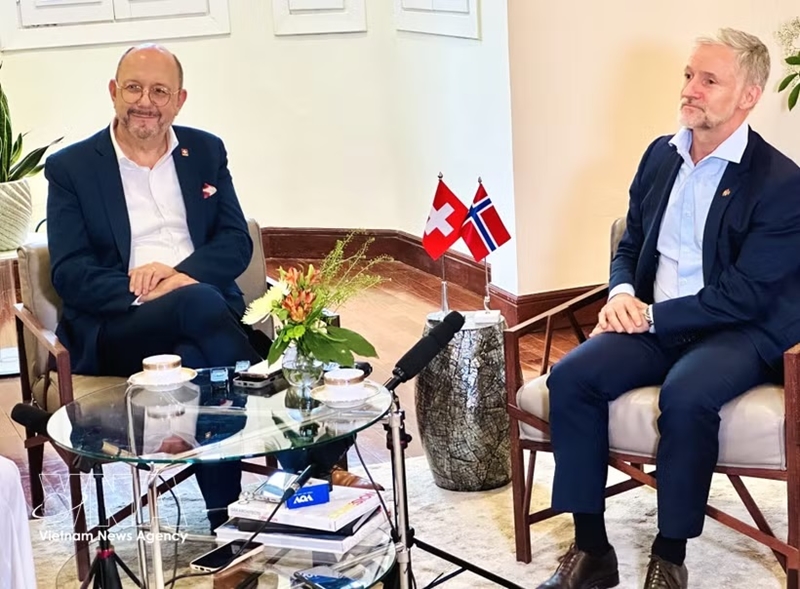
Norwegian Ambassador Stein Iversen (right) and Swiss Ambassador Thomas Gass |
Gass, for his part, said that although Viet Nam has signed numerous trade agreements and EFTA countries have an extensive network of their own, the two sides had never concluded one with each other, leaving a gap. Major Swiss companies, including Schindler, ABB, Bühler and Nestlé, have operated in Viet Nam for more than 30 years, yet have not enjoyed the level playing field Viet Nam created with the European Union (E.U.).
The signing now sends a strong message in favor of a more predictable world, one in which an international legal framework underpins trust in trade as great-power competition increasingly weighs on global commerce, Gass said.
Iversen said consumers on both sides will gain access to a wider range of goods. Tariff-free access for Norwegian seafood is especially significant as seafood is a staple of bilateral trade. Vietnamese shoppers could see cheaper salmon while Norwegian seafood becomes more competitive in the market.
Norway, in turn, expects Vietnamese processed coffee, fruit and other products to become more widely available. Iversen urged Vietnamese producers and exporters to study the deal closely and move early to capture the opportunities.
Gass noted EFTA countries could supply technologies to help Viet Nam build a more modern, industrialized economy, including smart power grids, die-casting technology and low-carbon cement, helping it move up global value chains. With Viet Nam’s middle class having doubled in a decade, Swiss drugmakers are eyeing a market that offers stable operating conditions, product quality assurance and protection for innovation.
He also hoped quality Vietnamese goods, including sustainably produced farm products, will reach the Swiss market without unnecessary barriers and tariffs.
Green transition anchors broad cooperation
Iversen said maritime industry is a leading cooperation area, with Norwegian shipbuilders having made substantial investments and set up facilities in Viet Nam. Marine aquaculture is another, pairing Vietnamese expertise with Norwegian capital across the whole value chain.
Norway is especially interested in renewable energy. A delegation of six Norwegian companies recently visited Viet Nam to scout opportunities. About 14 Norwegian companies are operating in the country, many of which have expanded or are planning to boost investment, he said.
Gass perceived that the Switzerland–Viet Nam investment protection agreement, dating to the 1990s, needs updating to strengthen safeguards for investors.
He pointed to a major Swiss coffee group that processes about 25% of Viet Nam’s coffee output into refined, higher-value products for export. Swiss companies are also involved in container port development and have shown interest in LNG turbines, smart power grids and transformers. Others run quality testing labs or invest in fragrance production serving all of Southeast Asia.
The Swiss ambassador also highlighted services, noting that Swiss firms are building sophisticated banking security software in Viet Nam by combining technology with the skills of Vietnamese engineers.
On technology transfer, Iversen cited a major football stadium under construction in Viet Nam, whose roof is being raised with a large-scale hydraulic jacking system from a Swiss company. The technology is also being used on airport projects in Phu Quoc and Ho Chi Minh City. Many Vietnamese hospitals and universities are working with leading Swiss drugmakers on cancer treatments, and a Swiss company among the world’s top hearing-aid makers is producing equipment in Ho Chi Minh City for the wider Asian market.
He hoped the agreement will speed the approval of new pharmaceutical products so patients benefit sooner.
The deal offers stability and predictability and shows the parties’ long-term commitment, sending a strong signal to investors, Iversen said, adding that Norway regularly fields inquiries from investors about Viet Nam and expects them to rise after the signing.
The Norwegian ambassador said the Green Strategic Partnership, alongside the trade pact, is a key pillar and major milestone in bilateral ties this year. The partnership provides political direction and a framework for the cooperation roadmap, while the FTA sets the legal basis and rules for trade and investment. Offshore wind power, low-emission shipping, marine aquaculture, circular economy and forest protection are also covered with clear roadmaps.
The year also marks 55 years of diplomatic ties between Norway and Viet Nam, and the four EFTA countries celebrated the anniversary on October 18, the day the deal was signed.
Meanwhile, the Swiss diplomat praised Viet Nam for reaffirming its sustainable development and green transition goals at the 14th National Party Congress, including its target of net-zero emissions by 2050. He called the goal ambitious at a time when some countries are reassessing sustainable development investment.
Because eco-friendly products can cost more to make, Viet Nam needs access to markets with strong purchasing power, and EFTA’s average purchasing power is considerably higher than many others. Adding EFTA to Viet Nam’s FTA network will help it stay the course on sustainability.
University cooperation between the two countries also offers opportunities in research, innovation and workforce development to support the transition, according to the ambassador.
Gass outlined two points on supply chains. First, EFTA technology, particularly Swiss, can let Vietnamese exports to the US, Europe and elsewhere carry more advanced technological content and add distinctive value. Second, EFTA consumers increasingly want sustainable goods made in industrial parks that protect workers’ rights and run efficient water reuse and recycling, and they are willing to pay for them.
Iversen called aquaculture a prime example of a full value chain, spanning feed, seed stock, equipment, technical expertise and services.
Research institutes in both countries are already working closely with investors and trading firms, and the agreement will add momentum through a clear legal framework. The circular economy and maritime industries hold similar potential, he continued.
Push to prepare firms before ratification
Iversen urged companies to study the agreement thoroughly, saying spreading information is a shared responsibility of Norwegian and Vietnamese authorities, particularly for small and medium-sized enterprises (SMEs) with limited resources.
Technical requirements and standards should be seen as tools to sharpen export competitiveness, not as barriers, he said.
Gass noted Switzerland has run economic development cooperation schemes for the past 15 years, including negotiation training and support for firms entering more complex markets, and will continue them.
He suggested that SMEs should not shoulder the entire burden of accessing European and EFTA markets. Large Vietnamese companies with existing networks there could help smaller ones by bringing them into their value chains.
Iversen said the agreement takes effect three months after Viet Nam and at least one of the four EFTA states complete ratification. Norway will submit it to parliament for approval, and he said he has no reason to expect it would fail to clear the process.
For Switzerland, the first priority is parliamentary ratification, Gass said. Under the country’s direct democracy system, the deal could go to a referendum if enough citizens request one.
Both ambassadors said preparations should not wait for ratification. All parties should start disseminating information, running communications campaigns and laying the groundwork for rollout now.
Looking to the next decade of ties, Gass said stronger university cooperation will be crucial to building the workforce for a modern, technology-intensive economy. Switzerland, a perennial leader in the Global Innovation Index, hopes to bring more innovative solutions to Viet Nam so Vietnamese products can compete on quality, efficiency and sustainability.
Agreeing that relations are shifting from development cooperation to partnership, Iversen said a Norwegian university and a Vietnamese one in Da Nang signed a memorandum of understanding on October 18. Similar initiatives are underway with universities in Ho Chi Minh City, Hanoi and elsewhere.
Students from both countries will become future leaders who understand both nations, he said.
According to Iversen, education could open up collaboration areas hard to foresee today, just as artificial intelligence was not a mainstream topic a decade ago. Maritime industry, marine economy, aquaculture and circular economy will nonetheless remain key pillars of collaboration.
In closing, he said he is very optimistic about the future of cooperation between Viet Nam and Norway and believes that many opportunities still lie ahead.
Source: VNA