The Nanning Railway Logistics Centre said that demand for cargo rail transport between the two countries continued to rise sharply last year, with the types of transported commodities increasing from 262 to 455.
    |
 |
|
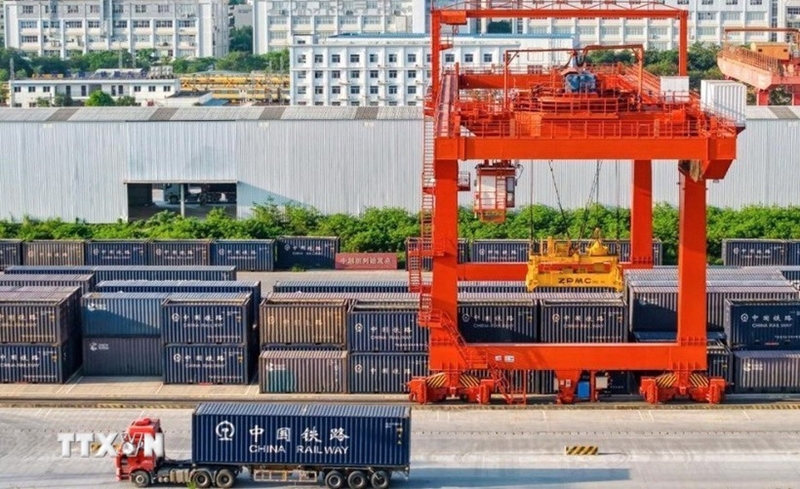
Containers of goods are handled at Nanning International Railway Port before being transported to Vietnam by cross-border trains. |
Cargo on this route currently accounts for 73% of the total volume exported to Vietnam by rail and 86% of the container volume shipped to the country by this means of transport, up 5 percentage points and 2 percentage points from 2024, respectively, statistics show.
To meet growing cross-border trade demand, China’s railway sector last year raised the towing capacity of trains on the Pingxiang (Guangxi) – Dong Dang (Vietnam) route from 1,000 tons to 1,300 tons, helping boost the Pingxiang railway border gate’s customs clearance capacity by 30%.
The train operating plan has also been optimized, increasing the number of trips each week from three to 14. That has helped ensure stable transport capacity to support cross-border trade.
With its swiftness, convenience, and efficiency, the China – Vietnam freight rail route is becoming an important transport channel for Chinese businesses to stretch their reach to ASEAN markets. It is favored also thanks to stability, credibility, and reasonable costs, suitable for less-than-container load shipment to ASEAN.
In the time ahead, the Nanning Railway Logistics Centre plans to step up reforming the customs monitoring model at Nanning International Railway Port, thereby further simplifying clearance procedures, cutting logistics expenses, and improving customs efficiency to promote the quality of the cross-border rail route between the two countries.
Source: VNA