According to Ngo Xuan Nam, Deputy Director of the Viet Nam SPS Office, the E.U. is drafting new rules to tighten maximum residue limits for eight pesticide active ingredients. The regulation is expected to be published in March 2027 and take effect six months later.
The E.U. always provides a transition period to allow exporting countries time to adjust production.
    |
 |
|
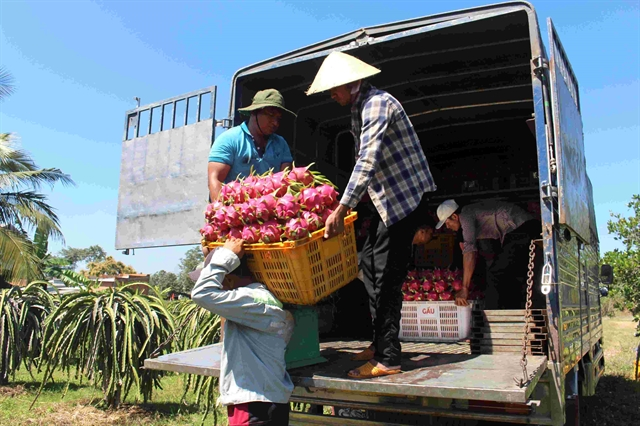
Harvesting dragon fruits in Lam Dong province |
Analysis by the Viet Nam SPS Office indicates that some proposed residue limits would be reduced significantly. For example, Viet Nam currently allows a maximum residue level of 10 parts per million (ppm) for the active ingredient profenofos in tomatoes, while the E.U. is proposing to lower the limit to 0.01-0.05 ppm.
Similarly, proposed limits for certain citrus fruits and strawberries would be reduced to around 0.01 ppm. Nam said such low thresholds would require producers to follow pesticide application guidelines rigorously if they want to retain access to the E.U. market.
Among the eight active ingredients under review, some have already been banned in Viet Nam, and the E.U. has not detected them in Vietnamese export shipments. Others, however, remain approved for domestic use and will require continued monitoring.
Under the E.U.'s latest import control regime, four Vietnamese plant products remain subject to increased border inspections: durian, dragon fruit, okra and chili peppers.
Inspection rates are set at 20% for durian, 30% for dragon fruit, and 50% for okra and chili peppers, with shipments also required to include pesticide residue analysis certificates.
Managing compliance at source
Viet Nam previously had seven products subject to enhanced controls. Increased oversight has helped reduce that number to four.
Nam said that during a meeting with the European Commission's Directorate-General for Health and Food Safety (DG SANTE) in May 2026, the Viet Nam SPS Office requested that inspection frequencies for dragon fruit be reduced after no Vietnamese shipments were found in violation during the first half of the year.
The E.U. bases inspection frequencies on risk assessments. If exporters maintain effective pesticide residue controls, inspection rates may be reduced every six months. Conversely, repeated violations could result in stricter checks.
Nam said exporters should closely monitor market-specific requirements, noting that residue limits vary by commodity and cannot be applied uniformly across different agricultural products. Failure to keep pace with evolving standards could jeopardize access to some of Viet Nam's most valuable export markets.
Ho Truc Thanh, Deputy Director of Ho Chi Minh City's Department of Agriculture and Environment, said SPS regulations should be viewed not only as mandatory import requirements but also as an opportunity to strengthen national governance, standardize production and build the international reputation of Vietnamese agricultural products.
Dao Thu Vinh, Executive Director of CropLife Viet Nam, stressed the importance of managing compliance from the production stage.
To meet SPS requirements in the E.U. and the U.K., compliance must begin at the farm level, as the cost of prevention is far lower than the cost of addressing violations after shipments are flagged at border inspections, she said.
Standards are diverging
Meeting SPS requirements is no longer simply a technical obligation. It has become a prerequisite for maintaining market access, enhancing competitiveness and ensuring the sustainable development of Viet Nam's agricultural sector, according to Ngo Hong Phong, Director of the Department of Quality, Processing and Market Development and Director of the Viet Nam SPS Office.
Global agricultural trade is shifting toward greater transparency, standardized production and quality control across the entire value chain. As a result, effective implementation of commitments under the E.U.- Viet Nam Free Trade Agreement (EVFTA) and the U.K.-Viet Nam Free Trade Agreement (UKVFTA) requires exporters not only to capitalize on tariff preferences but also to comply with stricter rules on pesticide residues, traceability and sustainability.
The E.U. and the U.K. remain key export markets for Viet Nam's agriculture, forestry and fisheries sector. In 2025, exports of agricultural, forestry and fishery products to the E.U. reached about USD 9.28 billion, accounting for about 13% of the sector's total exports and ranking third after China and the U.S.
EU requirements now extend beyond traditional SPS standards to include digitalization, data transparency and sustainability. Exporters that fail to keep pace with regulatory changes and maintain complete documentation throughout the production, processing and export chain risk losing market access or facing shipment disruptions.
Nam said over the past five years, the E.U. had repeatedly revised its SPS measures, focusing on lowering maximum residue limits for pesticides, updating food additive regulations and expanding the list of regulated plant pests.
Following the U.K.'s departure from the E.U., Viet Nam has implemented the EVFTA with the E.U. and the UKVFTA with Great Britain. Initially, the U.K.'s SPS framework largely mirrored E.U. rules, but differences have begun to emerge, according to Nam.
While the E.U. continues to reduce pesticide residue limits to strengthen food safety controls, the U.K. has moved to relax limits for certain active ingredients. Exporters should take these differences into account when planning shipments.
Differences are also beginning to emerge within the E.U. itself. Whereas SPS measures were previously applied uniformly across all 27 member states, some countries have started introducing stricter national requirements.
Germany, for example, has adopted SPS measures that exceed E.U.-wide standards. As a result, products that comply with E.U. regulations may not necessarily circulate freely across all member states. The Viet Nam SPS Office has raised the issue with the E.U. through bilateral SPS Committee meetings.
Nam said differing national regulations were a normal feature of international trade, but exporters must understand those differences and adjust production accordingly.
Source: VNA