The event introduced Viet Nam’s new strategic economic orientations following the 14th National Party Congress, as well as investment opportunities through the joint-venture model linked to technology transfer.
Lan briefed participants on Viet Nam’s Politburo Resolution No.57-NQ/TW on science, technology and innovation; the resolution of the third plenum of the 14th Party Central Committee on reforming the development model; and Politburo Resolution No. 10-NQ/TW on developing the foreign-invested economic sector.
    |
 |
|
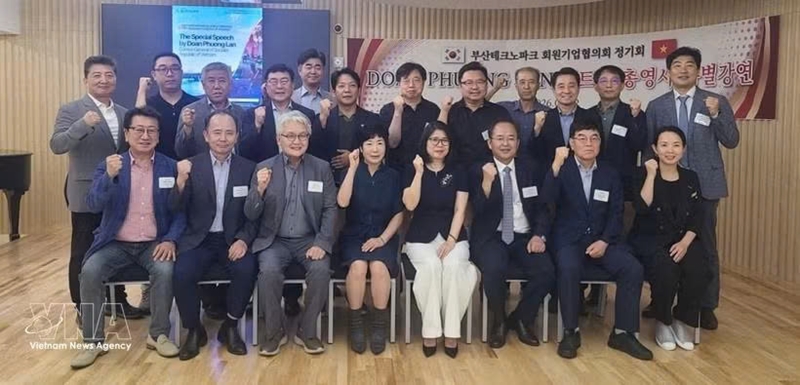
Participants pose for a group photo at the roundtable held by the Vietnamese Consulate General in Busan. |
She stressed that Viet Nam is shifting towards a growth model driven by productivity, knowledge and innovation while linking foreign investment with technology transfer and domestic capability enhancement. The country aims to maintain annual GDP growth in double digits through 2030 and raise per-capita income to 8,500 USD.
At the roundtable, the two sides focused on the joint-venture model incorporating technology transfer. Businesses from the Republic of Korea (RoK) paid particular attention to Vietnam’s 2025 Law on Science, Technology and Innovation, which for the first time recognizes technology as an asset that can be contributed as capital. This opens up opportunities for Busan businesses to participate in joint ventures through sharing know-how and production processes rather than cash contributions.
According to the Consul General, the model could help small- and medium-sized enterprises (SMEs) share risks, optimize initial investment capital, and gain access to the Vietnamese market through local partners.
Korean businesses already operating in Viet Nam also proposed strengthening cooperation between southeastern Korean and Vietnamese localities with similar development needs.
Established in 1999, the BTP serves as a gateway for SMEs in Busan to access the RoK Government's support programs in areas that Viet Nam is prioritizing, including smart maritime technology, mechanical engineering, clean technology and digital transformation.
Meanwhile, the BTEC brings together hundreds of SMEs within an ecosystem covering sectors aligned with Viet Nam's development needs, including environmental and water treatment, maritime and shipbuilding industries, mechanical engineering, materials and components, smart factories, testing and measurement, as well as consumption–services–logistics.
At the conclusion of the meeting, the two sides agreed to strengthen business connections in priority sectors, organize field-study delegations to Viet Nam, and explore the possibility of signing cooperation agreements between the BTP and Vietnamese partners on joint research and development, product testing and human resources training.
On the occasion, the Vietnamese Consulate General invited BTEC businesses to attend a Vietnam–RoK conference which will be jointly organized by the Vietnamese Ministry of Foreign Affairs, the Dong Nai municipal People's Committee, and the Embassy of the RoK in Viet Nam on September 20–21. The event is expected to see the participation of leaders and representatives from all 34 Vietnamese provinces and cities.
Source: VNA