Deeper economic ties
According to Viet Nam Customs, bilateral trade reached approximately 137.42 billion USD in the first eight months of 2026, up 23.4% year-on-year.
    |
 |
|
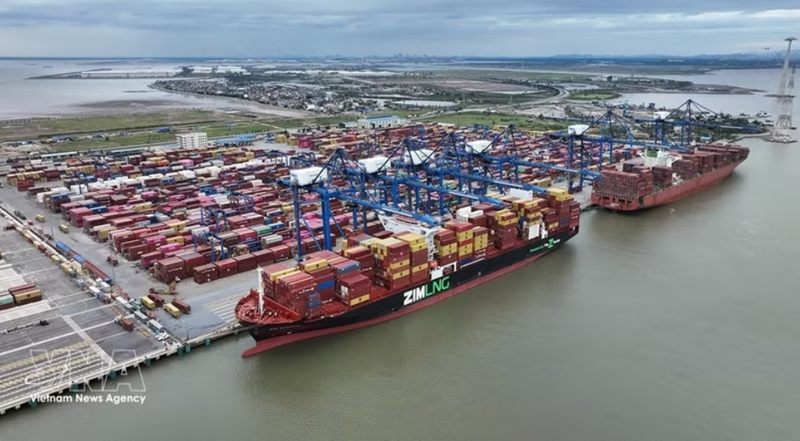
Containers are handled at Lach Huyen Port in Hai Phong city. |
The U.S. remains one of Viet Nam’s most important export markets, accounting for about 32.1% of the latter’s total export turnover. U.S. statistics showed that as of the end of July 2026, Viet Nam had become the U.S.'s fifth-largest trading partner, moving up five places from the same period last year.
Do Ngoc Hung, Trade Counsellor and head of the Viet Nam Trade Office in the U.S, said what stands out is not only the growth in trade volume but also the increasingly deep economic ties between the two countries.
Hung said that a key driver of bilateral trade is the complementarity of the two economies. Viet Nam has strengths in processing and manufacturing, consumer goods, electronics, textiles and garments, footwear, wooden products, agricultural and aquatic products, while the U.S. has advantages in technology, machinery, equipment, energy, aviation, agricultural products and production inputs.
Businesses from both countries are increasingly recognizing each other’s importance in their business strategies and supply chains. Viet Nam is becoming an increasingly important link in regional supply chains while also offering a market of more than 100 million people with growing demand for technology, energy, and high-quality products and services.
Bilateral trade now has favorable conditions to move from growth in scale towards deeper cooperation in terms of quality, technology and value chains, Hung said.
According to the Viet Nam Trade Office in the U.S, there remains considerable room to expand bilateral trade if the two countries continue to leverage the complementary strengths of their economies. Viet Nam has strong demand for machinery, equipment, technology, production materials, energy, aviation products and farm produce in which the U.S is strong at.
Conversely, it is capable of supplying a wide range of products that meet demand in the U.S market at competitive prices, with quality continuing to improve.
Therefore, Hung said, the goal going forward should not be limited to increasing trade turnover, but should also focus on building a more complementary trade structure that delivers practical benefits to businesses, workers and consumers in both countries.
Alongside trade, Viet Nam–U.S investment cooperation has also shown positive signs. As of the end of July 2026, U.S investors had 1,587 valid projects in Viet Nam with total registered capital of about 12.5 billion USD. In the first seven months of the year alone, U.S investors registered around 437.6 million USD in capital across 86 new projects, up 67.9%. Meanwhile, as of the end of April 2026, Vietnamese investors had 279 projects in the U.S with total registered capital of approximately 1.45 billion USD.
|
|
 |
|
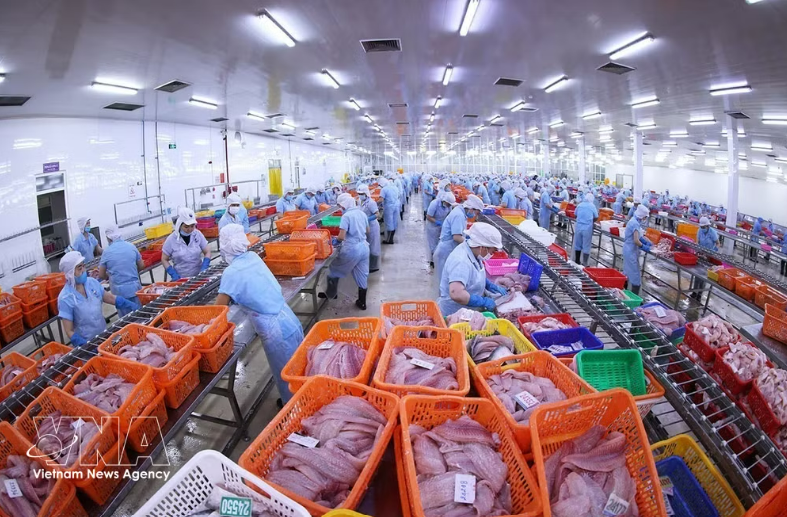
An export-standard pangasius processing line at the Dai Tay Duong (Navico) factory |
New room for cooperation
Regarding areas offering substantial room for cooperation and requiring greater focus in the coming period, Vietnamese Ambassador to the U.S Nguyen Quoc Dung said the Comprehensive Strategic Partnership has identified broad pillars of bilateral cooperation, ranging from politics, diplomacy, security and defense to the economy, trade, investment, science – technology, education – training, and people-to-people exchanges.
He held that in the time ahead, the two sides will also place greater focus on the areas to which Viet Nam gives priority for its new development phase and which are also the fields the U.S is strong at, including advanced technology, clean energy and resilient supply chains.
Hung said while Viet Nam has advantages in human resources, electronics manufacturing capacity and its position in regional supply chains, the U.S has strengths in technology, chip design, artificial intelligence and foundational technologies. Cooperation could therefore expand from manufacturing investment into research, design, human resources training and the development of supporting industry ecosystems.
Energy and aviation are also areas with considerable potential as Viet Nam has strong development needs while U.S businesses possess advantages in technology, capital and management experience.
Alongside deeper participation in U.S supply chains, Viet Nam needs to continue diversifying its sources of supply while ensuring transparency, traceability and compliance with market standards, the Trade Counsellor said.
According to the Viet Nam Trade Office in the U.S, the two economies should in the coming period aim not only to increase exchanges of goods, services and energy but also to jointly create greater value within supply chains.
Referring to General Secretary and President To Lam’s bilateral activities in the U.S, Hung said high-level diplomatic activities are important to providing direction and fresh momentum for bilateral relations, particularly within the framework of the Viet Nam–U.S Comprehensive Strategic Partnership.
From an economic and trade perspective, he said, high-level activities help consolidate trust, increase exchanges and create a favorable environment for government agencies and business communities in both countries to promote specific cooperation programs.
The two countries also have considerable room to expand collaboration in areas such as high technology, semiconductors, energy, aviation, the digital economy, human resources training and supply chains. These are areas capable of generating long-term value for both economies, he added.
Source: VNA