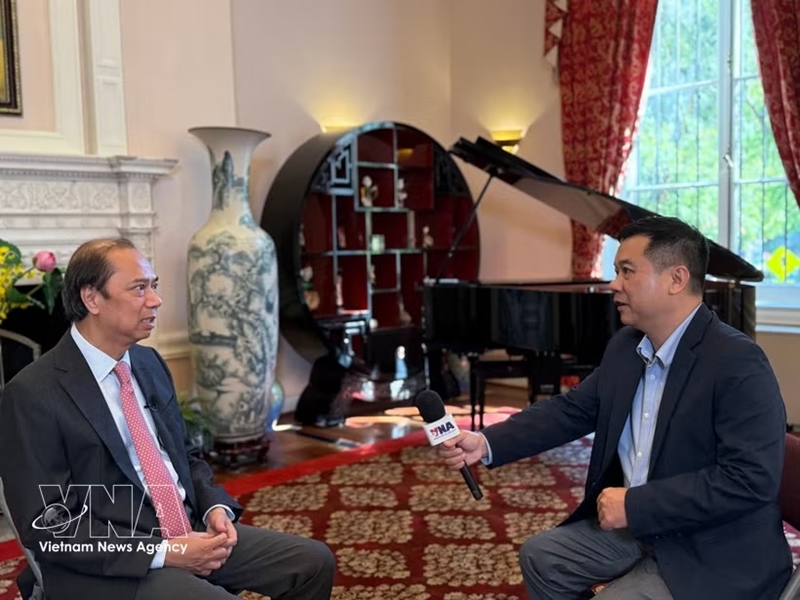
In an interview granted to the Viet Nam News Agency (VNA)'s correspondents in the U.S. ahead of the top leader’s participation in the high-level general debate of the 81st session of the U.N. General Assembly (UNGA) and bilateral activities in the U.S. from September 20, the Ambassador highlighted the significance of the trip and areas with substantial potential for further cooperation.
    |
 |
|
Vietnamese Ambassador to the US Nguyen Quoc Dung (left) grants an interview to the Vietnam News Agency correspondent in the U.S. |
During his trip, General Secretary and President Lam will have meetings with leaders of the U.S. administration and Congress, businesses, investors, leading technology corporations of the country, Vietnamese and Vietnamese-American intellectuals, and U.S. friends, Dung said.
The Vietnamese leader will also hold working sessions with representatives from organizations involved in addressing post-war consequences, particularly efforts to search for and verify the identities of Vietnamese fallen soldiers who laid down their lives in the war, he said.
Against a backdrop of rapid scientific and technological development and the complex global political, security and economic situation, stronger substantive cooperation between Viet Nam and the U.S. is important to both countries and can contribute to peace, cooperation and development in the region and the world, Dung said.
According to the diplomat, the Viet Nam-U.S. Comprehensive Strategic Partnership covers a wide range of areas, including politics and diplomacy, security and defense, economy, trade and investment, science and technology, education and training, and people-to-people exchanges. In the next phase, priority should be given to areas that are crucial to Viet Nam’s development and where the U.S. has strengths and cooperation needs, particularly advanced technology, clean energy and resilient supply chains.
The two sides can expand cooperation in the fields of semiconductors, artificial intelligence (AI), data centers, advanced digital services and human resource training, he noted, adding that these areas are closely aligned with Viet Nam’s goal of having the digital economy account for 30% of GDP by 2030.
In clean energy, Viet Nam needs to significantly increase energy capacity while pursuing high economic growth and its net-zero emissions target by 2050. This creates opportunities for U.S. businesses to provide capital, technology and expertise in renewable energy, liquefied natural gas, power grids, energy storage and energy efficiency.
The two countries can also build more diversified and resilient supply chains by expanding trade in advanced technology products, strengthening logistics connectivity and deepening links between U.S. investors and Vietnamese businesses, the diplomat said, noting that these are areas where their interests are increasingly converging and can create long-term value beyond simply expanding trade and investment.
Dung also highlighted prospects for Viet Nam–U.S. cooperation in science and technology, innovation, AI, semiconductors and digital transformation, saying that Viet Nam’s development needs and the U.S.’s strengths in these areas are highly complementary.
Viet Nam views these areas as important drivers of productivity, growth quality and economic competitiveness, while they are also closely aligned with its new priorities for attracting foreign investment.
Viet Nam’s important role in global electronics supply chains, extensive network of free trade agreements and abundant workforce offer favorable conditions for U.S. investors to access existing supply chains and markets, while opening new opportunities in semiconductors, AI, data centers, advanced manufacturing and digital services, the Ambassador noted.
Regarding the role played by the Vietnamese community in the U.S. in promoting bilateral relations, Dung described it as diverse, dynamic and accomplished in science and technology, education, healthcare, business, culture, arts and social activities, saying it naturally serves as a vibrant and important bridge between the two countries.
He called for greater opportunities for intellectuals, businesspeople and young people in the community to join Viet Nam’s development through consulting, teaching, joint research, knowledge transfer, human resource training, startup support and technology-investment networks.
Such contributions do not necessarily require them to return to Viet Nam for long-term work, as experts can participate through research projects, advisory networks, online training and sector- or locality-based connections, he noted.
The embassy will continue to listen to, support and create practical channels for the community to contribute in ways suitable to them to the homeland’s development and Viet Nam-US friendship and cooperation, Dung affirmed.
Source: VNA