    |
 |
|
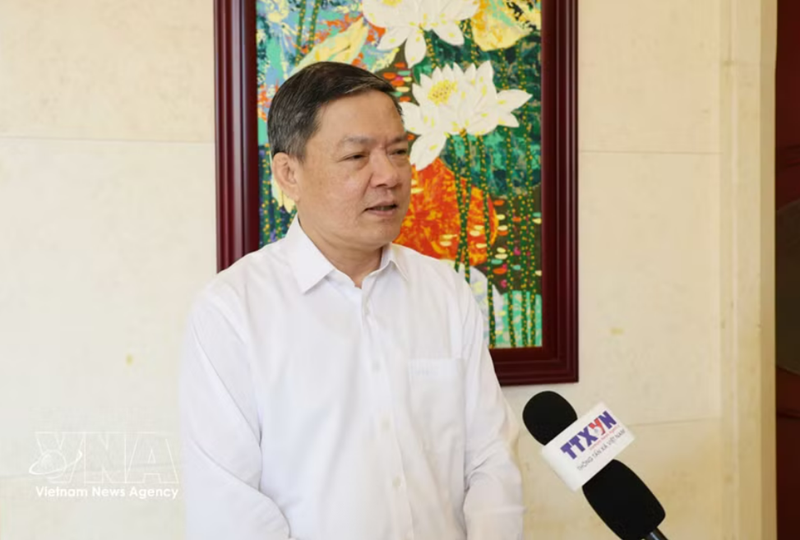
Commercial Counselor at the Vietnamese Embassy in China Nong Duc Lai |
In an interview recently granted to Viet Nam News Agency (VNA) reporters in Beijing, ahead of National Assembly President Tran Thanh Man’s official visit to China, Lai said this momentum has been driven not only by market demand and the complementary nature of the two economies, but also by the close alignment between the strategic orientations of the two Parties’ and countries’ high-ranking leaders and efforts to turn those orientations into concrete mechanisms, schemes and practical cooperation activities. That gives trade a base to keep growing in scale, improve in quality and adapt to a shifting global landscape.
First, strategic orientations from the high-ranking leaders offer political impetus and a favorable framework to trade. Through high-level visits and contacts in recent years, the two sides have consistently named economic and trade ties as a pillar of their comprehensive strategic cooperative partnership. High-level shared understandings and agreements, particularly since 2023, have clearly outlined directions for balanced and sustainable trade, wider market access; stronger infrastructure, logistics and supply chain connectivity; and joint work in such emerging areas as digital economy, e-commerce and green transition.
The orientations have grown more specific and more closely tied to practical needs and direct benefits for companies. Trade is no longer treated in isolation but as part of a broader framework spanning development, investment, production, transport infrastructure and regional supply chains. That lets ministries, agencies, localities and firms launch interconnected, complementary, long-term cooperation schemes.
Second, trade has kept growing strongly, driven by high-level direction and demand for substantive cooperation. China remains Viet Nam’s largest trade partner and import source, and one of its top export markets. Viet Nam is China’s largest trade partner in ASEAN and its third largest worldwide.
According to the Viet Nam Customs data, bilateral trade hit 253.1 billion USD in the first nine months of this year, up 37.6% annually. Viet Nam’s exports to China rose 32.9% to 65.8 billion USD while imports climbed 39.3% to 187.3 billion USD. China accounted for around 41.3% of Viet Nam’s imports and 15.2% of its total exports. Electronics, machinery and equipment, materials and components, and agricultural and food products were among the main product groups.
The trade structure is increasingly tied to supply chains, particularly in electronics, machinery and equipment, materials and components, and processing and manufacturing. Export growth to China points to room for further expansion, not only in farm produce but also in processed and manufactured goods.
Third, high-level common understandings are gradually turning into tangible results. Vietnamese ministries and agencies have staged numerous trade and investment promotion events in China, raising the presence of Vietnamese goods and spreading Vietnamese brands among Chinese consumers.
Notably, the two sides are coordinating more closely to clear trade barriers and widen market access for farm produce, food and other key exports. The negotiation, signing and delivery of protocols on quarantine and food safety give many Vietnamese farm produce a legal basis for official export to China. That is steadily shifting toward more standards-based, stable and sustainable commerce.
Work on smart border gates, customs, quarantine, logistics and rail connectivity continues to advance. It eases immediate bottlenecks in moving goods while fostering long-term links between the two economies, cutting trade costs and smoothing business operations.
Efforts to advance mechanisms for cross-border economic cooperation zones and production and supply chains signal a move beyond traditional trade. The aim is deeper economic integration that ties trade to investment, production and infrastructure.
Fourth, trade cooperation is moving into new areas in line with development trends and both countries’ long-term interests. Alongside traditional sectors, cross-border e-commerce, digital economy, smart logistics and green transition are opening opportunities. Chinese e-commerce platforms give Vietnamese firms more direct access to China’s distribution networks and consumers, particularly for farm produce, processed food and branded consumer goods.
The Regional Comprehensive Economic Partnership and existing frameworks, notably the ASEAN-China Free Trade Area, are also easing trade and investment. They support rules of origin and production links among Viet Nam, China and other regional partners. Such help both countries make better use of complementary strengths and adapt to changes in global supply chains.
Fifth, prospects remain promising, but the focus needs to shift decisively from scale to quality and efficiency. Viet Nam-China trade is poised to keep growing, backed by stable political ties, regular attention from the high-ranking leaders, complementary economies, geographic proximity and an increasingly comprehensive cooperation framework. Agreed orientations on market opening, infrastructure connectivity, trade facilitation, supply chain development and digital economy should add momentum.
Realizing that potential, however, depends largely on effective delivery of signed agreements, clearing technical barriers, improving logistics connectivity and business competitiveness. Priority should be given to expanding Vietnamese exports to China, developing higher value-added products, building business-to-business ties and propelling more balanced, sustainable trade, Lai added.
Source: VNA