Travel companies should play a key role in directing tourist flows and linking the tourism value chain, thus enhancing the competitiveness of the tourism sector.
According to Cao Thi Ngoc Lan, Standing Vice Chairwoman of the Viet Nam Tourism Association, travel firms should go beyond selling tours to understand market demand, design products, connect services, organize tourist flows, manage risks and contribute to shaping destination images.
    |
 |
|
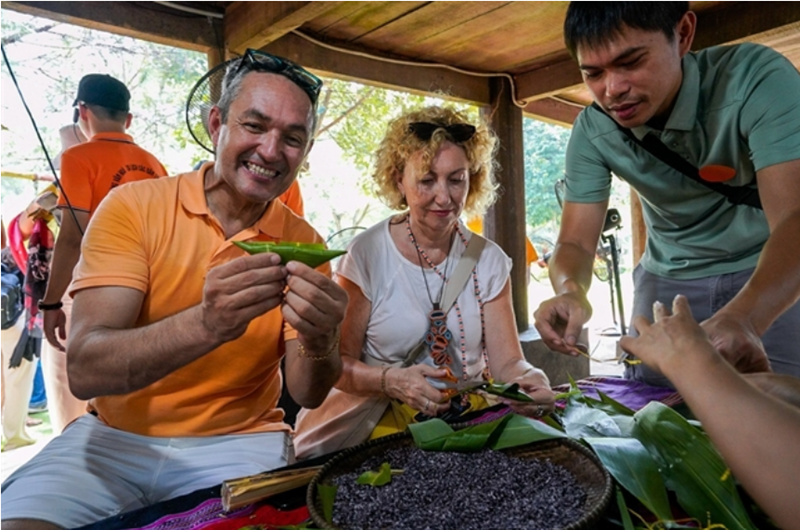
International tourists enjoy choosing Viet Nam. |
She noted that even destinations with attractive resources could struggle to achieve sustainable growth if those resources were not transformed into suitable products and effectively distributed through close coordination among airlines, accommodation providers, transport operators, tour guides, attractions and media outlets.
The Viet Nam National Authority of Tourism reported that as of August 15, the country had 4,673 international travel service businesses. During the first eight months of the year, the authority processed 821 applications for international travel business licenses, granting 404 new licenses and revoking 181. The figures reflect continued market correction and competition, making business capacity and reputation increasingly important to sustainable growth.
Dr. Nguyen Anh Tuan, Director of the Institute for Tourism Economics, said tourists now seek not only destinations but also safety, convenience, quality experiences and distinctive stories. The sector therefore needs to shift from a “sell what is available” approach towards identifying market demand and designing products accordingly.
Doan Thanh Tra, Deputy General Director of Saigontourist Travel, stressed that travel firms need to improve their ability to serve different tourist segments. High-end travelers seek privacy and personalized services, while younger visitors tend to prefer flexible, experience-rich products. Cruise passengers, meanwhile, require compact, punctual and well-organized programs.
She also highlighted the need to expand business-to-consumer (B2C) channels through websites, social media and digital platforms, enabling firms to better understand customer demand, test products and personalize services.
As green transition and digital transformation become two key pillars of tourism development, travel firms should integrate green criteria into product design, and utilize data and artificial intelligence for market analysis.
Phung Quang Thang, Vice Chairman of the Viet Nam Society of Travel Agents, said green tourism development should be supported by clear criteria, assessment procedures, recognition mechanisms and monitoring systems. Green investment, he noted, should be viewed not merely as a cost but as an investment in competitiveness and brand reputation.
In the new era, travel firms need to be positioned as a central force connecting markets, resources and tourist flows. An integrated ecosystem involving institutions, infrastructure, destinations, airlines, transport providers, accommodation businesses and local communities will be essential for Viet Nam to increase tourism’s added value and strengthen its sustainable competitiveness.
Source: VNA