Its score rose 6.1% from 2024 to 4.15. The index gauges the factors and policies that underpin a sustainable, resilient tourism sector. It does not track performance metrics such as visitor numbers, spending or revenue, but measures the conditions that let a destination attract visitors, deliver services and sustain activity over the long term.
    |
 |
|
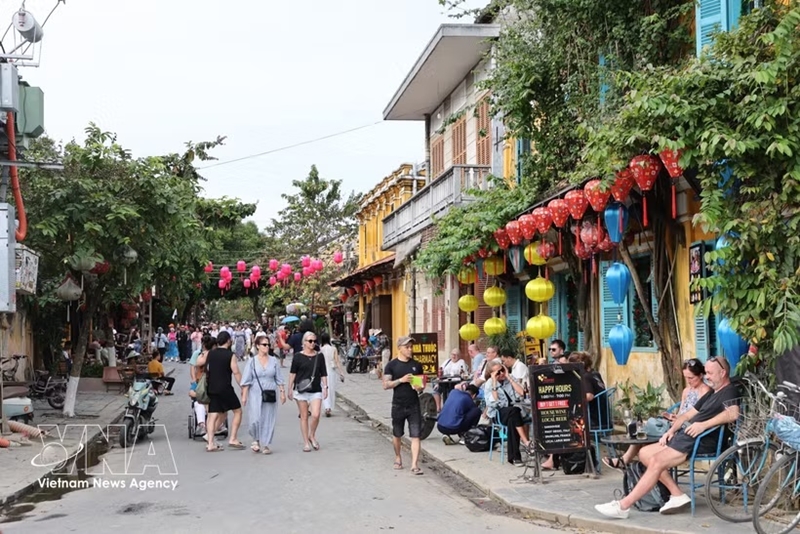
Foreigners tour Hoi An Ancient Town in Da Nang city |
The TTDI is built on five dimensions, 17 pillars and 102 indicators. The dimensions are enabling environment, tourism policy and favorable conditions, infrastructure and services, travel resources, and tourism sustainability.
Indicators roll up into scores for each of the 17 pillars, and the overall TTDI score is the arithmetic mean of those pillar scores. The five dimensions are used mainly to organize and present results.
Indicators are standardised on a scale of 1 to 7, allowing economies to be compared on their level of development and their capacity to create a favorable environment for tourism.
Within Southeast Asia, Viet Nam ranked fifth, trailing Singapore (13th), Indonesia (23rd), Malaysia (26th) and Thailand (38th). Its 6.1% score gain, however, outpaced all four.
Tourism climate improves across key pillars
Notably, seven Vietnamese pillars placed among the world's top performers (1st to 35th), up from four in 2024. Price competitiveness, at seventh, and safety and security, at ninth, ranked highest.
VNAT said price competitiveness gained eight places and safety and security 18, reflecting WEF's favorable view of Viet Nam's political – social stability and security amid global volatility. These factors have been central to Viet Nam's appeal to foreign visitors in recent years.
Next came cultural resources (21st), natural resources (22nd), travel demand sustainability (27th), non-leisure resources (30th) and air transport infrastructure (34th).
Against the previous rankings, air transport infrastructure gained nine places, ground and port infrastructure 10, cultural resources six and natural resources four. Environmental sustainability jumped 18 places. Travel demand sustainability made the biggest leap, climbing 24 places to 27th.
Six pillars landed in the upper-middle tier (36th to 70th), including ground and port infrastructure (43rd), workforce and labour market (50th), ICT readiness (58th), business environment (63rd), tourism openness (67th) and health and hygiene (68th).
In all, 13 of Viet Nam's 17 pillars ranked from upper-middle to world-leading. The other four fell in the lower-middle and low tiers (71st to 110th), including tourism infrastructure and services, environmental sustainability, travel prioritisation, and the socio-economic impact of tourism.
Source: VNA