The International Research and Innovation Funders Forum (IRIFF 2026), hosted by the National Foundation for Science and Technology Development (NAFOSTED) on November 5-6, has brought together more than 300 domestic and foreign delegates representing management agencies, scientific organizations, universities, research institutes, funding agencies and businesses.
Seeking to make further progress in acquiring knowledge and technology
In his remarks, Quan said science is opening up new opportunities in artificial intelligence, healthcare, semiconductors and clean energy, while challenges such as climate change, energy security and epidemics require international cooperation. Science, technology, innovation and digital transformation are central to Viet Nam’s new growth model, he noted.
    |
 |
|
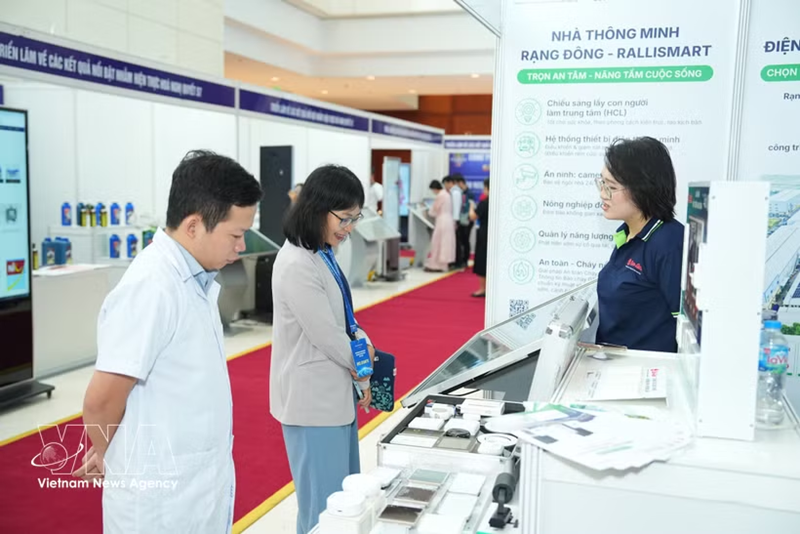
A new technology exhibition area arranged within the framework of the International Research and Innovation Funders Forum in Ha Noi. |
He called for stable funding and greater investment in human resources and an enabling environment for research, particularly basic research and young scientists. Funding mechanisms should be fair, transparent and suited to different types of research, while ensuring scientific quality and accountability in the use of public resources, he said.
The minister also stressed the need to strengthen links between researchers and businesses from the stage of identifying research needs, with support for testing, prototyping and bringing promising results from laboratories into production. Success should be measured by better products, stronger businesses and improved living standards.
To turn international partnerships into joint action, partners should identify common priorities, coordinate research calls, pool funding, share infrastructure and expertise, and create more opportunities for young scientists to work with international colleagues, he said.
Bringing State-scientist-business linkage into practice
Assoc. Prof., Dr. Dao Ngoc Chien, Director of NAFOSTED, said international scientific cooperation should go beyond academic exchanges to jointly define research questions, combine strengths and infrastructure, share costs and risks, and translate knowledge into practical impact.
He said research funding agencies play an important role in facilitating such cooperation through transparent and competitive funding processes, joint calls for proposals, common evaluation principles and support for cross-border research teams.
Chien underscored the need to put the State-scientist-business linkage into practice, with NAFOSTED serving as a bridge and developing funding mechanisms to facilitate domestic and international coordination projects.
Swiss Ambassador to Viet Nam Thomas Gass highlighted the importance of providing scientists with time and resources to pursue new ideas, including those whose outcomes are not yet clear.
Under a scientific cooperation framework established in 2020, Switzerland and Viet Nam have issued two joint calls for research proposals, supporting more than 20 projects with a total investment of around USD 8 million. Their collaboration also includes research on the Mekong Delta, the use of artificial intelligence to interpret chest X-rays, and biomedicine with the University of Geneva. The Swiss National Science Foundation and NAFOSTED are considering a third joint research call in 2027, he said.
Initiated by NAFOSTED, IRIFF 2026 features international presentations, a roundtable of research funding agencies and field visits. Discussions focus on research excellence, the State-scientist-business linkage, strategic technology transfer and scientific integrity.
Source: VNA